
FEMA Emergency Vehicle Safety Initiative Practice Test
$69.00
- Buy to unlock unlimited access to all Quiz questions and Answers in this Quiz.
- After purchase you can print a PDF of the whole quiz at any point. The PDF will contain the questions and the correct answers.
About this Exam
The FEMA Emergency Vehicle Safety Initiative is a vital program dedicated to reducing the number of deaths and injuries to emergency responders, including firefighters, EMS personnel, and law enforcement officers, resulting from vehicle-related incidents. While not a single certification with a designated exam, this initiative establishes critical safety guidelines, best practices, and standard operating procedures (SOPs) for emergency vehicle and roadway operations. A dedicated practice test is designed to evaluate and reinforce an emergency responder's comprehension of these life-saving protocols. This guide is tailored for all first responders who operate or are responsible for emergency vehicles, ensuring they are prepared to cultivate and implement a profound culture of safety within their departments.
Ready to test your knowledge?
Buy Now to Access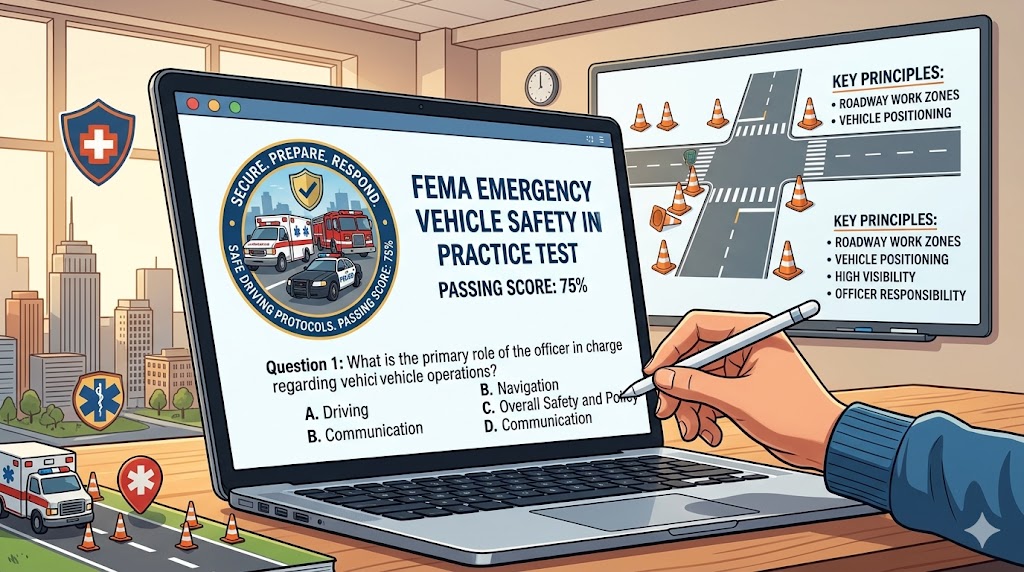
Additional Information
What the Course Entails and Exam Details
This initiative covers a wide array of competencies focused on maximizing safety during emergency response. The core themes include:
Driver and Passenger Safety: Understanding the specific roles and responsibilities of the driver, passenger, and officer in charge, including an uncompromising standard for mandatory seat belt usage.
Roadway Operations: Implementing effective strategies to protect responders on active roadways, including advance warning, correct vehicle positioning, and manual traffic control.
Technological and Equipment Safety: Familiarity with emergency lighting, high-visibility innovations for both personnel and vehicles, and equipment like fire apparatus, tankers, and ambulances.
Specific Incident Challenges: Reviewing the safety and traffic management challenges presented by special circumstances, such as vehicle fires, hazmat incidents, and medical helicopter operations.
Departmental Culture: Encouraging a culture shift within emergency service organizations to prioritize safety in all aspects of vehicle operation and roadway work.
Exam Details:
Since the "Emergency Vehicle Safety Initiative" is a USFA program, it does not have one exclusive examination that grants a single certification. The corresponding knowledge assessment, which a practice test mirrors, generally exists as the final exam for relevant FEMA Emergency Management Institute (EMI) Independent Study (IS) courses that cover components of the initiative. These assessments typically possess the following structure:
Format: Multiple-choice, with approximately 25–50 questions.
Delivery: Conducted entirely online via the FEMA IS program testing portal.
Passing Score: Typically 75%.
Time Limit: Generally untimed, but the test must be completed in a single session.
What to Expect in the Final Exam
While the exact final exam will depend on the specific FEMA Independent Study (IS) course you are taking, a typical knowledge assessment for an emergency vehicle safety-related course will be a multiple-choice exam that evaluates your proficiency in applying the initiative's guidelines to real-world scenarios. You can expect to encounter questions that present a specific situation—such as approaching a multi-vehicle crash on a highway or positioning an engine at a building fire—and require you to select the action that aligns with the established safety standards. A well-designed practice test is invaluable for preparing for this by mimicking the style, content, and difficulty of the official assessment. The final assessments are done online, and upon passing with a minimum score of 75%, you will be eligible for a certificate of completion from the FEMA EMI.
How to Study and Exam Centers
Preparation for mastering the FEMA Emergency Vehicle Safety Initiative's principles involves a combination of official study materials and active practice:
Actionable Study Strategies:
Read the Official USFA Publication: Obtain and thoroughly review the cornerstone document, "Emergency Vehicle Safety Initiative." This guide provides the primary foundation for all of the best practices and recommendations.
Take Related FEMA IS Courses: Enroll in and complete foundational and specialized FEMA Independent Study (IS) courses available on the EMI website.
Utilize the Practice Test: Repeatedly take the "FEMA Emergency Vehicle Safety Initiative Practice Test" to familiarize yourself with the question style and identify specific areas where your knowledge may be lacking. Use it as a repetitive diagnostic tool, focusing your study on topics where you make errors.
Engage with Colleagues: Discuss the safety guidelines with other members of your department to reinforce your understanding and learn how they are implemented locally.
Create Custom Flashcards: Build digital or physical flashcards for critical information, such as mandatory safety procedures, standard operating guidelines, and emergency vehicle operator responsibilities.
Exam Centers:
You do not take a final assessment for a FEMA IS course at a physical testing center or a facility like Pearson VUE. The entire process, from registering for the course to taking the final examination, is conducted online. To get credit for your training, you must have a FEMA Student Identification (SID) number. You can register for an SID for free on the Center for Domestic Preparedness (CDP) website. Once you have your SID, you can access the FEMA EMI's Independent Study course catalog, complete your courses, and take the final exam online in your own timeframe.
Job Opportunities from the Course
While completing the FEMA Emergency Vehicle Safety Initiative-related courses may not directly create a new job position, it is an essential component of a first responder's professional development. It demonstrates a commitment to personal and team safety, a quality that is highly valued and often required for all roles in emergency services. The knowledge acquired directly enhances safety and performance in numerous career paths:
Firefighter (all ranks and roles)
Fire Department Driver-Operator / Engineer
Emergency Medical Technician (EMT)
Paramedic
Police Officer / State Trooper
Emergency Management Specialist
Departmental Safety Officer
Fleet Management Personnel
Frequently Asked Questions
Reviews
5.0
Based on 0 reviews
Leave a Review
No reviews yet. Be the first to review!