
FEMA Fundamentals of Emergency Management (IS-230E) Practice Exam
$69.00
- Buy to unlock unlimited access to all Quiz questions and Answers in this Quiz.
- After purchase you can print a PDF of the whole quiz at any point. The PDF will contain the questions and the correct answers.
About this Exam
The FEMA IS-230.e Fundamentals of Emergency Management course serves as a critical cornerstone certification for public safety and disaster response personnel across the United States.
This comprehensive professional training program is developed and administered by the Federal Emergency Management Agency through its specialized Emergency Management Institute.
The course is meticulously structured to introduce participants to the foundational tenets of disaster preparedness, tactical response, long-term recovery, hazard mitigation, and active risk prevention.
It is universally designed for newly appointed emergency management professionals, public health administrators, municipal government officials, law enforcement leadership, and civilian volunteer coordinators.
By providing a structured framework for understanding how a community handles disasters, this certification establishes a shared operational vocabulary across local, state, federal, tribal, and territorial boundaries.
Earning this certification demonstrates a professional commitment to public safety and ensures that you possess the theoretical insights necessary to navigate complex multi-agency emergency operations successfully.
Ready to test your knowledge?
Buy Now to Access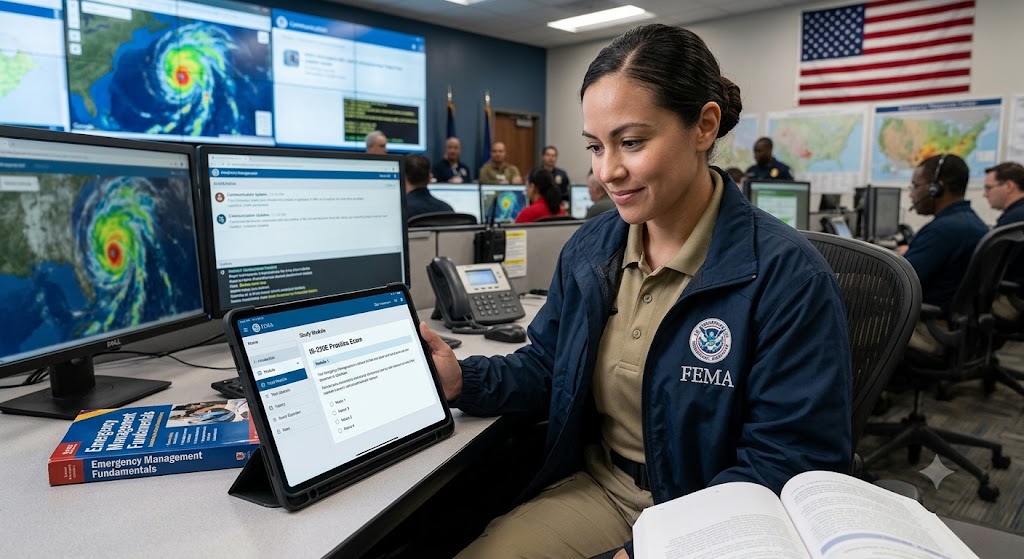
Additional Information
What the Course Entails and Exam Details
The comprehensive syllabus for the IS-230.e course is highly detailed and touches upon several critical domains of modern public safety infrastructure.
First, you will learn the core legal and historical authorities that empower modern federal and regional emergency response teams, including the landmark Stafford Act.
Second, the curriculum places a massive emphasis on the "Whole Community" concept, which teaches how private citizens, NGOs, corporate partners, and government agencies must coordinate seamlessly during a crisis.
Third, you will study the Five Mission Areas designated by national preparedness frameworks, which are Prevention, Protection, Mitigation, Response, and Recovery.
Fourth, the lessons detail the exact structural components of a standard Emergency Operations Plan, including the Basic Plan, Functional Annexes, and Hazard-Unique Appendices.
Finally, the course addresses resource typing standards, logistical allocation strategies, and the real-time operational workflow of a centralized Emergency Operations Center.
The full instructional material spans approximately six hours of self-paced learning content, which translates to 0.6 Continuing Education Units for your professional portfolio.
What to Expect in the Final Exam
The final assessment for the IS-230.e module is carefully designed to validate your comprehension of all core emergency management concepts and frameworks.
The exam consists entirely of multiple-choice questions delivered in a standardized, accessible digital format.
Because this is an independent study program, the test functions as an open-book evaluation, allowing you to reference your downloaded lesson materials during the process.
To pass the exam and secure your official, printable FEMA certificate, you must achieve a minimum passing score of 75 percent or higher.
There is no strict, ticking countdown timer forced upon you during the testing window, allowing you to carefully analyze each situational scenario without unnecessary stress.
However, you must maintain a stable internet connection and submit your answers in a single session to ensure your exam data is recorded successfully by the portal.
You will be required to authenticate your identity using a valid Login.gov account tied to your official FEMA Student Identification Number before opening the test interface.
How to Study and Exam Centers
Preparation for the IS-230.e exam requires a systematic approach to reading the primary literature provided online by the Emergency Management Institute.
Begin your studies by downloading the complete interactive course PDF and printing out the final module review summaries for manual note-taking.
As you progress through each individual unit, pay close attention to the specific definitions of key federal terminologies like resource management, community lifelines, and hazard mitigation.
Utilizing a high-quality practice exam is an exceptional way to gauge your readiness, identify knowledge gaps, and familiarize yourself with the phrasing used in federal assessments.
When you feel fully ready to challenge the final test, you do not need to schedule an appointment at a physical testing venue like Pearson VUE or Prometric.
This entire Independent Study program is fully hosted online, allowing you to take the exam from the comfort of your home or office workstation at any time.
Simply log into the official FEMA Emergency Management Institute Independent Study portal at training.fema.gov to complete your test and receive your immediate results.
Job Opportunities from the Course
Completing this fundamental federal certification acts as an excellent career stepping stone for dozens of rewarding pathways within the broader public safety sector.
Many certificate holders go on to work directly as Local or State Emergency Management Coordinators, designing proactive safety plans to protect towns and cities.
Others secure vital positions as Disaster Recovery Specialists, helping communities rebuild structural, financial, and emotional frameworks following a major natural catastrophe.
The private corporate sector also highly values this knowledge, frequently hiring certified individuals as Business Continuity Specialists to protect corporate assets and operational pipelines.
Non-governmental organizations and non-profits hire certified personnel as Disaster Relief Managers to oversee humanitarian supply distribution networks and volunteer groups.
Healthcare institutions actively recruit candidates for the role of Healthcare Emergency Preparedness Coordinator to maintain hospital compliance and mass-casualty readiness.
Frequently Asked Questions
Reviews
5.0
Based on 0 reviews
Leave a Review
No reviews yet. Be the first to review!