
FEMA NIMS An Introduction (IS-700.B) Practice Exam
$69.00
- Buy to unlock unlimited access to all Quiz questions and Answers in this Quiz.
- After purchase you can print a PDF of the whole quiz at any point. The PDF will contain the questions and the correct answers.
About this Exam
Welcome, ambitious emergency management professionals and public safety heroes! The FEMA IS-700.B course, "An Introduction to the National Incident Management System (NIMS)," serves as your critical first step into understanding the unified framework that guides all levels of government, non-governmental organizations (NGOs), and the private sector in working seamlessly together during incidents. Whether you are a first responder, government executive, or part of a community organization, this foundational course equips you with essential knowledge of NIMS concepts, principles, and components. It is designed for anyone who may be involved in preventing, protecting against, mitigating, responding to, or recovering from incidents, ensuring a standardized, effective nationwide response. This study guide and any associated practice exams are invaluable tools to help you confidently master this critical material and prepare for success in the final certification exam.
Ready to test your knowledge?
Buy Now to Access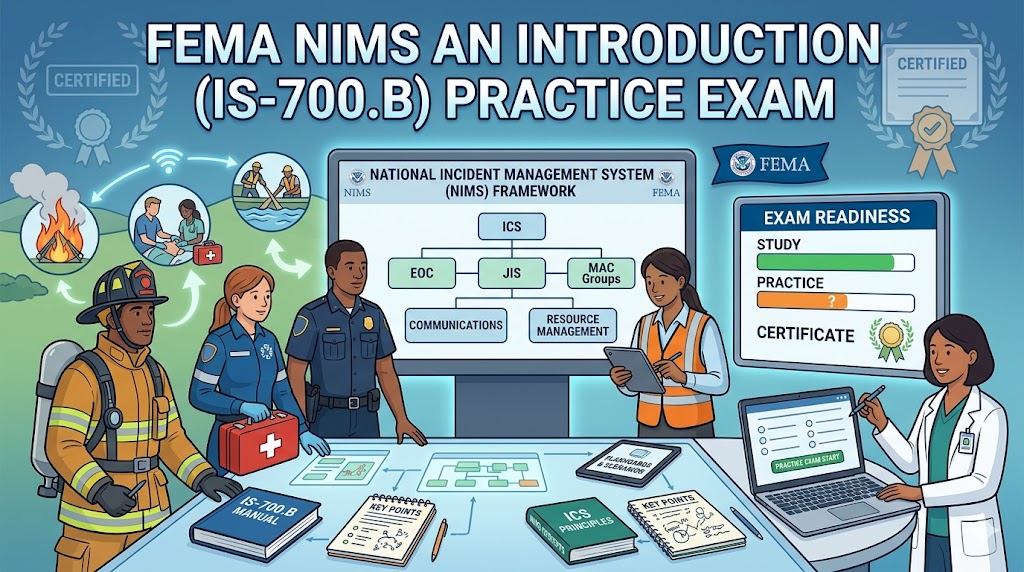
Additional Information
What the Course Entails and Exam Details
The IS-700.B course, which is a completely free, self-paced online offering through the FEMA Emergency Management Institute (EMI), typically takes around three hours to complete. It delves deep into the core concepts, principles, and key components of NIMS. Expect comprehensive coverage of:
Key concepts, principles, scope, and applicability of NIMS.
NIMS Management Characteristics.
Incident Command System (ICS) organizational structures.
Emergency Operations Center (EOC) functions, staff organization models, and activation levels.
Interconnectivity between ICS, EOCs, Joint Information Systems (JIS), and Multiagency Coordination (MAC) Groups.
Characteristics and standards for communications and information systems during incidents.
Resource management activities and methods.
The course materials provide diverse learning formats, including interactive content, visuals, student manuals, and other resources to facilitate thorough learning at your own pace. While official practice tests might not be included directly within the standard course structure, generic practice exams available online are excellent preparatory resources. These diverse elements ensure you understand how each component works individually and in concert to create a unified, scalable response to any incident. The final exam, which practice helps you ace, consists of multiple-choice questions rigorously assessing your understanding of all these critical aspects.
What to Expect in the Final Exam
While you may be utilizing practice exams as a crucial part of your preparation, the actual final IS-700.B exam is an online assessment taken through the official FEMA EMI Independent Study Program portal. Here is what you can typically expect from the official final exam to gain your certification:
Format: The final exam consists of multiple-choice questions. These questions test both your recall of specific NIMS principles, components, and concepts and your ability to apply this knowledge to hypothetical situations. The exact number of questions can vary but is designed to comprehensively cover the course content, often featuring a unique set of randomized questions for each attempt to verify individual understanding.
Passing Score: To successfully pass the final exam and earn your official FEMA IS-700.B certificate, you must achieve a minimum score of 75%. This passing requirement ensures you have a strong grasp of the fundamental tenets of NIMS.
Time Limit and Session Rules: While the course itself is self-paced, allowing you to learn at your convenience, once you commence the actual final exam, there is typically a timeframe to complete it in one sitting. For example, generic online sources and exam documentation may suggest completing that section in a single session. This ensures the integrity of the individual assessment. Though the time limit isn’t typically overly restrictive for those well-prepared, it's essential to set aside a dedicated block of time, generally an hour or two, to carefully read and answer each question.
Specific Rules: The final exam is designed as an individual assessment. You are expected to complete it on your own, reflecting your genuine comprehension. Thorough preparation is paramount to demonstrate your understanding efficiently. As is standard practice for online open-resource style verification exams, you should use all permitted resources of the course and your own knowledge effectively within the assessment guidelines. Be sure to check the official exam portal instructions just before starting for any last-minute details on rules, question numbers, or session timing, as procedures can occasionally be updated.
How to Study and Exam Centers
Effective and thorough preparation is key to not only passing the official final exam but also genuinely understanding and retaining the NIMS framework. Here are some highly actionable study strategies to set you up for success:
Review All Course Materials Thoroughly: Dedicate ample time to going through the entire IS-700.B interactive course content. Watch the videos, work through scenarios, and take notes. Download and study the Student Manual, Instructor Guide, visuals, and any other available resources.
Utilize Practice Exams: Practice is highly recommended! Reputable NIMS IS-700.B practice exams online can expose you to diverse question formats and potential scenario questions, helping you identify areas where you need more review and improving your test-taking confidence and efficiency. This study guide is just one tool; active practice is essential.
Create Flashcards: NIMS and ICS involve numerous critical acronyms, terms, and distinct components (e.g., ICS, EOC, JIS, MAC Groups, Comprehensive Resource Management, Management by Objectives, Unified Command). Flashcards are a proven, efficient way to memorize these definitions and concepts.
Focus on Key Components & Interconnections: Don't just learn the definitions; truly understand the specific purposes and functions of the primary NIMS components: Preparedness, Communications and Information Management, Resource Management, and Command and Management. Comprehend how these components interact and support one another during an incident.
Form Study Groups: If possible, connect with colleagues or fellow emergency management students. Discussing different perspectives on scenarios and clarifying challenging concepts with others can significantly deepen your understanding and reveal insights you might have missed individually.
Exam Centers Details: Unlike many professional certifications and state licensure exams, the FEMA IS-700.B final exam does not require you to schedule an appointment or travel to any specific physical exam centers like Pearson VUE, state government offices, or authorized schools. It is taken exclusively online through the FEMA EMI Independent Study Program portal, which is accessible free-of-charge from any computer with reliable internet access. To take the course and the final exam, you only need to ensure you have obtained your FEMA Student Identification (SID) number and can log in to the portal. You will then complete both the course sections and the comprehensive final exam fully online at your own convenience within each section’s session rules.
Job Opportunities from the Course
Completing the IS-700.B course and earning your NIMS certification is a fundamental achievement that not only enhances your public safety knowledge but also makes you a more competitive and valuable asset in numerous critical fields. Consider these specific roles and career areas where NIMS knowledge is essential, and often mandatory:
Emergency Manager / Emergency Management Specialist: Coordinates disaster planning, response, and mitigation efforts at various government and private sector levels.
First Responder: Dynamic on-scene roles such as:
Firefighter
Law Enforcement Officer (Police, Sheriff, etc.)
Paramedic / Emergency Medical Technician (EMT)
Search and Rescue Personnel
Public Safety Communicator / Dispatcher: Handles critical emergency communications and resource allocation in dispatch centers.
Disaster Recovery Specialist / Consultant: Manages post-disaster assessments, funding applications, and long-term rebuilding efforts.
Hospital and Healthcare Facilities Personnel: Positions involving emergency preparedness, response planning, and coordination during medical surges or facility incidents.
Non-Governmental Organization (NGO) Response Staff: Roles within organizations like the Red Cross, actively involved in community relief, sheltering operations, and disaster assistance.
Private Sector Emergency Management & Continuity: Positions in corporations, critical infrastructure entities, and utilities focused on resilience, business continuity, and crisis response.
Diverse Government Employees (beyond traditional first responders): Many local, state, tribal, and federal government positions have vital roles in incident support, coordination, or resource management requiring foundational NIMS knowledge.
Frequently Asked Questions
Reviews
5.0
Based on 0 reviews
Leave a Review
No reviews yet. Be the first to review!