
FEMA Structural Collapse Rescue Technician Certification Practice Test
$69.00
- Buy to unlock unlimited access to all Quiz questions and Answers in this Quiz.
- After purchase you can print a PDF of the whole quiz at any point. The PDF will contain the questions and the correct answers.
About this Exam
The FEMA Structural Collapse Rescue Technician certification is one of the most advanced and rigorous qualifications within the realm of technical rescue. This comprehensive program is designed for emergency response personnel—including members of Urban Search and Rescue (US&R) Task Forces, fire departments, and specialized regional rescue teams—who must operate in the aftermath of catastrophic structural failures caused by natural disasters, accidents, or acts of terrorism. The certification validates a technician's ability to perform complex, heavy rescue operations in highly unstable environments, including light frame, heavy wall, precast concrete, and steel-frame structures. It meets the critical requirements of NFPA 1006 Standard for Technical Rescuer Professional Qualifications for the Structural Collapse level.
Ready to test your knowledge?
Buy Now to Access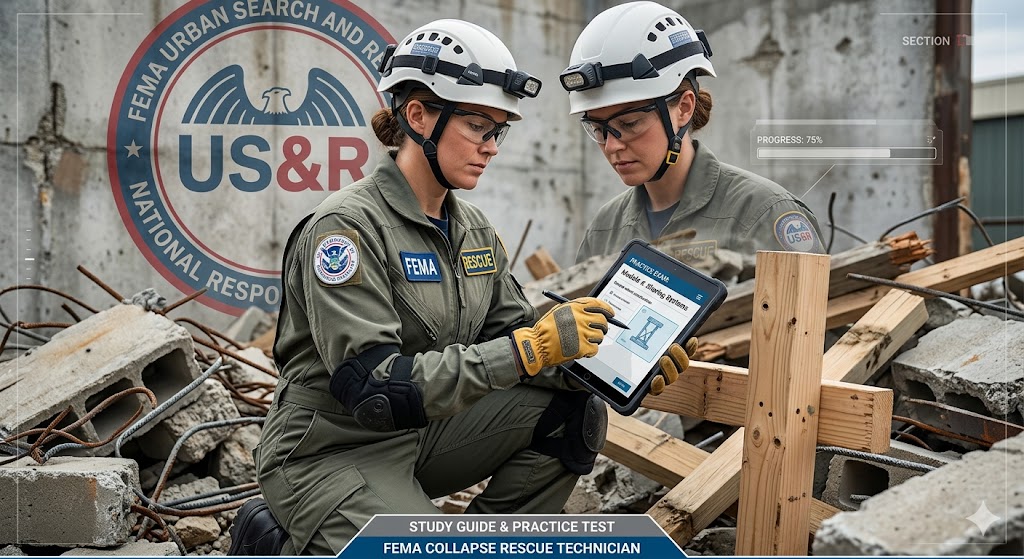
Additional Information
What the Course Entails and Exam Details
The standard curriculum for this certification is typically an intensive, 80-hour course that blends classroom instruction with extensive hands-on, scenario-based training.
Core topics and skills covered include:
Structural Collapse Size-up and Hazard Recognition: Learning to "read" cracks and distress signs in concrete and masonry to predict structure performance and identify falling, collapse, and other hazards.
Structural Engineering Systems and Building Construction: Understanding collapse patterns for different building types.
Emergency Shoring Theory and Construction: Hands-on fabrication and installation of wood and mechanical shores to stabilize damaged structures.
Lifting, Moving, and Cribbing Heavy Loads: Mastering techniques to safely move large structural components and debris.
Breaching and Breaking: Utilizing specialized tools to penetrate concrete, steel, and masonry walls and floors.
Cutting and Metal Burning: Operating exothermic torches and saws for metal breaching.
Victim Search, Extrication, and Packaging: Advanced medical and removal techniques for entrained victims.
Heavy Rigging and Basic Crane Operations: Coordinating with crane operators for large-scale debris removal.
What to Expect in the Final Exam
The final examination is a demanding, multi-part assessment that requires students to demonstrate both theoretical knowledge and flawless technical proficiency.
The process typically includes:
Written Examination: A comprehensive written test, often featuring multiple-choice questions, which evaluates understanding of all classroom modules, structural theory, and safety regulations. A minimum passing score (often 70% or higher) is required to proceed.
Practical Skills Assessment: This is the heart of the exam. Candidates are continuously evaluated in a "hands-on" setting. You must successfully complete a series of mandatory, scenario-based skill stations, such as setting up complex shoring, moving heavy objects, and performing a simulated breach and rescue. Unlike the written portion, many skill stations require 100% mastery and safety adherence. A failure of any single critical step in a station typically constitutes a failure of that skill until a re-test.
How to Study and Exam Centers
How to Study:
To succeed on the written exam, you must dive deep into the official student manual and training guides. Focus on structural dynamics, the official FEMA marking system, and shoring calculations. To prepare for the rigorous practical exam, you must utilize your task book to identify every required skill, and then practice those skills physically—preferably under the supervision of a certified instructor. Remember, precision and safety are paramount.
Exam Centers:
This certification is not typically administered through general online portals like Pearson VUE. It is held at authorized, specialized training academies, FEMA/US&R task force training sites, and state-specific emergency management centers. To find a test site, you must generally look at your state's Office of the State Fire Commissioner, your local task force's training schedule, or a national consortium like the REACT Center, and follow their specific registration process, which may involve getting a FEMA Student Identification (SID) number.
Job Opportunities from the Course
Obtaining the FEMA Structural Collapse Rescue Technician certification is a primary career-driver for technical rescue professionals and unlocks roles with elite teams and agencies.
Specific job titles and career paths this certification enables include:
FEMA US&R Task Force Rescue Specialist
Urban Search and Rescue (US&R) Technician
Regional Technical Rescue Team Member
Fire Department Heavy Rescue Specialist
Disaster Collapsed Structure Canine Search Technician
Disaster Response Manager/Coordinator
Technical Rescue Instructor/Program Coordinator
Disaster Collapsed Structure Technical Specialist
Frequently Asked Questions
Reviews
5.0
Based on 0 reviews
Leave a Review
No reviews yet. Be the first to review!