
Fencing Referee General Rule Practice Test
$69.00
- Buy to unlock unlimited access to all Quiz questions and Answers in this Quiz.
- After purchase you can print a PDF of the whole quiz at any point. The PDF will contain the questions and the correct answers.
About this Exam
The Fencing Referee General Rule Practice Exam is a crucial stepping stone for anyone aspiring to become a certified fencing referee or for current referees looking to refresh their fundamental knowledge. This comprehensive tool is designed to test your understanding of the universal rules that govern all three fencing weapons: foil, epee, and saber. Whether you are a seasoned fencer looking to give back to the sport, a parent eager to understand the bout on a deeper level, or an aspiring official, this practice exam provides a risk-free environment to gauge your readiness for official certification. It focuses on the core principles of conduct, safety, equipment standards, and the complex system of penalties that ensure fair play on the strip.
Ready to test your knowledge?
Buy Now to Access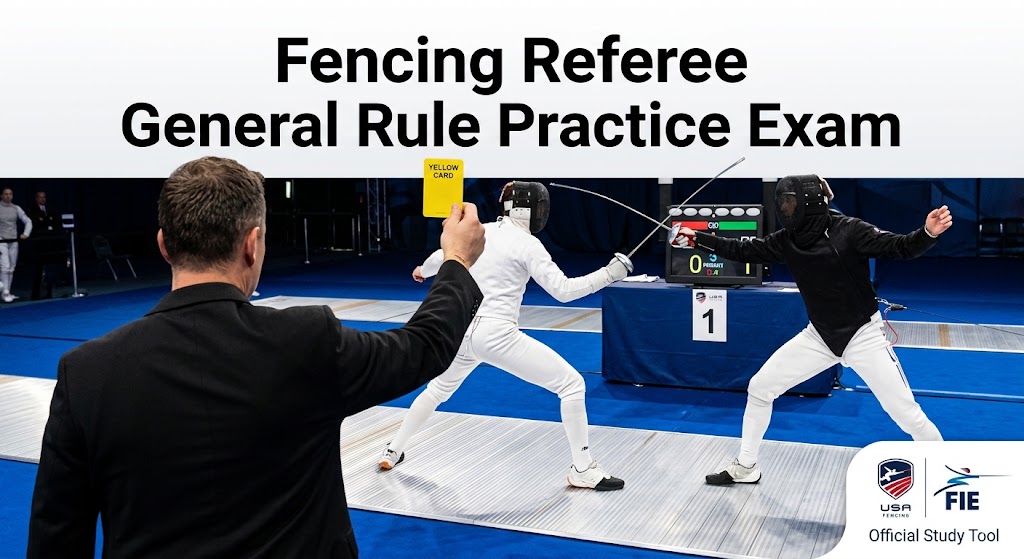
Additional Information
What the Course Entails and Exam Details
The core of this practice exam is based on the official rules of fencing, often derived from the FIE (International Fencing Federation) statutes as adapted by national bodies like USA Fencing. The course and practice test cover a broad spectrum of general officiating knowledge.
Core Topics Include:
Penalty System: Mastering the "Penalty Chart" is essential. You must understand the four groups of offenses, from simple warnings (yellow cards) to point-penalties (red cards) and exclusion (black cards). You'll need to know which actions trigger which penalties and how they are recorded and applied consecutively.
Bout Procedures: Knowing when to call "Halt," how to resume fencing with "On Guard," and proper starting/ending procedures for pools and direct elimination matches.
Equipment and Safety: Understanding what safety equipment is mandatory (jackets, masks, plastrons, chest protectors for women), how to perform preliminary equipment checks, and how to handle non-conforming or fraudulent equipment during a bout.
Conduct of the Bout: Rules regarding cross-step and leaving the strip (both sides and rear limits), corps-à-corps, and sportsmanship.
Referee Authority and Gestures: The correct use of hand signals and verbal commands to communicate calls clearly to fencers, coaches, and the scoring table.
Injury Protocols and Time Limits: What to do when a fencer is injured, medical breaks, and rules concerning the duration of bouts.
What to Expect in the Final Exam
While this is a practice exam, it is modeled after the official online tests provided by fencing federations.
Exam Format:
The actual certification exam is typically online and consists of multiple-choice questions.
It is divided into a mandatory "General Section" and individual "Weapon Specific Sections" (Foil, Epee, Saber). To receive your initial "P" (Passed) rating in the USA, you must pass the general exam and at least one weapon-specific exam.
Passing Score and Retakes:
For bodies like USA Fencing, a high passing score is required, typically 90% for both the general and the weapon sections.
If you do not pass, there is usually a mandatory waiting period (e.g., 48 hours) before you can retake the exam for a fee.
Time Limit and Focus:
The practice exam, like the real one, will challenge you with scenario-based questions (e.g., "Fencer X, already having a yellow card, does Y. What is the correct penalty?").
There is generally no specific time limit to complete the online test once you begin, but the practice test will help you build the speed and confidence needed.
How to Study and Exam Centers
Success on the Fencing Referee General Rule Exam requires a combination of self-study and practical engagement.
Actionable Study Strategies:
Read the Rulebook: Your number one resource is the current, official rulebook of your federation. Download it and read it from cover to cover, paying special attention to the Penalty Chart.
Use Study Guides: Many federations offer a Referee Study Guide that breaks down complex rules into common-sense scenarios and provides additional study tips.
Attend a Seminar: Mandatory for certification in many regions, attending a referee seminar led by a Certified Referee Instructor (CRI) is invaluable. These seminars offer deep dives into rule interpretation and provide a forum for questions.
Practice in the Club: The best way to learn is by doing. Offer to referee practice bouts at your local club. Ask experienced referees for feedback on your calls and hand gestures.
Review Video: Watch high-level bouts on platforms like the FIE YouTube channel and practice making calls, especially regarding right-of-way in foil and saber.
Where to Take the Exam:
Online Portal: The official referee exam is typically hosted on your national federation’s member database or specialized testing portal. You will need to log in to your member profile to access and take the test. In the United States, for instance, you would complete Safesport training and a background check before being eligible to purchase and take the exam online.
Job Opportunities from the Course
Successfully passing the general rule exam is your official entry into the world of fencing officiating. While full certification requires passing a practical exam as well, passing the rules test opens initial opportunities and sets you on a rewarding career path.
Unlocked Career Paths:
Local Club Referee: Officiate non-sanctioned events and practice matches.
Sanctioned Local/Regional Referee: Begin getting hired for local tournaments and regional points events once you complete the practical component.
High School and Collegiate Officiating: Many school leagues seek certified referees for their competitions.
Pathway to National Referee: Gain experience and seek a national rating, allowing you to referee at major national tournaments.
Referee Mentor and Instructor: Experienced refs help develop the next generation.
Head Referee or Referee Coordinator: Leadership roles within tournaments to manage other officials and resolve disputes.
Frequently Asked Questions
Reviews
5.0
Based on 0 reviews
Leave a Review
No reviews yet. Be the first to review!