
FERPA Student Records Practice Test
$69.00
- Buy to unlock unlimited access to all Quiz questions and Answers in this Quiz.
- After purchase you can print a PDF of the whole quiz at any point. The PDF will contain the questions and the correct answers.
About this Exam
This FERPA Student Records Practice Test is designed to evaluate and enhance your understanding of the Family Educational Rights and Privacy Act (FERPA).
It is a crucial assessment tool for educational professionals, including K-12 and higher education administrators, registrars, academic advisors, teachers, and any school staff members who routinely handle student educational records.
Mastering FERPA regulations is essential for ensuring institutional compliance and protecting the privacy rights of students and parents in an increasingly complex data landscape.
Ready to test your knowledge?
Buy Now to Access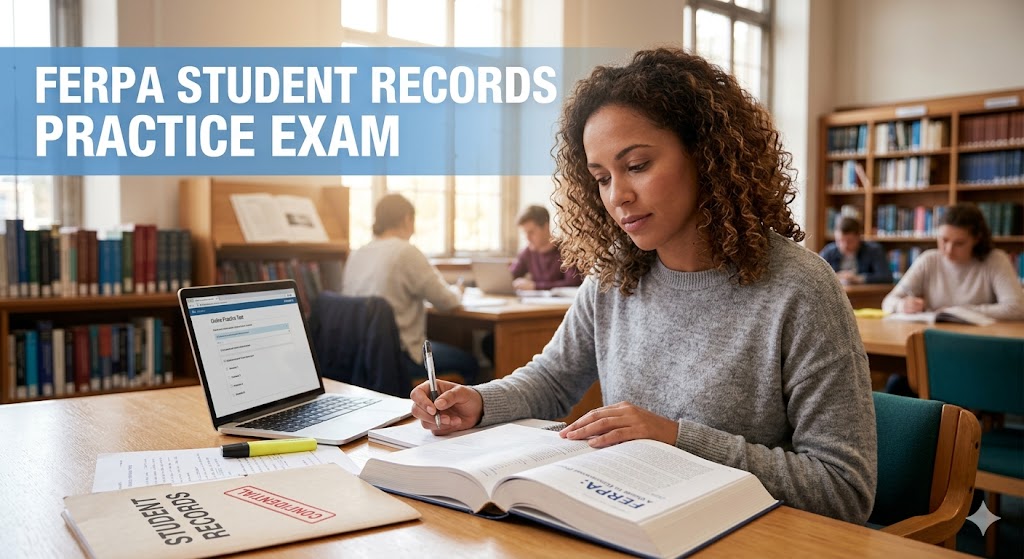
Additional Information
What the Course Entails and Exam Details
This practice test mirrors the structure and content of professional certification exams centered on student privacy law.
The comprehensive assessment covers the following core topics and regulatory requirements:
Understanding "Educational Records": Defining what constitutes an educational record under FERPA.
Rights of Parents and Eligible Students: Detailing the rights to inspect, review, and request amendments to records.
Requirements for Consent: Understanding the strict guidelines for the disclosure of personally identifiable information (PII).
Exceptions to the Consent Requirement: Identifying specific situations where PII can be shared without prior written consent (e.g., to other school officials with legitimate educational interests, studies, or health/safety emergencies).
Recordkeeping and Annual Notification: The administrative duties required of institutions.
Enforcement and Penalties: Consequences of non-compliance.
This is a vital tool for verifying that you possess the necessary knowledge to make compliant decisions when managing sensitive student data.
What to Expect in the Final Exam
Since this is a practice test, the format is optimized for learning and rapid feedback.
However, a standard final certification exam in this subject matter typically possesses the following characteristics:
Format: Multiple-choice questions, which may include scenario-based questions requiring you to apply regulations to real-world educational situations.
Time Limit: Usually timed, giving test-takers approximately 60 to 90 minutes to complete the exam.
Passing Score: Professional certifications often require a passing score of 70% to 80% to demonstrate proficiency.
Key Focus: The emphasis will be on your practical ability to distinguish between lawful and unlawful data handling practices, rather than simple rote memorization.
How to Study and Exam Centers
Preparation for the FERPA exam requires a combination of reviewing official regulatory guidance and applying that knowledge. Here is your roadmap to success:
Actionable Study Strategies:
Read the Official Statute: Study the core text of the FERPA regulations (20 U.S.C. § 1232g; 34 CFR Part 99).
Utilize Department of Education Resources: The U.S. Department of Education’s Student Privacy Policy Office (SPPO) offers extensive webinars, case studies, and FAQ documents that are invaluable.
Use Practice Tests: Leverage this practice exam multiple times. Review all answers, understanding why a choice was compliant or non-compliant. Scenario-based practice is critical.
Institutional Policies: Familiarize yourself with your specific institution’s localized policies on handling student data, as they must comply with but may expand upon the federal standards.
Exam Centers:
Because this specific practice test is a flexible training tool, it is administered entirely online.
For the final certification exam that this practice test prepares you for, candidates usually take it through authorized online compliance portals provided by their employer (such as a university or school district) or via professional organizations focused on educational compliance and administration. Check your institution’s training or HR department for specific details.
Job Opportunities from the Course
A strong, validated understanding of FERPA regulations is not just about compliance; it is a vital skill that unlocks several key career paths within educational and data management sectors.
Potential Career Paths:
School Registrar
Assistant/Associate Registrar
Director of Student Records
Educational Administrator (K-12 and Higher Ed)
Academic Advisor
Student Services Coordinator
Data Privacy Officer (DPO) in an Educational Setting
Compliance Officer or Compliance Analyst
School Counselor or School Social Worker
Admissions Officer or Admissions Counselor
Frequently Asked Questions
Reviews
5.0
Based on 0 reviews
Leave a Review
No reviews yet. Be the first to review!