
FFA Farm Business Management Contest Practice Exam
$69.00
- Buy to unlock unlimited access to all Quiz questions and Answers in this Quiz.
- After purchase you can print a PDF of the whole quiz at any point. The PDF will contain the questions and the correct answers.
About this Exam
The FFA Farm Business Management Career Development Event (CDE) is a prestigious and rigorous competition designed to challenge the analytical and decision-making skills of high school FFA members. It is specifically created for students interested in the business, financial, and economic aspects of the agriculture industry. This contest goes beyond the classroom, tasking participants to apply classroom knowledge to real-world scenarios faced by farm and agribusiness managers, cultivating future leaders in the agribusiness systems career pathway.
Ready to test your knowledge?
Buy Now to Access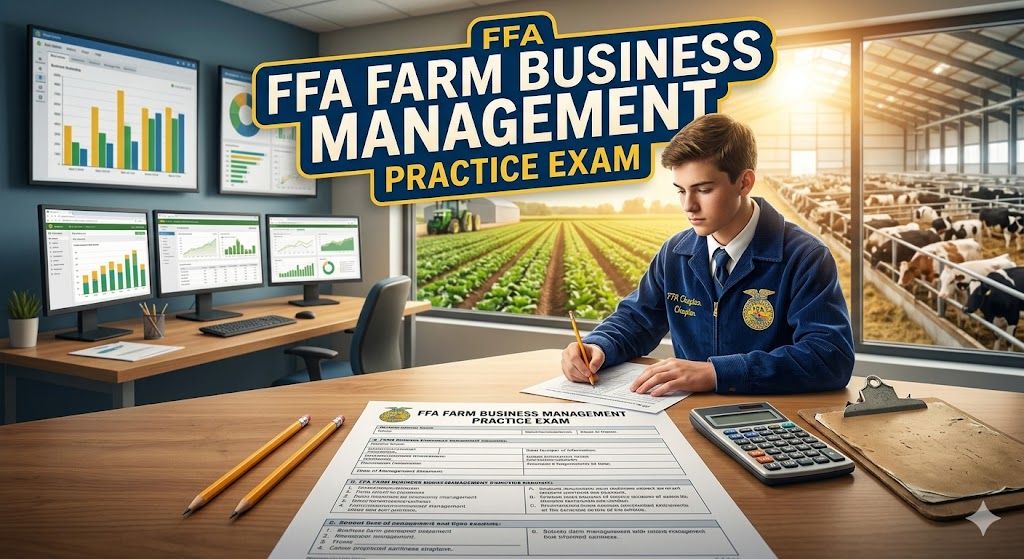
Additional Information
What the Course Entails and Exam Details
To prepare for this competition, students must delve into a comprehensive curriculum covering the complex machinery of modern agribusiness. The "course," which is typically equivalent to Advanced Agricultural Business and Economics classes, focuses on key areas such as:
Economic Principles: Understanding fundamental concepts like supply and demand, diminishing returns, profit maximization (MC=MR), marginal analysis, and opportunity costs.
Business Organization: Comparing the structures, advantages, and disadvantages of sole proprietorships, partnerships, corporations, and cooperatives.
Financial Statements & Analysis: Master the creation and interpretation of balance sheets, income statements, cash flow statements, and statements of owner's equity. This includes calculating critical ratios to assess solvency, liquidity, profitability, and efficiency.
Budgeting: Developing enterprise, partial, and whole-farm budgets to forecast costs, returns, and break-even points.
Risk Management: Identifying and mitigating production, marketing, financial, legal, and human risks, and creating comprehensive risk management plans.
Ag Investment & Finance: Navigating the principles of credit, interest, time value of money, loan application, investment analysis, and land/machinery acquisition.
Agriculture Law & Taxes: Gaining foundational knowledge in ag law, estate planning, business structures, and taxation impacting farms and agribusinesses.
The exam details, while varying slightly by state, typically involve a written individual test. This test acts as a gatekeeper and a core component of the final score for both the individual and their team. The CDE aims to replicate management decisions, requiring critical thinking and information assimilation.
What to Expect in the Final Exam
While not a "final exam" in the traditional sense of a singular certificate, the FFA Farm Business Management CDE at the district, state, or national level functions as a high-stakes competitive evaluation. For those taking a "practice exam," it's crucial to understand the format of the competition. Students can expect a written examination that usually includes:
A Multiple-Choice Section: Typically consisting of 50 to 75 questions designed to test knowledge of concepts, terms, and principles. Many questions require calculations.
A Problem-Solving Section: This portion is where theory is applied to complex, multi-step scenarios. It may be integrated into the main exam or a separate section. It asks students to analyze data, solve financial calculations, and recommend business decisions. It is designed to determine the member's ability to apply economic principles and concepts to a decision-making process by actual problem analysis.
Time Limit: Contests are usually strictly timed. The written exam can range from 120 minutes up to 3 hours, depending on the state and level of competition.
Passing/Target Score: Since this is a competitive event, there is no set "passing score." Success is measured by points. Top individuals and teams are ranked. For practice, students should aim for a competitive target score—such as scoring over 70-80%—to measure their readiness for state or national levels. Each section of the contest contributes to a total individual score, which is also used to calculate the four-member team score.
Specific Rules: Students must bring appropriate tools, such as two pencils. Non-programmable and non-graphing calculators are typically allowed and are a necessity. Outside materials, cell phones, smart watches, and communication with others are strictly prohibited. Official FFA Dress is almost always required at the convention and event sites.
How to Study and Exam Centers
Preparation is the absolute key to success in the Farm Business Management CDE. Unlike memory-based contests, this one demands dynamic problem-solving. Here are actionable study strategies:
Utilize Past Materials: The best resource is practice exams and past problem-solving scenarios from state and national contests. Analyze the logic behind the answers.
Master the Financial Statements: Create and analyze multiple sample balance sheets and income statements. Do not just learn the definitions; learn the relationships between the numbers.
Practice with a Calculator: Become extremely familiar and efficient with the non-programmable calculator you will use. Calculations must be fast and accurate.
Simulate Contest Conditions: Take practice exams under strict time limits, with no access to external resources, and in a quiet environment to build mental stamina.
Study Team-Based Scenarios: If your competition includes a team dynamic, practice decision-making activities cooperatively.
Exam Centers: The actual competition is administered through the FFA organizational structure. It progress as follows:
Local/Chapter Level: Often starts in the classroom or as a local selection event at the high school level.
District/Area Level: Moves to regional testing sites, often educational centers or community colleges.
State Level: Held during the State FFA Convention, frequently at a university campus or convention center.
National Level: The culmination of the event occurs during the National FFA Convention in late October, usually at a major convention center complex in a designated city (e.g., Indianapolis).
Job Opportunities from the Course
Competing successfully in the FFA Farm Business Management CDE is a powerful credential. It unlocks a wide range of lucrative and impactful career paths in the Agribusiness Systems pathway. The skills mastered are highly transferable to any financial and management field. Careers that this certification unlocks or significantly accelerates include:
Agribusiness Manager
Agricultural Loan Officer
Financial Officer / Controller for Ag Firms
Commodity Trader
Agricultural Consultant / Farm Business Analyst
Seed or Feed Dealership Manager
International Agricultural Marketing Specialist
Agricultural Insurance Agent
Agriculture Tax Accountant
Ag Auctioneer
Logistics Specialist for Agriculture
Marketing Communications Manager for Agribusinesses
Agricultural Educator / FFA Advisor
Frequently Asked Questions
Reviews
5.0
Based on 0 reviews
Leave a Review
No reviews yet. Be the first to review!