
FFA Small Engines Career Development Event (CDE) Practice Test
$69.00
- Buy to unlock unlimited access to all Quiz questions and Answers in this Quiz.
- After purchase you can print a PDF of the whole quiz at any point. The PDF will contain the questions and the correct answers.
About this Exam
The FFA Small Engines Career Development Event (CDE) is a highly competitive, practical, and knowledge-based contest designed for middle and high school agricultural education students.
This event allows participants to demonstrate their understanding of small engine mechanics and their ability to troubleshoot, maintain, and repair various types of small gasoline engines. It is an excellent opportunity for students to apply classroom knowledge to real-world mechanical problems and to showcase their skills to potential employers in the agricultural and power equipment industries.
Ready to test your knowledge?
Buy Now to Access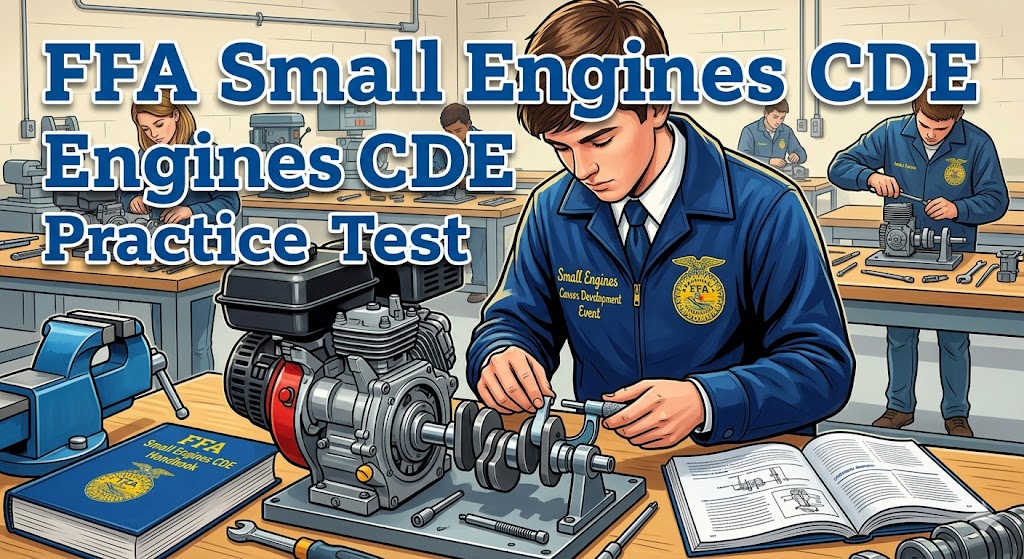
Additional Information
What the Course Entails and Exam Details
The content and skills evaluated in the FFA Small Engines CDE are comprehensive and align with industry standards for power mechanics pathways.
While specific rules can vary slightly between state FFA associations, the core syllabus typically includes a thorough understanding of engine principles, including the 2-stroke and 4-stroke cycles. Participants must be proficient in:
Identifying and explaining the function of specific engine parts and components.
The proper identification, selection, and use of relevant tools and test equipment.
Performing general maintenance and specific repairs, such as servicing air cleaners, managing fuel systems, and adjusting carburetors.
Troubleshooting and resolving non-starting, poor running, or other engine problems.
Understanding and executing procedures related to systems like ignition, valves, pistons, and lubrication.
What to Expect in the Final Exam
The final exam for the Small Engines CDE generally includes both individual and, at state levels, team-oriented components, making it a rigorous assessment of a student’s technical skills and collaborative abilities. The competition typically consists of three major phases:
Written Examination: A timed, individual, multiple-choice test. It focuses on the theory of small engine operation, tool identification, safe work practices, and troubleshooting principles.
Problem Solving and Part Identification: This segment requires participants to identify various engine parts, tools, and technical data. Students may also solve problems related to part numbers or service specifications.
Mechanics Skills Stations: Participants rotate through several practical stations. Each station tasks the student with performing a specific job, such as checking valve-tappet clearance, measuring the crankshaft for wear, assembling specific components, or adjusting a governor.
Scoring is based on the speed and accuracy of completing tasks, adhering to official labor time guides, and, crucially, strict adherence to safety protocols. A dress code requiring official FFA dress or appropriate workshop attire is usually enforced, with potential penalties for non-compliance.
How to Study and Exam Centers
Preparation for this event is both academic and practical. Successful students often utilize a blend of the following strategies:
Official Resources: Thoroughly study the National FFA Organization’s official Small Engines CDE handbook, as well as the rules and test banks provided by your state FFA association.
Practice Tests: Consistently use practice exams and previous written tests to improve speed and familiarity with the question style.
Hands-On Practice: The most critical component of study. Obtain various small engines and practice disassembling, measuring, reassembling, and troubleshooting them, ideally under the guidance of your agricultural education teacher.
Skill Checklists: Create checklists for each technical skill outlined in the rules and practice performing them accurately, safely, and within standard time limits.
It is important to understand that the FFA Small Engines CDE is not an exam you register for on a typical portal. Instead, it is a sequential competitive event. Participants must first compete and qualify at the local or district level through their school’s FFA chapter. The highest-scoring individuals and teams advance to the state competition, often held during the State FFA Convention, with the state winner earning the chance to compete at the National FFA Convention & Expo.
Job Opportunities from the Course
Participating in and excelling at the FFA Small Engines CDE directly opens doors to numerous career paths within the mechanical and agricultural sectors. The skills and knowledge you gain are immediately transferable to the following job titles:
Small Engine Technician
Power Equipment Service Technician
Agricultural Mechanic
Outdoor Power Equipment Specialist
Agricultural Sales and Service Representative
Shop Foreman
Service Manager
Technical Trainer
Field Service Technician
Frequently Asked Questions
Reviews
5.0
Based on 0 reviews
Leave a Review
No reviews yet. Be the first to review!