
FHR Monitoring V2 Practice Test
$69.00
- Buy to unlock unlimited access to all Quiz questions and Answers in this Quiz.
- After purchase you can print a PDF of the whole quiz at any point. The PDF will contain the questions and the correct answers.
About this Exam
The FHR Monitoring V2 Practice Test is a critical tool for healthcare professionals aiming to validate and enhance their competency in electronic fetal heart rate monitoring. This specific resource, likely a comprehensive set of practice questions and scenarios, is designed for registered nurses, nurse-midwives, physicians, and other members of the maternal-child health team who interpret fetal heart rate patterns. While not a certification itself, this practice test serves as robust preparation for final certification exams, such as those offered by organizations like NCC or AWHONN, and ensures professionals are up-to-date with the latest, version-controlled practices in this life-saving skill. It is ideal for both new practitioners seeking a foundational review and experienced clinicians looking to refresh their knowledge and skills.
Ready to test your knowledge?
Buy Now to Access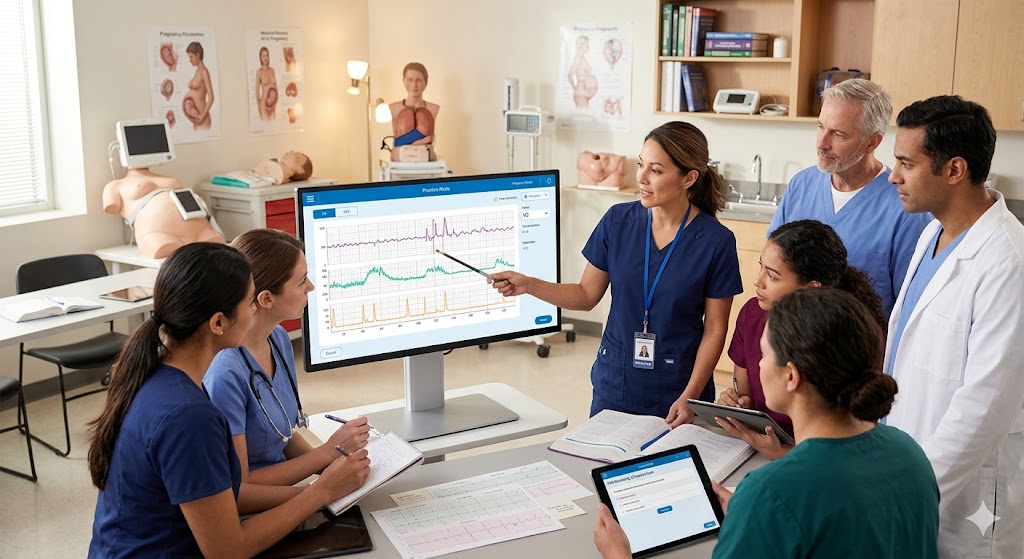
Additional Information
What the Course Entails and Exam Details
This comprehensive practice resource and by extension, the relevant courses and final certification exams, delve deeply into the critical principles and physiological bases of electronic fetal heart rate (FHR) monitoring. Key areas covered include:
Maternal-Fetal Physiology: Understanding the underlying physiology that drives fetal heart rate patterns.
FHR Pattern Recognition: Mastery in identifying, defining, and interpreting all standard FHR patterns, including baseline, variability (absent, minimal, moderate, marked), accelerations, and various types of decelerations (early, late, variable, prolonged, sinusoidal).
Uterine Contraction Interpretation: Accurately assessing uterine activity, including frequency, duration, intensity, and resting tone.
Categorization Systems: Proficiently applying the standard categorization systems (like Categories I, II, and III as defined by ACOG and NICHD) to determine the likelihood of normal or abnormal fetal acid-base status.
Technique and Equipment: Proper placement of external monitors (ultrasound transducer, tocodynamometer) and internal monitoring techniques (fetal scalp electrode, intrauterine pressure catheter), including their respective advantages and limitations.
Clinical Intervention: Determining appropriate nursing and medical interventions based on FHR pattern interpretation, prioritizing maternal and fetal safety.
Communication and Documentation: Effective communication within the healthcare team regarding monitoring results and meticulous documentation practices.
Ethical and Legal Considerations: Understanding the implications and responsibilities of continuous fetal monitoring in various clinical scenarios.
The practice test itself is structured as a collection of diverse, challenging multiple-choice questions, many featuring clear illustrations or tracings for visual interpretation, mirroring the structure of final certification exams.
What to Expect in the Final Exam
While the exact structure of the actual final certification exam varies by the specific issuing body (e.g., the National Certification Corporation (NCC), the Association of Women's Health, Obstetric and Neonatal Nurses (AWHONN)), students can generally anticipate the following:
Format: The final certification is typically a comprehensive, proctored computer-based test consisting of multiple-choice questions. Many questions will require interpreting complex FHR tracings presented in real-world scenarios.
Scope: The exam will cover all core topics detailed in the 'What the Course Entails' section.
Time Limit: Expect a designated time limit (often several hours), demanding both knowledge and time management skills.
Passing Score: The passing score is determined by the certifying organization and is usually standard for this level of professional competency. This is typically a set raw score or a percentile, not a simple percentage.
Testing Environment: Candidates must typically register and take the final exam in a specific, physical testing center or under secure, proctored online conditions with specific technology requirements.
How to Study and Exam Centers
Preparation is key to success on both the practice test and the final certification. A robust study plan should include:
Utilize the V2 Practice Test Thoroughly: The FHR Monitoring V2 Practice Test is an excellent primary resource. Answer all questions, review explanations for correct and incorrect answers, and identify your areas of strength and weakness. Repeatedly take the test to improve accuracy and speed.
Engage with Comprehensive Courses: If you are preparing for a specific certification (e.g., NCC's C-EFM or AWHONN's FHM courses), complete the recommended course materials and attend workshops. These provide structured learning and expert guidance.
Consult Textbooks and Guidelines: Review relevant sections of authoritative textbooks, clinical guidelines (like ACOG Committee Opinions, NICHD standards, AWHONN clinical competencies), and peer-reviewed journals.
Clinical Practice: Nothing replaces hands-on experience. Apply knowledge on the labor and delivery unit, discuss FHR tracings with colleagues and mentors, and participate in case reviews.
Study Groups: Collaborate with peers. Discussing challenging tracing interpretations and interventions can enhance understanding for everyone involved.
Time Management Practice: When taking practice tests, simulate exam conditions, including timing yourself, to build confidence and manage pressure.
Exam Centers: The actual final certification exams are not typically administered in general centers, but through specific networks.
Online Portals: Many certifying bodies offer online registration and sometimes the option for remote proctoring under strict guidelines.
Physical Testing Centers: Standard physical testing centers (such as those managed by Pearson VUE or Prometric) or specific educational institutions authorized by the certifying body are common locations. Check the website of the organization providing the certification (e.g., nccwebsite.org, awhonn.org) to find approved testing locations and details on registration and requirements. You must register in advance.
Job Opportunities from the Course
Obtaining a specialized certification in Fetal Heart Rate Monitoring (for which the V2 Practice Test is excellent preparation) signifies an advanced level of professional competence and commitment in the field of maternal-child health. This distinction can unlock numerous career paths and lead to enhanced roles.
Labor and Delivery (L&D) Nurse: A core role in obstetric nursing, where advanced FHR monitoring skills are essential for the safe care of both mother and baby during labor.
OB/GYN Nurse: Providing comprehensive care throughout pregnancy, labor, and postpartum. Certification enhances expertise and potentially opens up specialized clinic roles.
Antepartum Nurse: Caring for high-risk pregnancies, requiring expertise in prenatal FHR monitoring and assessment.
Certified Nurse-Midwife (CNM): Many CNMs find certification valuable to reinforce and demonstrate their proficiency in this critical area of practice.
Clinical Nurse Specialist (CNS): Specializing in maternal-child health, a CNS with advanced FHR skills can provide education, leadership, and expertise across the unit.
Nursing Educator: Certification can be a strong qualification for roles teaching FHR monitoring to students, new hires, or current staff.
Clinical Leader / Charge Nurse: Demonstrating expertise in FHR interpretation can position a nurse as a clinical leader, responsible for guiding colleagues and managing patient care decisions.
Quality Improvement or Risk Management: Advanced knowledge of correct monitoring and intervention practices can lead to opportunities within a hospital's quality or risk management departments focused on maternal health.
Frequently Asked Questions
Reviews
5.0
Based on 0 reviews
Leave a Review
No reviews yet. Be the first to review!