
FIBA Agent Practice Test
$69.00
- Buy to unlock unlimited access to all Quiz questions and Answers in this Quiz.
- After purchase you can print a PDF of the whole quiz at any point. The PDF will contain the questions and the correct answers.
About this Exam
Welcome to your essential resource for the FIBA Agent Practice Test! This guide is designed for aspiring and current basketball player representatives who have their sights set on obtaining the official FIBA Agent License – the internationally recognized standard for representing players and clubs within the complex landscape of global professional basketball.
The final FIBA Agent Certification is the gateway to representing basketball talent across international leagues, working with elite players, negotiating substantial contracts, and navigating the intricate regulations governing the sport worldwide. The Practice Test is your primary diagnostic and preparation tool, allowing you to gauge your readiness, identify critical knowledge gaps, and familiarize yourself with the type of challenges you will face in the official examination.
Ready to test your knowledge?
Buy Now to Access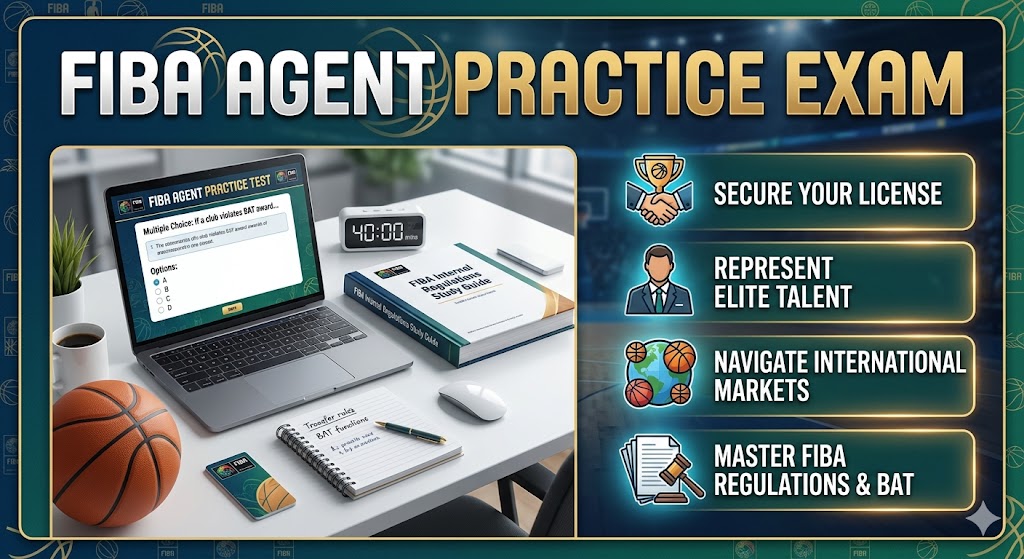
Additional Information
What the Course Entails and Exam Details
This section outlines the comprehensive body of knowledge and skills, which we refer to as the required "course of study," needed to succeed both on your practice test and the subsequent final certification exam. As there is no single mandated official preparation course, candidates are expected to proactively master the material from the official FIBA study guidelines and materials. The core focus is on the FIBA Internal Regulations (FIBA IR) and related legal and ethical standards.
The essential knowledge domains covered in this overall body of knowledge (and reflected in practice tests) include:
FIBA Internal Regulations (FIBA IR): In-depth knowledge of all books, with a critical focus on Book 1 (Code of Conduct, Sanctions) and Book 3 (Eligibility, National Status, Availability of Players, International Transfer of Players, and the Basketball Arbitral Tribunal - BAT). This is the cornerstone of your entire agent role.
Basketball Law & Contract Negotiation: Understanding contract dynamics, legal principles governing agent-player and agent-club relationships, and developing effective negotiation skills.
Player Eligibility & Transfers: Mastery of the rules determining which players are eligible for specific national and international competitions, and the detailed procedures for managing players across borders.
The Basketball Arbitral Tribunal (BAT): Knowing the structure, function, and precedent of the BAT, which is the specialized dispute resolution body for professional basketball. Understanding how to handle disputes, file claims, and interpret awards is crucial.
Anti-Doping Regulations: Familiarity with the anti-doping policies of FIBA, the International Olympic Committee (IOC), and the World Anti-Doping Agency (WADA) that all players and agents must adhere to.
Ethics & Code of Conduct: Upholding the highest standards of professional conduct, integrity, and fair play in all agent activities.
General Details for Your Practice Test: While practice tests can vary in exact format depending on the source (official or third-party), they are typically structured to simulate the pressure and content of the final written exam. Candidates should expect:
Format: Primarily multiple-choice questions, requiring you to select the best answer from several options.
Question Types: A mix of direct regulatory questions, scenario-based applications of FIBA rules, and basic legal interpretation scenarios.
Number of Questions: A standard practice test might contain 25-50 targeted questions, though longer simulations are also beneficial.
Time Limit: To best prepare, practice tests are often timed. Aim to complete your practice sessions within 45-60 minutes to mirror the pressure you will face during the official written exam.
What to Expect in the Final Exam
This is the main event: the official FIBA Agent Certification Exam, administered by FIBA directly. Understanding the specific, high-stakes nature of this exam is essential for tailoring your final study push. The process is rigorous, and passing it successfully means you have demonstrated the required foundational knowledge and professional aptitude.
The final official certification exam traditionally consists of two main components, completed during designated test sessions:
A Written Multiple-Choice Examination:
Format: This is a timed, proctored written exam, typically consisting entirely of multiple-choice questions.
Duration: Candidates are typically given 45 minutes to complete this portion of the examination.
Content: The questions assess your direct knowledge of the FIBA Internal Regulations and related core knowledge areas (as detailed in the "Course Entails" section), often involving scenario application. The emphasis is on understanding and applying the rules accurately.
An Interview Process:
Purpose: The interview is a crucial step that evaluates your professional background, motivations for becoming a FIBA agent, and overall aptitude for the role. It is not a knowledge test but a key factor in the final licensing decision. This demonstrates your communication skills, ethical alignment, and understanding of the agent business model and its challenges.
Final Exam Score & Passing Threshold:
Passing Threshold: While the exact standard can be revised for each specific test session and threshold values are provided on-site prior to the test, historical passing thresholds are typically set around 60% correct responses for the written examination.
Overall Decision: Your success is determined by both your performance on the written exam and the results of your interview. FIBA evaluates each candidate on a comprehensive basis.
Specific Rules: Final exam sessions are strictly regulated. Candidates are expected to be present, adhere to all test day rules (which may include no external aids and specific allowed items), and follow instructions explicitly.
How to Study and Exam Centers
Preparation is paramount, and leveraging practice resources alongside official study materials is the winning formula. The distinction between where you take the practice test and where you take the final official exam is important.
How to Study Effectively:
Master Official FIBA Materials: The absolute most critical step is to obtain and thoroughly study the official FIBA Internal Regulations and any specifically recommended study guides or materials provided by FIBA upon registration. These are the gold standard and the source of all exam questions. Print them, highlight key chapters (especially Book 3 on Transfers, Eligibility, and BAT), and know the terminology inside and out.
Prioritize key Chapters: While you should have overall regulatory knowledge, focus heavily on the known priority chapters mentioned above: Code of Conduct, Sanctions, Eligibility/National Status, International Transfers, and BAT.
Leverage This Practice Test: Treat practice tests (like the ones this guide supports) as diagnostic tools. Take them repeatedly. After each session, meticulously review the answers – both the ones you got wrong and the ones you got right. Understand why an answer is correct based on the relevant FIBA regulation. This targeted revision is incredibly powerful.
Simulate Test Conditions: When taking practice tests, especially full simulations, do so in a quiet environment without notes, and time yourself strictly according to the official examination time limit (45 minutes). This will help you manage test-day anxiety and learn efficient time management.
Create a Study Schedule: Break down the core regulations into manageable study blocks and schedule regular practice test sessions. Consistency is key.
Focus on Scenario Application: Go beyond rote memorization. Read scenario questions carefully. Ask yourself: "Which regulation applies here?" and "What are the potential consequences of this action according to FIBA IR?"
Review Contract Law Basics: A solid foundation in basic contract law and legal principles is beneficial, even if the primary focus is on FIBA regulations.
Final Exam Centers and Process:
Location: The final certification exams are not typically taken online from home or via widely available third-party centers (unless specifically stated in your registration materials). They are administered at official FIBA Test Sessions held a few times annually at designated locations around the world. These locations are determined by FIBA and vary by region (e.g., Americas, Asia, Europe, Oceania). Typical past or upcoming locations include places like Miami, Miami (USA) or Ulaanbaatar (Mongolia).
Registration Process: Candidates must pre-register for these sessions through the official FIBA channels (e.g., the FIBA Agents' licensing portal or by contacting agents@fiba.basketball).
Application Deadline & Fees: Pay close attention to registration deadlines and administrative fees (which are non-refundable) that are part of the application and test session participation process.
Test Day: You will receive specific information regarding the test day program, exact location details, and required documents and processes well in advance of your selected test session. Candidates are responsible for their own transportation and accommodation costs.
Interview: The interview component is often scheduled during or around the test session dates.
Licensing: Upon successfully passing both the written exam and interview, you will be required to pay an annual membership fee to activate and maintain your official FIBA Agent License and be able to operate in the international basketball environment with FIBA status.
Your journey is about disciplined preparation. This study guide and practice test, in combination with official materials, will provide the structure and feedback you need. Good luck with your study – the world of international basketball is waiting!
Job Opportunities from the Course
Successfully navigating the FIBA Agent Practice Test and ultimately securing your official FIBA Agent License unlocks a diverse and potentially highly rewarding career path within the global basketball industry. The license is a key differentiator and often a requirement for various professional roles.
Here are distinct job titles and potential career paths this certification enables:
Licensed International Basketball Agent (Player Representative): This is the most direct and common path. Represent players and clubs in negotiating contracts for professional teams across the globe, managing career trajectories, and navigating international transfers.
Talent Manager / Consultant for Basketball Professionals: Beyond contract negotiation, manage players' overall careers, including endorsements, marketing opportunities, career development planning, and personal brand building. A FIBA license adds significant credibility.
Agency Director / Founder (Basketball Focus): Establish or lead a sports agency specializing in basketball talent, managing other agents and overseeing a roster of clients on both a domestic and international scale.
Head of Basketball Operations (Clubs/Agencies): Utilize your in-depth knowledge of international regulations and transfer protocols in leadership roles within professional clubs or larger sports agencies, overseeing talent acquisition and player movement.
Basketball Scout / Recruitment Coordinator: Leverage your knowledge and network, enhanced by your agent credibility, to scout emerging talent for professional clubs, identifying players with potential for international or higher-tier domestic play. A background in regulations is valuable when advising clubs on the feasibility of international recruits.
Dispute Resolution Specialist (Sports Law Context): Develop expertise in handling contractual and regulatory disputes, representing clients before the Basketball Arbitral Tribunal (BAT) or other relevant bodies (this typically requires a complementary legal background but the FIBA knowledge is foundational).
Agency Compliance Officer: For larger agencies, specialize in ensuring that all agent activities and contracts comply with the continuously evolving FIBA, national federation, and regional regulations.
Sports Executive/Consultant (Basketball/Sports Business): Apply your strategic thinking, regulatory expertise, and industry network in broader executive roles within basketball organizations, leagues, or sports consulting firms.
Frequently Asked Questions
Reviews
5.0
Based on 0 reviews
Leave a Review
No reviews yet. Be the first to review!