
FIBA Referee IOT Practice Test
$69.00
- Buy to unlock unlimited access to all Quiz questions and Answers in this Quiz.
- After purchase you can print a PDF of the whole quiz at any point. The PDF will contain the questions and the correct answers.
About this Exam
The FIBA Referee Integrated Official Training (IOT) Certification is the global gold standard for basketball officials who aspire to work in high-level international competitions. Developed by the Fédération Internationale de Basketball (FIBA), this comprehensive training and certification program is designed for dedicated referees who have already proven themselves at the national level and are looking to make the leap to the international stage. It validates their deep understanding of the FIBA Official Basketball Rules and individual officiating techniques, ensuring that the game is called consistently and fairly across all borders. Achieving this license is a critical milestone, demonstrating a commitment to the highest levels of professional performance and ethical conduct in the sport.
Ready to test your knowledge?
Buy Now to Access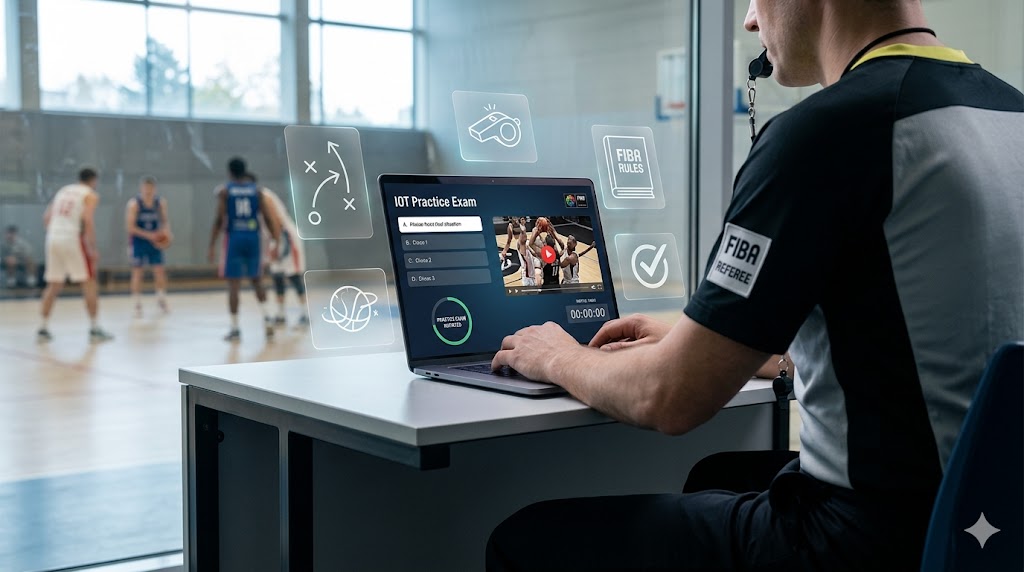
Additional Information
What the Course Entails and Exam Details
The FIBA IOT course is a comprehensive program covering all facets of modern, high-level basketball officiating. Candidates are expected to master a demanding syllabus, including:
FIBA Official Basketball Rules and Interpretations: Deep and complete knowledge of the latest rulebook and its specific application in complex game situations.
Individual Officiating Techniques (IOT): Mastery of foundational mechanical and technical procedures executed individually on the court, such as distance, stationary positioning, refereeing the defense, staying with the play, making the call, decision making, communication, signals, and reporting.
Game Management and Philosophy: Strategies for maintaining control, managing flow, interacting with players and coaches, and handling high-pressure moments with composure.
Physical Fitness and Ethics: Understanding the demanding physical standards required of international officials and upholding the core ethical values and image of a FIBA referee.
The exam itself is delivered through FIBA's dedicated online e-learning platform, which is generally structured into two distinct phases. First, there is a Training Period during which candidates can practice with unlimited, untimed attempts. Following this, the Testing Period consists of a single, timed attempt. This format reflects the real-world pressure where split-second decisions are final. The overall process ensures that only the most prepared candidates receive the prestigious certification.
What to Expect in the Final Exam
The final FIBA IOT timed assessment is a rigorous and comprehensive test of your theoretical and practical knowledge. While specific details can vary by license period, here is what candidates can generally expect:
Multiple Choice Questions (MCQ): A core component covering all aspects of the rules, mechanics, and FIBA organizational regulations.
Video-Based Scenario Analysis: Candidates must watch and analyze video clips of actual game situations and make correct calls, assessments, or decisions based on IOT principles and rules knowledge within a limited timeframe.
Comprehensive Coverage: The test will draw from the 2024 (or latest) Official Basketball Rules, IOT Manual, and organizational modules, challenging your speed, accuracy, and judgment.
High Passing Standard: Candidates must typically achieve a very high score, often over 80% or 90%, depending on the specific license category they are targeting (e.g., Black, Green, or White).
Timed Assessment: You will have a single attempt to complete all sections within the allotted time, which mimics the fast-paced nature of an actual basketball game.
How to Study and Exam Centers
Preparing for the FIBA Referee IOT Practice Exam requires a strategic and dedicated approach. Here are actionable study strategies:
Master the Manuals: Study the FIBA Official Basketball Rules, Rules Interpretations (OBRI), and the Individual Officiating Techniques (IOT) manual. Create summaries, flashcards for key definitions, and visual diagrams for signals and positioning.
Use the E-Learning Platform: Actively engage with all the training modules, quizzes, and practice materials provided by FIBA. Use the "unlimited attempts" phase to identify and improve on your weak areas.
Visualize and Simulate: Practice visualizing game scenarios and mentally applying the correct IOT principles and rule calls. Watch game footage of past FIBA competitions and analyze the officials' decisions and positioning.
Join Study Groups: Collaborate with fellow national-level referees and instructors to discuss rules interpretations and share IOT insights.
Stay Physically Fit: Physical readiness is a key part of the broader licensing process, and a strong body helps maintain mental clarity under pressure.
Exam Centers and Access: The FIBA IOT exam is not administered in physical testing centers like Pearson VUE. It is an online, secure exam accessed directly through the official FIBA e-learning portal. Candidates are usually granted access via their respective National Basketball Federations, who coordinates with FIBA. It is essential to ensure you have a stable, reliable internet connection for the timed final attempt and that you follow all security procedures provided by your federation.
Job Opportunities from the Course
A FIBA Referee License (Black, Green, or White) is not just a certification; it is the passport to an extraordinary career in international sports. The different categories define the specific level of global competitions that an official can oversee, unlocking unmatched professional experiences. Here is a clear list of the career paths and job opportunities that can be unlocked:
FIBA World Cup Referee: The absolute pinnacle for any basketball official, calling games at the highest level of international competition.
Olympic Games Basketball Official: Representing your country and federation at the most famous multi-sport event in the world.
Regional Championship Referee: Officiating major competitions like EuroBasket, AfroBasket, FIBA AmeriCup, and FIBA Asia Cup.
International Club Competition Official: Working in prestigious leagues and tournaments such as the Basketball Champions League (BCL), EuroLeague, EuroCup, and regional club championships.
International Youth and Development Tournaments: Developing the next generation of players and referees, and gaining invaluable experience.
FIBA Referee Instructor/Educator: Transitioning from the court to mentoring new referees at the international level.
Technical Commissioner: Taking an administrative and leadership role, overseeing game operations for international events.
Frequently Asked Questions
Reviews
5.0
Based on 0 reviews
Leave a Review
No reviews yet. Be the first to review!