
Fiber Installation and Activation Practice Test
$69.00
- Buy to unlock unlimited access to all Quiz questions and Answers in this Quiz.
- After purchase you can print a PDF of the whole quiz at any point. The PDF will contain the questions and the correct answers.
About this Exam
The Fiber Installation and Activation certification is a specialized credential that validates your expertise in modern broadband network deployment.
It is expertly designed for aspiring telecommunications technicians, network installers, and broadband professionals who want to master high-speed internet infrastructure.
By taking this practice exam, you are actively preparing to prove your competence in handling delicate optical fibers and activating fast, reliable network connections.
Whether you are stepping into the IT field for the first time or upgrading your legacy copper-cable skills, this certification acts as a powerful catalyst for your career growth.
Ready to test your knowledge?
Buy Now to Access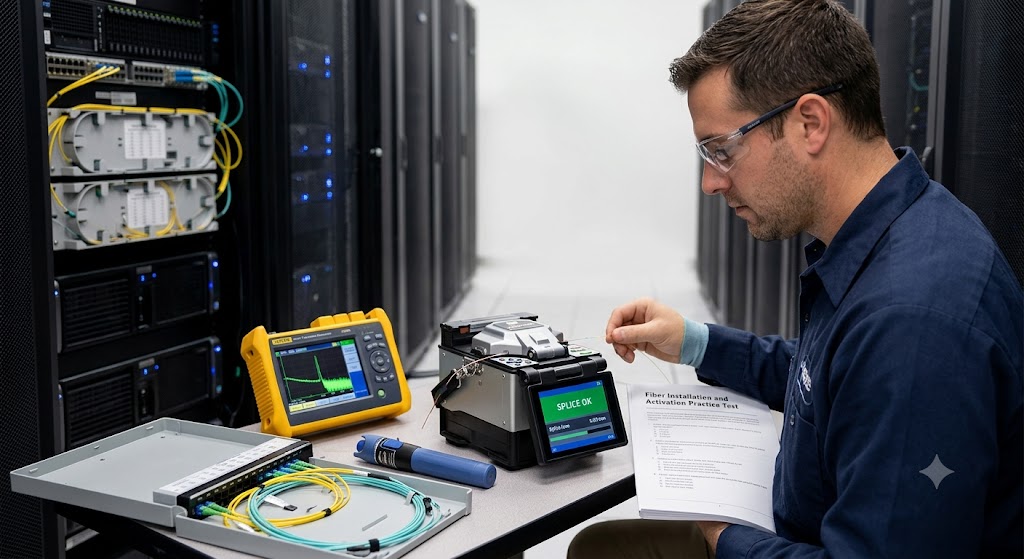
Additional Information
What the Course Entails and Exam Details
The core syllabus of this course dives deep into both the theoretical foundations and the practical applications of fiber optics.
You will master essential topics such as fiber optic theory, light transmission principles, and strict industry safety protocols.
The coursework extensively covers cable preparation, mechanical and fusion splicing techniques, and the delicate process of connectorization.
Furthermore, you will learn the exact procedures for activating Fiber to the Home (FTTH) networks and using optical time-domain reflectometers (OTDR) to test for signal loss.
By the end of your studies, you will possess a comprehensive understanding of how to troubleshoot physical network layers and ensure optimal data flow.
What to Expect in the Final Exam
The final certification exam is a rigorous evaluation designed to test both your conceptual knowledge and your hands-on problem-solving abilities.
You can expect a hybrid format consisting of 50 to 75 multiple-choice questions, alongside a practical skills assessment where you must successfully splice and test a fiber cable.
Candidates are generally given a strict time limit of 90 to 120 minutes to complete the written portion of the exam.
To achieve certification, you must secure a passing score of at least 70% to 75%, depending on the specific testing authority.
Please note that the exam is conducted in a closed-book, highly proctored environment to ensure absolute fairness and industry compliance.
How to Study and Exam Centers
Success in this exam requires a balanced blend of theoretical review and consistent hands-on repetition.
We highly recommend utilizing practice exams to identify your weak points in fiber optic theory and network troubleshooting.
Whenever possible, spend time in a physical lab environment to build muscle memory for stripping, cleaning, and splicing delicate glass fibers.
When you are ready to certify, you can easily schedule your written exam through authorized online testing portals like Pearson VUE, which offer convenient remote proctoring.
For the practical assessment, you will need to visit accredited technical colleges, specialized telecommunications training schools, or regional testing facilities that are equipped with the necessary fiber hardware.
Job Opportunities from the Course
Earning this certification immediately unlocks a highly lucrative and in-demand sector of the telecommunications industry.
Here are the exciting career paths and job titles you can confidently pursue after passing your exam:
Fiber Optic Technician: You will be responsible for installing, repairing, and maintaining complex fiber optic cables in various environments.
Broadband Installer: You will connect residential and commercial buildings to high-speed internet grids and activate their services.
Outside Plant (OSP) Technician: You will work on the exterior physical infrastructure, routing cables underground or across utility poles.
Network Activation Specialist: You will configure optical network terminals and ensure that data is successfully transmitting from the central hub to the end user.
Telecommunications Line Installer: You will lay the groundwork for expanding fiber networks across new cities and rural development areas.
Frequently Asked Questions
Reviews
5.0
Based on 0 reviews
Leave a Review
No reviews yet. Be the first to review!