
Fiber Optic Installer Practice Exam
$69.00
- Buy to unlock unlimited access to all Quiz questions and Answers in this Quiz.
- After purchase you can print a PDF of the whole quiz at any point. The PDF will contain the questions and the correct answers.
About this Exam
The Fiber Optic Installer certification is an essential credential for professionals looking to build a robust career in the rapidly expanding telecommunications and network infrastructure industries.
This certification proves your competence in installing, terminating, and testing fiber optic cabling systems to meet strict industry standards.
It is specifically designed for network technicians, electricians, IT professionals, and anyone transitioning into the specialized field of fiber optics.
By passing the exam, you demonstrate to employers that you possess the hands-on skills and theoretical knowledge required to handle delicate optical materials safely and effectively.
Taking a comprehensive practice exam is the best way to ensure you are fully prepared to secure this highly respected industry credential.
Ready to test your knowledge?
Buy Now to Access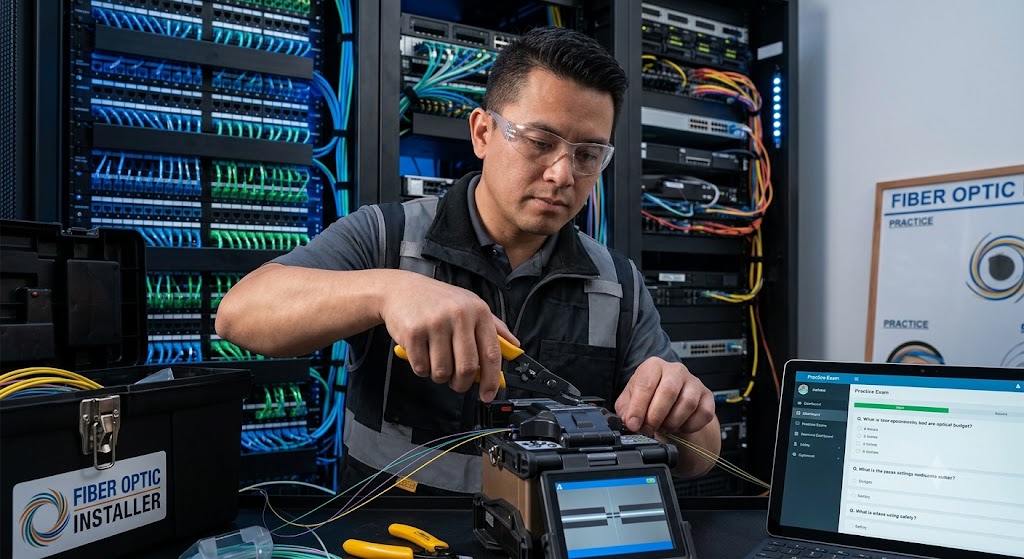
Additional Information
What the Course Entails and Exam Details
A standard Fiber Optic Installer course covers a broad spectrum of critical networking fundamentals and advanced optical concepts.
Students begin by mastering the basic theory of light transmission, learning exactly how data travels through glass and plastic fibers.
The syllabus heavily emphasizes workplace safety protocols, ensuring installers know how to properly handle sharp fiber shards, specialized chemicals, and high-intensity light sources.
You will also learn about different types of fiber optic cables, including single-mode and multimode, as well as the various connectors used in modern networks.
Practical skills covered include mechanical and fusion splicing, cable preparation, and precision cleaving techniques.
Finally, the curriculum delves into vital testing and troubleshooting methodologies using tools like optical loss test sets (OLTS) and optical time-domain reflectometers (OTDR).
What to Expect in the Final Exam
The final certification exam is designed to thoroughly evaluate both your theoretical understanding and your practical problem-solving skills.
Typically, the written or digital portion consists of a multiple-choice format featuring anywhere from 75 to 100 comprehensive questions.
You will be given a strict time limit, usually ranging between 90 minutes to two hours, depending on the specific certifying body you are testing with.
To achieve certification, candidates are generally required to earn a passing score of 70% to 75% or higher.
Many certification bodies also mandate a hands-on practical assessment where you must successfully prep, splice, and test fiber cables in front of a certified proctor.
Calculators are sometimes permitted for working out optical loss budgets, but candidates are typically prohibited from using smartphones or outside reference materials during the assessment.
How to Study and Exam Centers
Success on the Fiber Optic Installer exam requires a balanced blend of academic review and practical muscle memory.
Start by taking multiple practice exams to familiarize yourself with the phrasing of technical questions and to identify areas where your knowledge might be lacking.
Create flashcards for essential terminology, connector types, and industry safety standards to reinforce your memory.
Since fiber optics is highly tactile, you should also spend as much time as possible practicing your stripping, cleaving, and splicing techniques with real equipment.
When you are ready to test, exams are typically administered through authorized network training schools, community colleges, or professional organizations like the ETA (Electronics Technicians Association) or FOA (Fiber Optic Association).
Some certifying bodies also partner with third-party testing facilities like Pearson VUE, which offer highly secure, proctored physical testing centers globally, as well as heavily monitored online testing options for the written portion.
Job Opportunities from the Course
Earning this certification opens the door to a wide variety of lucrative and high-demand career paths across multiple sectors.
You can pursue a role as a Fiber Optic Technician, where you will be directly responsible for splicing and maintaining the critical cables that power internet service providers.
Another popular path is becoming a Network Cabling Specialist, working inside data centers and large corporate offices to install structured cabling systems.
For those who enjoy working outdoors, a career as an Outside Plant (OSP) Technician involves laying heavy-duty fiber infrastructure across cities and rural environments.
You might also find opportunities as a Telecommunications Field Engineer, traveling to different sites to troubleshoot complex optical network failures.
Finally, experienced installers often transition into roles like Quality Assurance Tester or Network Infrastructure Project Manager, overseeing massive telecommunications build-outs for major tech companies.
Frequently Asked Questions
Reviews
5.0
Based on 0 reviews
Leave a Review
No reviews yet. Be the first to review!