
Field Internship Student Data Acquisition Project. (FISDAP) Airway Practice Exam
$69.00
- Buy to unlock unlimited access to all Quiz questions and Answers in this Quiz.
- After purchase you can print a PDF of the whole quiz at any point. The PDF will contain the questions and the correct answers.
About this Exam
The Field Internship Student Data Acquisition Project (FISDAP) Airway Practice Exam is a critical resource for EMS students aiming to demonstrate proficiency in airway management. Designed for future Emergency Medical Technicians (EMTs), Advanced EMTs (AEMTs), and Paramedics, this online assessment is part of the comprehensive FISDAP educational suite, which supports competency tracking and test readiness. By simulating the cognitive challenges of certifying exams like the NREMT, this practice test allows you to identify strengths and weaknesses in vital life-saving techniques, from basic oxygen administration to advanced intubation, before the high-stakes final evaluation.
Ready to test your knowledge?
Buy Now to Access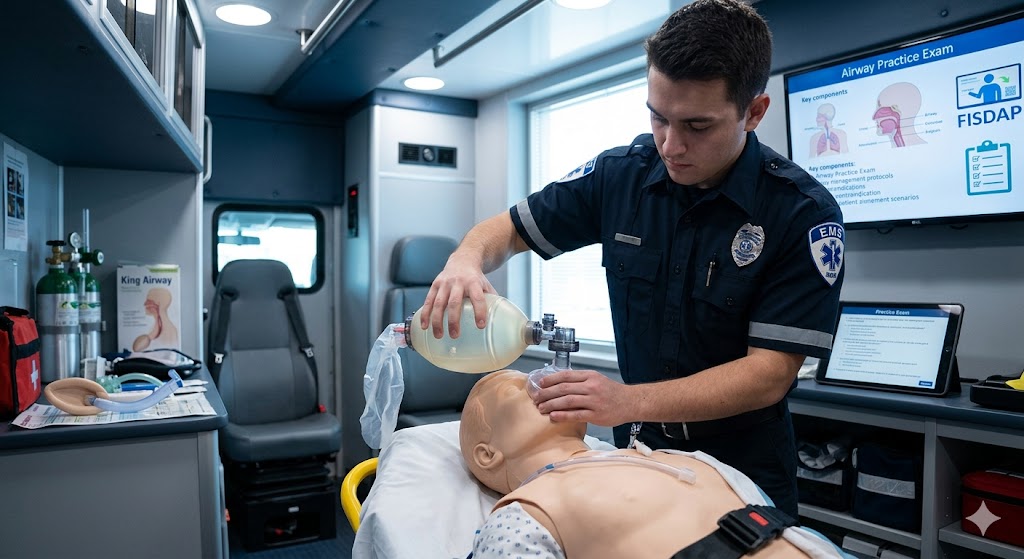
Additional Information
What the Course Entails and Exam Details
The core purpose of the FISDAP system isn't a standalone course, but rather a vital tool for tracking student progress through EMS education programs. The "course entails" fulfilling all required classroom and clinical hours, and mastering the associated skills, such as:
Comprehensive patient assessment
Anatomy and physiology of the human airway and respiratory systems
Oxygen delivery and continuous positive airway pressure (CPAP) application
Basic airway management: suctioning, adjunct insertion (OPA, NPA)
Advanced airway management: supraglottic airways (like the King Airway), endotracheal intubation (for Paramedics)
Ventilation techniques for all ages (from neonate to adult) using a bag-valve mask (BVM)
Identifying and treating respiratory failure and distress
Medications relevant to airway management and rapid sequence intubation (RSI) protocols.
The FISDAP Airway Practice Exam is a specific test within the system designed to assess a student's cognitive readiness for this critical domain. It is an online, multiple-choice assessment that mimics the format and difficulty of official certification exams. A comprehensive practice exam like this typically contains a substantial number of questions—ranging from 75 to 150—simulating the conditions you'll encounter on the actual NREMT or state exam. While your individual institution and instructor set specific rules for how and when you take it, the content is always focused on the mastery of the airway management domain.
What to Expect in the Final Exam
As an online multiple-choice assessment, the FISDAP Airway Practice Exam is typically accessed through the fisdap.net student portal. Here’s a general overview of what you can expect:
Format: You will answer multiple-choice questions delivered sequentially. The exam format is often not linear; you may be able to flag questions and return to them, although this depends on your instructor's specific configuration.
Length: Practice exams of this type usually consist of 75 to 100 questions.
Time Limits: You should expect to be timed. A hundred-question exam generally has a time limit in the range of 120-150 minutes, similar to actual cognitive testing.
Passing Score: A definitive "passing score" for the practice exam is determined by your EMS program. FISDAP itself does not set a national standard for passing its practice tests. The goal isn't just to "pass" but to achieve readiness. Your results will give you a percentage score and detailed feedback by domain, allowing you to focus your subsequent studying on area of need.
Specific Rules: Because it is a practice exam, your instructor will determine if it is proctored, if a calculator is permitted, and if it's considered open- or closed-book. You should follow your program's guidelines implicitly.
How to Study and Exam Centers
Actionable Study Strategies
Success on the FISDAP Airway Practice Exam and your subsequent certification starts with effective study:
Use Your Textbooks: Revisit your core EMS text (e.g., Paramedic Care: Principles & Practice). Dedicate time to thoroughly review the entire 'Airway, Respiration, and Ventilation' section.
Master Anatomy and Physiology: Understand the mechanics of breathing and gas exchange down to the cellular level. Knowing the anatomy of the upper and lower airway is crucial for intervention selection.
Review Protocols and Algorithms: Practice applying current American Heart Association (AHA) and local protocols for difficult airway management, foreign body obstruction, and ventilation.
Hands-on Practice: Utilize simulation lab time to drill airway management skills—from BVM use to advanced intubation. Physical repetition solidifies the cognitive knowledge you need for the multiple-choice exam.
Leverage FISDAP Study Tools: In addition to this specific practice exam, the FISDAP platform offers other study resources. Utilize their "Study Tools," quizzes, and detailed feedback to pinpoint your weak areas in airway management.
Exam Centers
You will not go to a public testing center like Pearson VUE to take the FISDAP Airway Practice Exam. This test is entirely online and must be accessed through your FISDAP student account. It is usually proctored by your EMS program instructors or authorized staff and taken on campus at your educational institution (in a classroom, lab, or computer room). Ensure you coordinate with your program director or instructor for scheduling and specific location instructions.
Job Opportunities from the Course
Achieving certification—which this practice exam helps ensure—unlocks numerous career opportunities for EMS professionals:
Paramedic (Primary)
Advanced Emergency Medical Technician (AEMT)
Flight Paramedic / Critical Care Transport
Community Paramedic / Mobile Integrated Healthcare provider
EMS Educator / Instructor
EMS Clinical Quality Coordinator
Firefighter/Paramedic
Offshore/Industrial Paramedic
Hospital Emergency Department Tech (Paramedic-level depending on location)
Police/EMS Tactical Medic
Remote Medicine / Expeditions Paramedic
Frequently Asked Questions
Reviews
5.0
Based on 0 reviews
Leave a Review
No reviews yet. Be the first to review!