
Field Internship Student Data Acquisition Project (FISDAP) Paramedic Practice Exam
$69.00
- Buy to unlock unlimited access to all Quiz questions and Answers in this Quiz.
- After purchase you can print a PDF of the whole quiz at any point. The PDF will contain the questions and the correct answers.
About this Exam
The Field Internship Student Data Acquisition Project (FISDAP) Paramedic Practice Exam is an invaluable resource for paramedic students nearing the completion of their training. FISDAP is a comprehensive online system widely utilized in Emergency Medical Services (EMS) education to track student goals, skills, and patient contacts.
The FISDAP Paramedic Practice Exam is designed specifically to prepare students for success on the rigorous National Registry of Emergency Medical Technicians (NREMT) Paramedic cognitive examination. This practice test simulates the format, difficulty level, and content areas of the official certification exam, providing students with a realistic assessment of their preparedness. It is ideal for students who want to gauge their knowledge, identify critical areas for improvement, and build the confidence necessary to pass the NREMT on their first attempt.
Ready to test your knowledge?
Buy Now to Access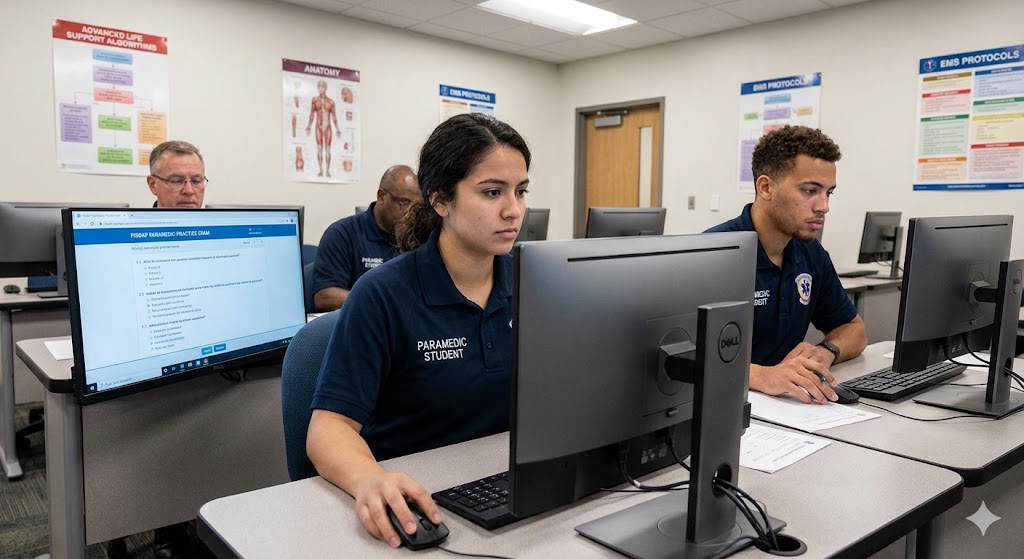
Additional Information
What the Course Entails and Exam Details
This practice exam is not a traditional "course" with lectures, but rather a diagnostic tool integrated into the paramedic program’s final phase. The content of the FISDAP Paramedic Practice Exam covers the full spectrum of paramedic-level knowledge and skills as outlined in the National EMS Education Standards.
Key areas tested typically include:
Airway Management, Resuscitation, and Ventilation: Advanced airway procedures, ventilation techniques, and oxygen therapy.
Cardiology and Resuscitation: Comprehensive knowledge of EKG interpretation, advanced cardiac life support (ACLS) protocols, and management of acute coronary syndromes.
Trauma: Assessment and management of diverse traumatic injuries, including hemorrhage control, spinal immobilization, and chest trauma.
Medical and Emergencies: In-depth understanding of neurological, endocrine, immunological, and gastrointestinal emergencies.
Obstetrics and Gynecology: Management of normal and complicated deliveries, as well as gynecological emergencies.
Pediatrics: Unique considerations for assessment and treatment of pediatric patients across different developmental stages.
EMS Operations: Knowledge of safety procedures, incident management, ambulance operations, and medical-legal issues.
What to Expect in the Final Exam
When taking a FISDAP Paramedic Practice Exam, students should expect a comprehensive, computer-based assessment that closely mirrors the experience of the actual NREMT Paramedic cognitive exam.
The practice exam typically consists of multiple-choice questions, which may include scenario-based questions requiring critical thinking and clinical judgment. While the number of questions can vary slightly depending on the specific FISDAP test version, they generally range from 100 to 150 questions.
Importantly, the FISDAP exam offers detailed feedback reports after completion. Students can analyze their performance by topic area, seeing exactly where they excelled and where they need to focus additional study efforts. The "passing score" or benchmark score is typically determined by individual EMS programs, but a high score on the FISDAP practice exam is a strong indicator of readiness for the national registry.
How to Study and Exam Centers
Preparation for the FISDAP Paramedic Practice Exam should begin early in your paramedic training. Because it is a comprehensive exam, consistent study throughout the program is essential.
Actionable Study Strategies Include:
Review Core Textbooks: Revisit your paramedic textbooks and study materials, paying close attention to the National EMS Education Standards.
Analyze FISDAP Reports: Use the results from previous FISDAP unit quizzes and practice exams to target your weak points. If cardiology is your lowest score, dedicate focused study time to that topic.
Create Flashcards: Make digital or physical flashcards for pharmacology, medical definitions, and protocols.
Participate in Study Groups: Reviewing challenging scenarios and concepts with peers can reinforce your understanding and expose you to different perspectives.
Practice Active Learning: Instead of passive reading, test yourself by explaining concepts out loud or taking additional practice quizzes.
Exam Administration:
FISDAP Paramedic Practice Exams are typically administered through your accredited EMS training institution or college. They are often scheduled as part of the curriculum’s final comprehensive review. The exams are taken online, usually in a proctored environment at the training center, ensuring academic integrity and replicating the controlled environment of the NREMT testing experience. Check with your program director for the specific schedule and administration procedures.
Job Opportunities from the Course
Successfully passing your paramedic program and the associated FISDAP comprehensive exams paves the way for achieving NREMT certification and state licensure, opening the door to a challenging and rewarding career in pre-hospital emergency care.
Potential job opportunities include:
Paramedic (Ground Transport): Working in 911 emergency response systems for private ambulance services or fire departments.
Flight Paramedic: Providing critical care during helicopter or fixed-wing air medical transports.
Critical Care Paramedic: Specializing in the transport and care of high-acuity patients between medical facilities.
Community Paramedic: Working in mobile integrated healthcare programs, providing preventative and primary care in patients' homes.
Tactical Paramedic: Providing medical support to law enforcement special operations teams.
EMS Instructor: Educating the next generation of EMS providers in classroom and clinical settings.
Emergency Room Technician (ER Tech): Utilizing advanced skills within an hospital emergency department setting.
Frequently Asked Questions
Reviews
5.0
Based on 0 reviews
Leave a Review
No reviews yet. Be the first to review!