
Field Internship Student Data Acquisition Project (FISDAP) Trauma Practice Exam
$69.00
- Buy to unlock unlimited access to all Quiz questions and Answers in this Quiz.
- After purchase you can print a PDF of the whole quiz at any point. The PDF will contain the questions and the correct answers.
About this Exam
The Field Internship Student Data Acquisition Project (FISDAP) Trauma Practice Exam is a critical stepping stone and invaluable study tool designed specifically for Emergency Medical Services (EMS) students, including those aiming to become Emergency Medical Technicians (EMTs) and Paramedics.
This practice exam serves as a simulation, meticulously crafted to align with the style, structure, and current standards of major EMS certification boards, most notably the National Registry of Emergency Medical Technicians (NREMT).
It allows you to assess your readiness in the complex and critical domain of trauma care, identifying strengths and areas needing further study in a low-stakes environment.
Ready to test your knowledge?
Buy Now to Access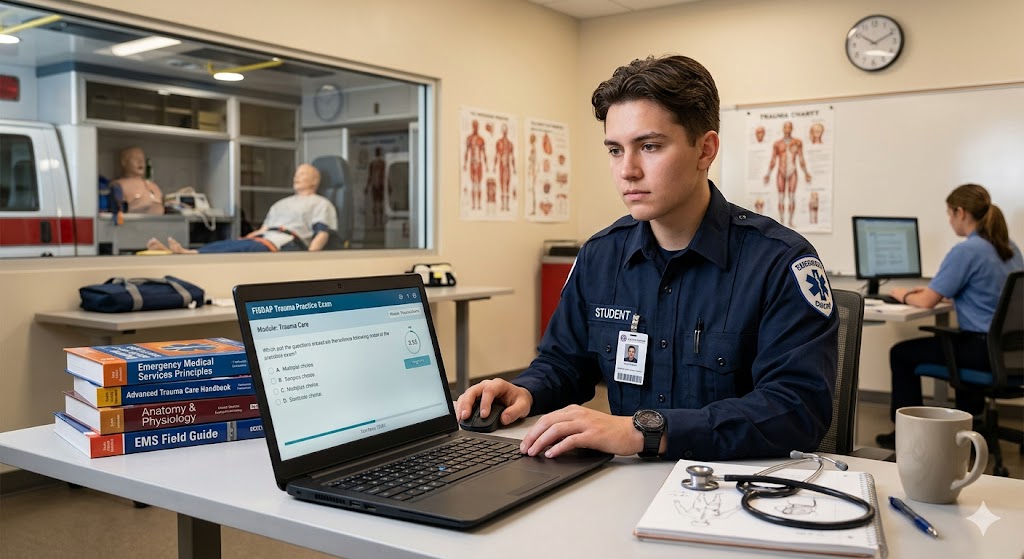
Additional Information
What the Course Entails and Exam Details
While the FISDAP Trauma Practice Exam itself is a practice test, the broader coursework and curriculum it assesses cover extensive topics crucial for a successful EMS professional.
You can expect questions spanning:
Comprehensive patient assessment strategies in trauma scenarios, from scene size-up to detailed physical examination.
Understanding and application of appropriate interventions for various types of trauma, including orthopedic injuries, soft tissue damage, burns, and multisystem trauma.
Critical life-saving techniques, such as proper bleeding control, airway management in trauma, and shock resuscitation.
Interpretation of mechanism of injury (MOI) and its implications for patient care.
Integration of current evidence-based practices and medical guidelines relevant to field trauma care.
The practice exam typically employs a multiple-choice format, often computerized and sometimes offering computerized adaptive testing features, which may slightly alter the difficulty as you progress, mirroring some official exams.
Detailed rationales are typically provided for both correct and incorrect answers immediately upon completion, serving as a powerful educational resource to solidify your understanding of essential concepts.
What to Expect in the Final Exam
It is essential to understand that this FISDAP tool is a practice exam; the final exam you are preparing for is your state or the National Registry (NREMT) certification.
The actual, high-stakes final certification exam has several notable differences to keep in mind:
Format: The actual NREMT exam, for instance, is a Computerized Adaptive Test (CAT). The difficulty of questions adjusts based on your performance, aiming to pinpoint your level of competence precisely.
Secure Environment: The final exam is taken at a secure, authorized testing center (e.g., Pearson VUE). Strict identity verification, security protocols, and proctoring are standard. You will not have access to study materials or feedback during the test.
Time Limits: A clear time limit will be enforced for the entire final exam or specific sections.
Passing Score: The exam is not scored as a simple percentage; instead, it uses a scaled scoring system to determine whether you meet the required standard of care. There are fixed passing standard benchmarks.
Question Style: While multiple-choice, final exam questions may be more scenario-based and require complex critical thinking and application of multiple concepts simultaneously. Unscored questions may also be included for testing purposes.
How to Study and Exam Centers
Preparation for both the practice and the final exams should be strategic and comprehensive.
Actionable study methods include:
Utilize Practice Questions Regularly: Dedicate time each day to answer a variety of practice questions, especially those within the FISDAP platform. Don’t just check the correct answer; read the provided detailed rationales for every option to deepen your understanding.
Refer to Primary Textbooks: Use practice results to pinpoint weak areas and then go back to your EMS textbooks (such as the current version of the American Academy of Orthopaedic Surgeons' (AAOS) EMT or Paramedic text) for focused review.
Understand the "Why": Focus on the underlying principles of anatomy, physiology, and pathology. Knowing why an intervention is correct is much more valuable than simply memorizing the "what".
Simulate Real Conditions: Occasionally take practice tests under simulated final exam conditions: in a quiet room, with a strict timer, and without any study aids. This builds mental stamina and time management skills.
Seek Guidance: If you consistently struggle with specific topics, consult your course instructors or preceptors for clarification.
Practice Exam Access: The FISDAP practice exams are usually accessed through an online portal. Your educational program will provide you with login credentials as part of your training.
Final Exam Location: To take the actual NREMT or state certification exam, you will generally have to schedule it after completing your program and registering online. The exams are typically administered through a network of authorized testing centers, often facilitated by Pearson VUE. You can select a time and location convenient for you after you receive your Authorization To Test (ATT). Be prepared to follow all center rules and security procedures.
Job Opportunities from the Course
Successfully navigating your coursework, using the FISDAP Trauma Practice Exam, and ultimately passing your final certification exam opens the door to numerous rewarding career paths in Emergency Medical Services.
Here is a list of job titles you may unlock:
Certified Emergency Medical Technician (EMT)
Licensed Paramedic
Firefighter/EMT or Firefighter/Paramedic
Emergency Department or Hospital Technician
Flight Paramedic / Flight Medic
Critical Care Transport Paramedic
Tactical Paramedic / Tactical Medic
Industrial or Corporate Medic
Event Medicine Technician
EMS Instructor or Educator (with further training and experience)
Dispatcher with specialized EMS knowledge (sometimes required)
Field Preceptor or Internship Coordinator (with experience)
Frequently Asked Questions
Reviews
5.0
Based on 0 reviews
Leave a Review
No reviews yet. Be the first to review!