
Field Medical Training Battalion (FMTB) Block 1 Practice Test
$69.00
- Buy to unlock unlimited access to all Quiz questions and Answers in this Quiz.
- After purchase you can print a PDF of the whole quiz at any point. The PDF will contain the questions and the correct answers.
About this Exam
The Field Medical Training Battalion (FMTB) Block 1 exam is a critical milestone for Navy Hospital Corpsmen who are preparing to serve alongside the United States Marine Corps.
This rigorous foundational module is specifically designed for enlisted medical personnel transitioning into the Fleet Marine Force (FMF).
It bridges the gap between traditional hospital-based medical care and the highly demanding, high-stakes environment of combat medicine.
By taking this practice exam, students can assess their readiness, reinforce their knowledge of Marine Corps operations, and build the confidence needed to pass the official certification.
Whether you are a newly graduated Corpsman or a seasoned sailor heading to a green-side command, this preparation is essential for your success and the safety of the Marines you will treat.
Ready to test your knowledge?
Buy Now to Access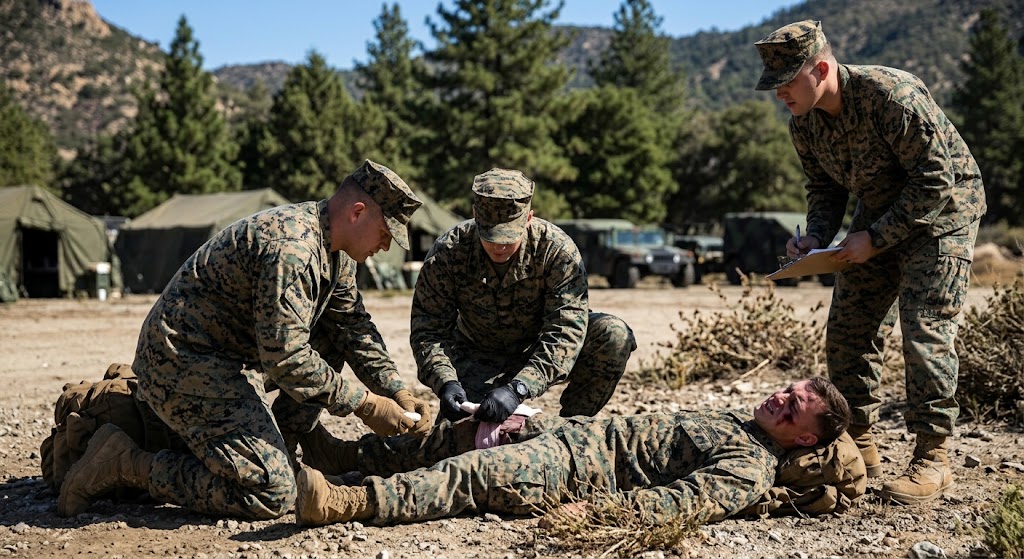
Additional Information
What the Course Entails and Exam Details
Block 1 of the FMTB curriculum heavily focuses on the absolute fundamentals of operating within a Marine Corps unit.
It introduces sailors to the rich history, traditions, and core values of the Marine Corps, ensuring they can seamlessly integrate into their new commands.
Students must master Marine Corps rank structures, uniform regulations, and basic military courtesies.
Additionally, the course covers vital administrative and operational knowledge, including the Code of Conduct, the history of the Hospital Corps, and fundamental land navigation principles.
While advanced trauma care is covered in later blocks, Block 1 lays the administrative and cultural groundwork that every Field Medical Service Technician must know by heart.
What to Expect in the Final Exam
The official FMTB Block 1 final exam is an intensive, multiple-choice written test designed to evaluate your rote memorization and practical understanding of the course material.
You can expect strict military testing protocols, meaning the exam will be timed and administered in a highly monitored classroom environment.
Students are typically given a set amount of time, often around 60 to 90 minutes, to complete the examination.
The passing score requirement is strict, generally set at 80%, reflecting the zero-margin-for-error nature of military medical operations.
Failure to meet the passing standard usually results in mandatory remediation and a re-test, making it absolutely vital to get it right the first time.
How to Study and Exam Centers
Success in the Block 1 exam requires disciplined, daily study habits rather than last-minute cramming.
Since the material is heavily based on history, ranks, and regulations, using flashcards and spaced repetition software is one of the most effective ways to lock in the information.
Forming study groups with your fellow Corpsmen can also help you test each other on Marine Corps knowledge and stay accountable during your liberty hours.
The official exam is not taken at civilian testing centers like Pearson VUE; rather, it is administered strictly on-base at the designated Field Medical Training Battalion schools.
You will take the test either at FMTB-East, located at Camp Johnson (Camp Lejeune) in North Carolina, or at FMTB-West, located at Camp Pendleton in California.
Job Opportunities from the Course
Passing Block 1 is the first step toward earning your Navy Enlisted Classification (NEC) L03A (formerly 8404) as a Field Medical Service Technician.
Successfully completing the entire FMTB pipeline unlocks highly respected and physically demanding career paths within the military.
Fleet Marine Force (FMF) Corpsman: Serving directly alongside Marine infantry squads, providing life-saving Tactical Combat Casualty Care (TCCC) on the front lines.
Line Corpsman: Attached to specific combat arms units, such as artillery or combat engineer battalions, managing the daily health and combat readiness of the troops.
Battalion Aid Station (BAS) Technician: Working in a forward-deployed medical tent or clinic, triaging casualties, and assisting Medical Officers with advanced care.
Marine Expeditionary Unit (MEU) Medical Staff: Deploying on naval vessels with a rapid-response Marine task force, providing medical support for global operations and humanitarian missions.
Reconnaissance Medical Enlisted (After further training): Providing specialized medical support to elite Marine Recon units during covert or specialized missions.
Frequently Asked Questions
Reviews
5.0
Based on 0 reviews
Leave a Review
No reviews yet. Be the first to review!