
Field Medical Training Battalion – West (FMTB-W) Block 3 Practice Test
$69.00
- Buy to unlock unlimited access to all Quiz questions and Answers in this Quiz.
- After purchase you can print a PDF of the whole quiz at any point. The PDF will contain the questions and the correct answers.
About this Exam
The Field Medical Training Battalion – West (FMTB-W) Block 3 is a demanding and crucial phase for Navy Hospital Corpsmen (HMs) preparing for service within the Fleet Marine Force (FMF). Often referred to as "Green Side" training, this curriculum equips medical personnel with the advanced field medical skills necessary to operate alongside Marine Corps units in dynamic and high-stress environments. Block 3 specifically hones tactical proficiency, moving beyond initial clinical knowledge to operational readiness in combat and austere settings.
This course is designed for Navy Hospital Corpsmen who have orders to a Marine Corps unit. Successful completion of FMTB-W is a prerequisite for earning the Navy Enlisted Classification (NEC) L11A (previously 8404), officially designating the Sailor as a Fleet Marine Force Reconnaissance Corpsman. This training ensures that when Marines need medical aid the most, their Corpsman is ready to perform critical life-saving interventions under any condition.
Ready to test your knowledge?
Buy Now to Access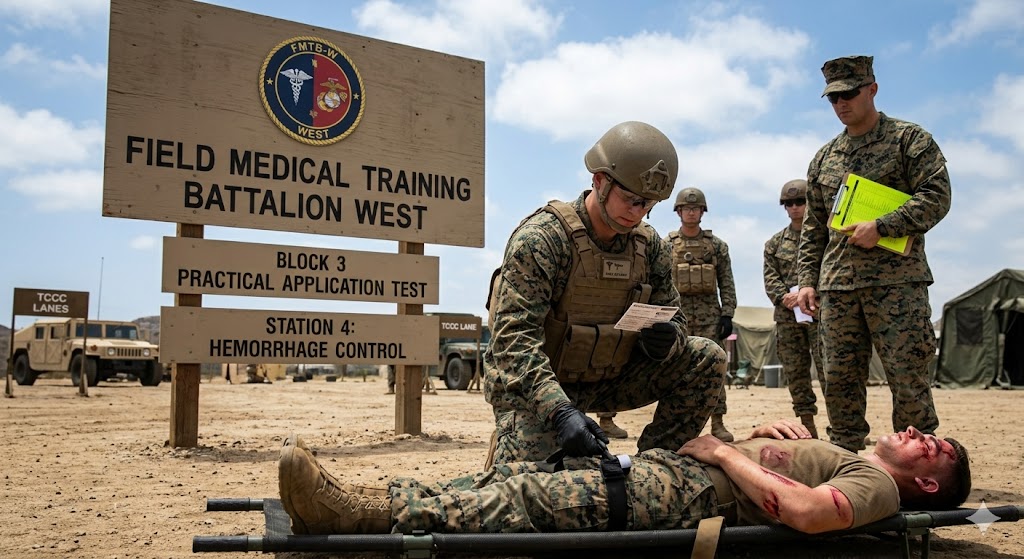
Additional Information
What the Course Entails and Exam Details
Block 3 focuses heavily on Tactical Combat Casualty Care (TCCC) guidelines and their application. While previous blocks build foundational knowledge, Block 3 tests the ability to integrate medical skills with tactical movement and decision-making.
The core syllabus and skills covered include:
Tactical Combat Casualty Care (TCCC): Mastery of Care Under Fire (CUF), Tactical Field Care (TFC), and Tactical Evacuation Care (TACEVAC) protocols.
Hemorrhage Control: Advanced application of tourniquets (junctional and extremity), wound packing, and hemostatic agents under stress.
Airway Management: Performance of surgical cricothyroidotomy and advanced airway adjuncts in the field.
Respiration and Shock Management: Diagnosis and treatment of tension pneumothorax (including needle decompression) and initiation of field IV/IO access for fluid resuscitation.
Hypothermia Prevention: Aggressive management of environmental threats to trauma casualties.
Mass Casualty (MASCAL) Management: Triage protocols and organization of care for multiple casualties in an operational environment.
Field Expedient Medicine: Utilizing limited resources and improvising medical equipment when standard supplies are unavailable.
Medical Documentation: Accurate and rapid completion of TCCC Casualty Card (DD Form 1380).
What to Expect in the Final Exam
The culmination of Block 3 is a comprehensive evaluation designed to ensure students can perform critical skills while under physical and mental stress, simulating a combat environment. This is not just a test of knowledge; it is a test of performance.
Written Examination: Students must first pass a multiple-choice written exam. This exam validates theoretical knowledge of TCCC guidelines, medical protocols, MASCAL organization, and operational terms. The passing score is typically 80% or higher, reflecting the high standard of knowledge required for field medicine.
Practical Application Test (The Performance Exam): The most demanding component is the hands-on practical assessment. Students are run through "TCCC Lanes"—simulated combat scenarios where they must treat a casualty (often a high-fidelity mannequin or an actor in moulage) while navigating tactical obstacles, reacting to simulated enemy fire, and communicating with their unit.
Evaluators score students based on strict adherence to TCCC algorithms and critical performance standards. There are "critical fail" points; for example, failing to properly apply a tourniquet to a life-threatening bleed within the allotted time will result in an automatic failure of the station, regardless of other actions taken. Speed, precision, and maintaining tactical situational awareness are paramount.
How to Study and Exam Centers
Preparation for the FMTB-W Block 3 exam requires a blend of intense academic study and relentless practical repetition. The margin for error in field medicine is near zero, and the training reflects that reality.
Study Strategies:
Master the Student Guide: The FMTB-W Block 3 Student Guide is your primary resource. Know every algorithm, protocol, and step.
Repetition of Practical Skills: You cannot study TCCC solely from a book. Practice applying tourniquets, packing wounds, and performing needle decompression until the actions are intuitive muscle memory. Practice under stress, in the dark, and while wearing full gear.
Utilize Practice Tests: Use Block 3 practice tests to validate your theoretical knowledge. Identify weak areas in the guidelines and revisit those sections in your Student Guide.
Practice Scenarios with Peers: Run through full TCCC scenarios with other students. Take turns being the responder and the observer, using current checklists to evaluate performance critically.
Review Current TCCC Guidelines: While the curriculum is based on TCCC, ensure you understand the "why" behind current protocols by reviewing resources from the Joint Trauma System (JTS).
Exam Centers: The FMTB-W Block 3 exam is administered exclusively on-site at the Field Medical Training Battalion – West location on Marine Corps Base Camp Pendleton, California. This exam is a mandatory, integrated part of the formal FMTB-W course and is not taken at civilian testing centers or via online portals. Students are scheduled for their exams as they progress through the course curriculum.
Job Opportunities from the Course
Successful completion of FMTB-W Block 3 and graduation from the course is the defining requirement for a Hospital Corpsman to be designated as a Fleet Marine Force Corpsman. This qualification is highly respected within both the Navy and the Marine Corps and is the gateway to a challenging and rewarding "Green Side" career pipeline.
This qualification unlocks specific job opportunities and assignments, including:
Fleet Marine Force (FMF) Corpsman (NEC L11A): The primary role, serving as the platoon or company medic for Marine Corps infantry, artillery, combat engineer, and logistics units.
Operational Medical Provider: Assigned to various Marine Corps operational commands and elements worldwide.
Field Medical Service Technician: A broader role encompassing medical readiness and support within Marine Corps environments.
Special Operations Combat Medic (SOCM) Pipeline Eligibility: Completing FMTB-W is a necessary step for those seeking to screen for and attend specialized training, such as the Special Operations Combat Medic course, which supports Navy SEALs, SWCC, Marine Raiders (MARSOC), and Reconnaissance Marines.
Deployment Medical Specialist: Serving as the lead medical asset for smaller, independent Marine Corps detachments during forward deployments.
Frequently Asked Questions
Reviews
5.0
Based on 0 reviews
Leave a Review
No reviews yet. Be the first to review!