
Field Sanitation Certification Practice Test
$69.00
- Buy to unlock unlimited access to all Quiz questions and Answers in this Quiz.
- After purchase you can print a PDF of the whole quiz at any point. The PDF will contain the questions and the correct answers.
About this Exam
The Field Sanitation Certification is a highly specialized credential designed to equip individuals with the vital knowledge needed to prevent disease and environmental health hazards in deployed or remote settings.
This certification is essential for military personnel, particularly those serving on Field Sanitation Teams, as well as public health workers, humanitarian aid responders, and agricultural safety officers.
It ensures that individuals are fully prepared to protect their units and communities from waterborne, foodborne, and vector-borne illnesses.
Taking a practice exam is the most effective way to gauge your readiness, build confidence, and identify areas where your preventative medicine knowledge needs strengthening before the official test.
Ready to test your knowledge?
Buy Now to Access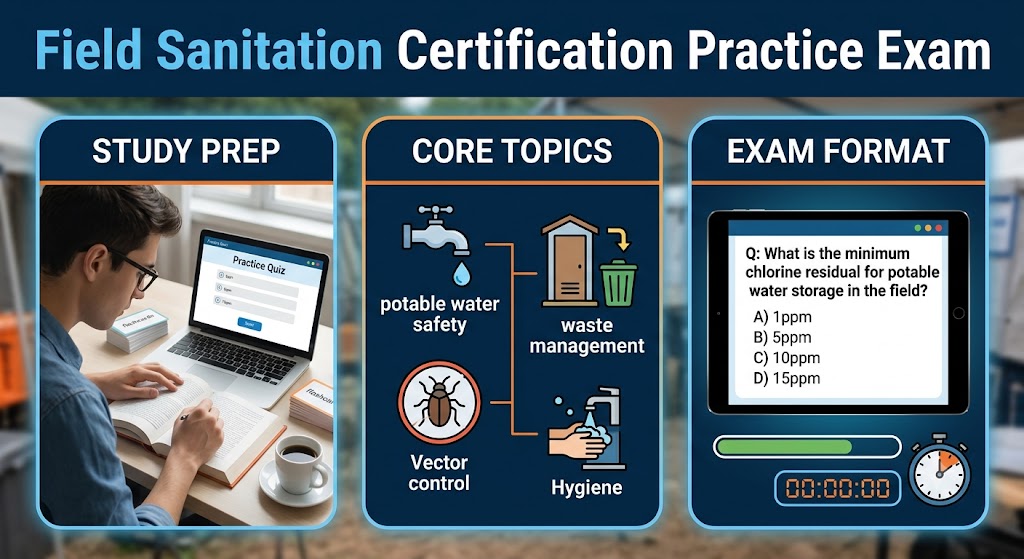
Additional Information
What the Course Entails and Exam Details
The course syllabus is comprehensive, focusing heavily on applied preventive medicine and environmental health strategies.
You will dive deep into the principles of water purification, including how to test for chlorine residuals and identify safe potable water sources.
Food service sanitation is another major pillar, teaching you the precise temperatures and hygiene standards required to prevent foodborne illness outbreaks in field kitchens.
Additionally, the curriculum covers proper waste disposal methods, such as constructing field latrines and managing hazardous materials.
You will also learn crucial vector control techniques to manage pests like mosquitoes and rodents, alongside strategies for preventing heat and cold injuries in extreme environments.
What to Expect in the Final Exam
The final certification exam is a rigorous test of both your theoretical knowledge and your ability to apply it in real-world scenarios.
You can expect a multiple-choice format consisting of 50 to 100 questions, depending on the specific certifying body or military branch.
To pass, candidates generally need to achieve a minimum score of 70% to 75%.
The exam is strictly timed, usually allowing between 60 and 120 minutes, which means you must be able to recall information quickly and accurately.
Some variations of the exam may also include practical application questions or simulations where you must correctly identify the right steps to treat a contaminated water supply or secure a field waste site.
How to Study and Exam Centers
Success on this exam requires a strategic mix of reading, memorization, and practical application.
Start by thoroughly reviewing the core manuals, such as the military’s Training Circular (TC) 4-02.3 or relevant civilian public health guidelines.
Create flashcards for specific metrics, such as the exact distance requirements between latrines and water sources or the parts-per-million required for water chlorination.
Take full-length, timed practice tests to simulate the pressure of the real exam and build your endurance.
When you are ready to test, the exam is typically administered either through authorized online learning portals like the Army Learning Management System (ALMS) or at physical testing facilities.
Civilian counterparts may take the exam at designated Pearson VUE centers or authorized public health educational institutions.
Job Opportunities from the Course
Earning this certification opens the door to a variety of impactful roles in both the military and civilian sectors.
You can pursue a career as an Environmental Health and Safety (EHS) Officer, where you will oversee workplace and environmental safety protocols for large organizations.
It also perfectly positions you for a role as a Preventive Medicine Specialist, directly working to mitigate disease outbreaks in communities or deployed units.
Other opportunities include working as a Public Health Inspector, ensuring local businesses and temporary camps comply with strict sanitation regulations.
Finally, you can step into the role of a Disaster Relief Field Coordinator, managing health and sanitation logistics for NGOs responding to natural disasters across the globe.
Frequently Asked Questions
Reviews
5.0
Based on 0 reviews
Leave a Review
No reviews yet. Be the first to review!