
Field Sanitation Team Training Practice Test
$69.00
- Buy to unlock unlimited access to all Quiz questions and Answers in this Quiz.
- After purchase you can print a PDF of the whole quiz at any point. The PDF will contain the questions and the correct answers.
About this Exam
The Field Sanitation Team training certification is a crucial credential primarily designed for military personnel and specialized civilian contractors.
It equips individuals with the life-saving knowledge required to protect unit health and prevent disease and non-battle injuries in deployed environments.
This certification is designed for service members selected to serve on their unit's field sanitation team, as well as outdoor expedition leaders and disaster relief workers.
By taking this practice test, you are taking a proactive step to ensure you can confidently safeguard the health and readiness of your team in austere conditions.
Ready to test your knowledge?
Buy Now to Access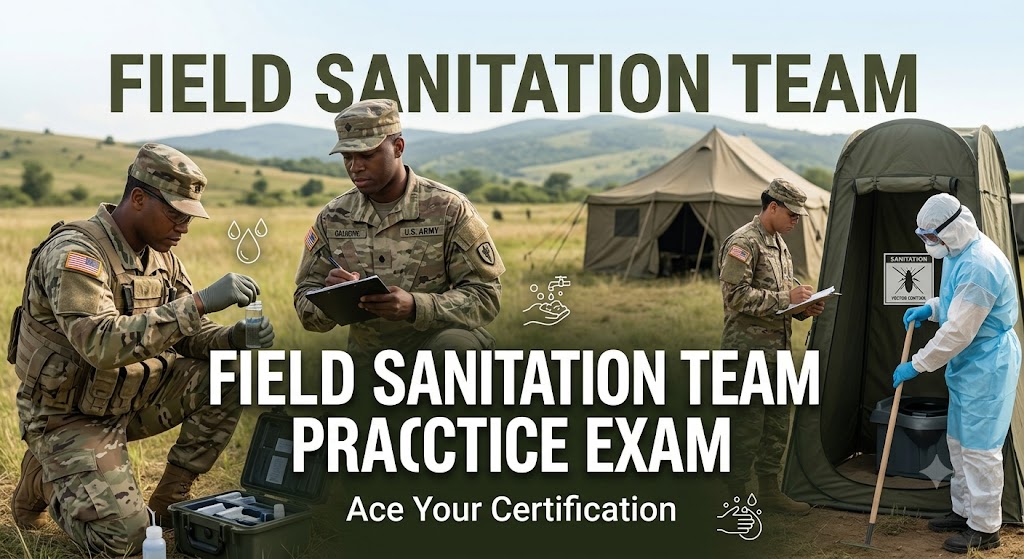
Additional Information
What the Course Entails and Exam Details
The training syllabus covers a robust set of environmental health and preventive medicine core competencies.
You will learn the fundamental techniques for purifying and monitoring field water supplies to ensure they are safe for consumption.
The course heavily focuses on the proper construction, maintenance, and closure of field waste disposal facilities.
Additionally, you will master the principles of vector control, specifically learning how to manage insects, rodents, and other pests that transmit diseases.
Other essential topics include preventing heat and cold weather injuries, managing toxic industrial materials, and enforcing personal hygiene standards in the field.
What to Expect in the Final Exam
The final certification exam typically consists of a combination of written multiple-choice questions and a hands-on practical evaluation.
You can expect to face between 50 to 100 multiple-choice questions testing your knowledge of specific regulations, temperature thresholds, and chemical dilution ratios.
A standard passing score is usually set at 70 percent or higher, though some specific military branches may require an 80 percent minimum.
Time limits generally hover around two hours for the written portion, ensuring you can recall critical information under a moderate time constraint.
During the practical portion, you must physically demonstrate skills such as testing water with a chlorination kit or properly identifying specific pest habitats without breaking safety protocols.
How to Study and Exam Centers
Success on this exam requires a blend of textbook review and practical repetition.
Start by thoroughly reading the official field manuals and technical manuals, such as TC 4-02.3 or your specific organization's preventive medicine guidelines.
Use flashcards to memorize exact measurements, chemical ratios for water purification, and required distances between latrines and water sources.
Taking multiple practice exams is highly recommended to familiarize yourself with the question formats and identify your weak areas before the actual test.
Exams are traditionally administered in-person at designated military installations, unit training rooms, or authorized medical training facilities.
For non-military personnel or civilian contractors, testing may be facilitated through approved online portals equipped with secure proctoring software.
Job Opportunities from the Course
Earning this credential significantly enhances your resume and opens doors to various health, safety, and operational roles.
Below are the primary career paths and job titles this certification can help you unlock:
Unit Field Sanitation Team Member: Serve as the primary health and hygiene advisor to your military commander during field operations and deployments.
Preventive Medicine Specialist: Advance into specialized medical roles focused entirely on environmental health, troop welfare, and disease prevention.
Occupational Health and Safety Technician: Apply your field sanitation skills in the civilian sector by monitoring workplace environments and ensuring OSHA compliance.
Disaster Response Coordinator: Work with NGOs or government agencies to set up safe, sanitary living conditions in the aftermath of natural disasters.
Environmental Health Inspector: Transition into local or state government roles inspecting water systems, waste management, and public sanitation facilities.
Expedition Logistics Manager: Manage health and safety protocols for civilian scientific expeditions, remote mining camps, or extreme outdoor tourism companies.
Frequently Asked Questions
Reviews
5.0
Based on 0 reviews
Leave a Review
No reviews yet. Be the first to review!