
Financial Conduct Authority (FCA) UK Regulation Practice Exam
$69.00
- Buy to unlock unlimited access to all Quiz questions and Answers in this Quiz.
- After purchase you can print a PDF of the whole quiz at any point. The PDF will contain the questions and the correct answers.
About this Exam
The Financial Conduct Authority (FCA) mandates rigorous ethical and operational standards for financial professionals operating within the United Kingdom.
The UK Financial Regulation exam is a foundational benchmark and a mandatory stepping stone for anyone entering the financial services industry.
Designed for aspiring wealth managers, investment advisors, and compliance professionals, this certification ensures you have a firm grasp of the regulatory framework that safeguards the UK economy and its consumers.
By taking a practice exam, candidates can safely gauge their readiness, identify knowledge gaps, and build the confidence needed to pass the official qualification on their first attempt.
Ready to test your knowledge?
Buy Now to Access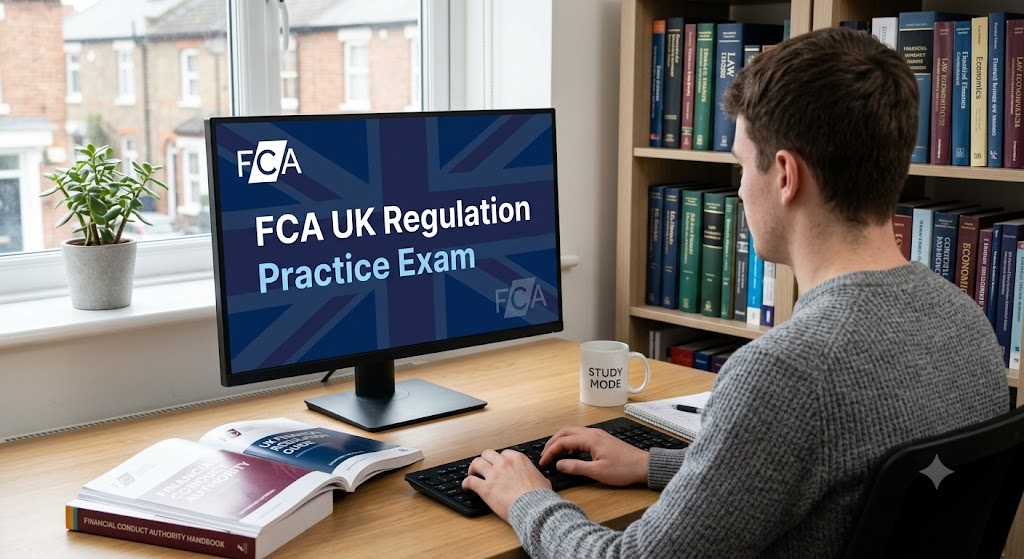
Additional Information
What the Course Entails and Exam Details
The syllabus for the UK Financial Regulation qualification is broad, highly detailed, and deeply focused on consumer protection and market integrity.
A significant portion of the course covers the FCA’s core principles for businesses, the role of the Prudential Regulation Authority (PRA), and the broader macro-economic environment in which these bodies operate.
Candidates will dive deeply into the rules surrounding financial crime, anti-money laundering (AML), bribery, and market abuse regulations.
Furthermore, the curriculum details the life cycle of financial products, the strict guidelines for handling client assets, the processes for resolving client complaints, and the intricacies of the Senior Managers and Certification Regime (SM&CR).
What to Expect in the Final Exam
While the FCA sets the standards, the actual exams are administered by recognized professional bodies such as the Chartered Institute for Securities & Investment (CISI) or the Chartered Insurance Institute (CII).
The official final exam is traditionally a computer-based, multiple-choice assessment consisting of approximately 75 to 100 questions.
Candidates are generally given between 1.5 to 2 hours to complete the test, demanding both accuracy and excellent time management.
To achieve a passing score, you must typically answer at least 70% of the questions correctly.
The exam environment is strictly supervised, with zero-tolerance policies for cheating, meaning candidates cannot bring unauthorized notes, electronic devices, or reference materials into the testing area.
How to Study and Exam Centers
Success in this regulatory exam requires a blend of active recall, consistent reading, and extensive mock testing.
Begin by thoroughly studying the official workbook or manual provided by your chosen examining body, breaking down the heavy legal jargon into easily digestible flashcards.
Taking multiple practice exams under timed conditions is the most actionable strategy to familiarize yourself with the question formats and pinpoint areas requiring further review.
When you are ready to take the final test, you can schedule your session through global testing partners like Pearson VUE or Prometric.
Candidates have the option to sit for the exam at specific, authorized physical testing centers located across the UK and internationally, or they can opt for highly secure, artificially intelligence-monitored online proctoring from the comfort of their own home or office.
Job Opportunities from the Course
Earning a qualification in UK Financial Regulation is a powerful catalyst for your career, unlocking doors to a wide array of highly respected roles within the financial sector.
One of the most direct paths is becoming a Compliance Officer or Compliance Analyst, where you will ensure your firm strictly adheres to FCA guidelines.
It is also a mandatory requirement for those wishing to become certified Wealth Managers, Investment Advisors, or independent Financial Planners.
Additionally, this knowledge is highly sought after for roles such as Risk Analyst, Regulatory Consultant, and Paraplanner.
Ultimately, this certification proves to employers that you possess the critical regulatory knowledge required to handle client wealth responsibly, making you an invaluable asset to banks, investment firms, and insurance companies.
Frequently Asked Questions
Reviews
5.0
Based on 0 reviews
Leave a Review
No reviews yet. Be the first to review!