
Fire Alarm Lesson 5&6 Practice Test
$69.00
- Buy to unlock unlimited access to all Quiz questions and Answers in this Quiz.
- After purchase you can print a PDF of the whole quiz at any point. The PDF will contain the questions and the correct answers.
About this Exam
This article provides a comprehensive overview for students and professionals preparing for assessments related to advanced fire alarm system concepts, specifically those often covered in Lesson 5 and Lesson 6 of industry-standard training or certification pathways.
These lessons typically delve into more complex aspects of fire alarm design, installation, programming, and troubleshooting, representing a crucial step towards achieving higher competency or specific levels of certification. The practice test itself is designed to evaluate your understanding of these deeper, technical components.
It is targeted at aspiring fire alarm technicians, inspectors, designers, and any fire safety professional aiming to advance their knowledge and career. Mastering this material demonstrates a serious commitment to life safety systems.
Ready to test your knowledge?
Buy Now to Access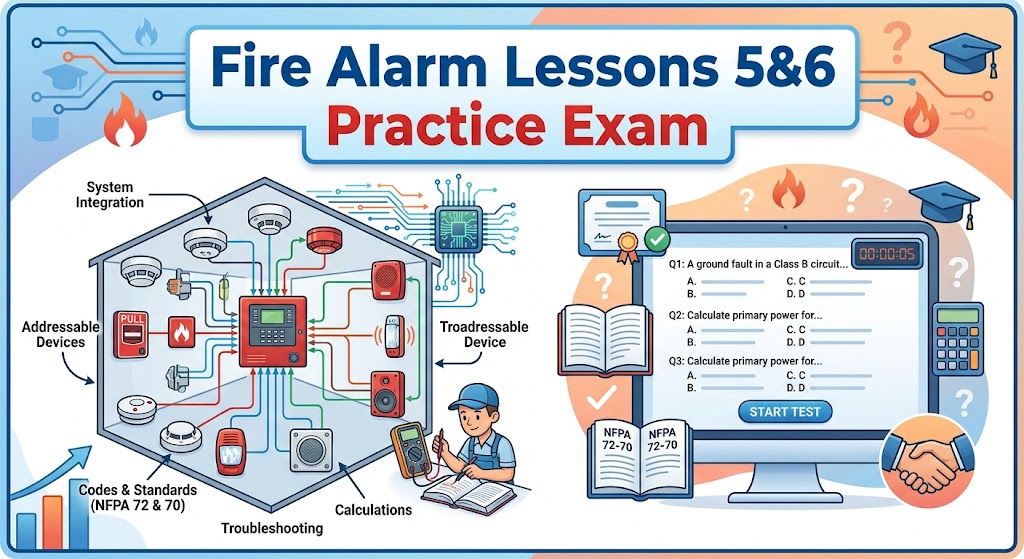
Additional Information
What the Course Entails and Exam Details
The training program leading up to Lessons 5 and 6 equips you with the foundational knowledge of basic electrical theory and essential fire alarm systems.
Building on that foundation, Lessons 5 and 6 commonly address advanced and nuanced subjects, including:
Complex System Troubleshooting: Techniques for isolating and resolving complex wiring faults, ground faults, communication errors, and circuit overloads.
NFPA 72 and Other Codes In-Depth: Specific, non-obvious applications of NFPA 72 (National Fire Alarm and Signaling Code), plus relevant aspects of NFPA 70 (National Electrical Code), IBC (International Building Code), and other standards.
Advanced Detection Methods: Detailed examination of specialized detectors, integration with non-fire systems, and understanding sensitivity settings/adjustments.
Networked Systems & Integration: Principles of addressable systems, peer-to-peer networking, communication protocols, and how fire alarms interconnect with building functions like HVAC, elevator recall, and access control.
Power and Survivability: Advanced calculations for primary and secondary power supplies, and understanding requirements for system survivability under adverse conditions.
Practice Exam Details: The practice test for these specific lessons serves as a check-point before attempting any final module exam or larger certification test. While not a formal certification in itself, typical lesson practice tests may feature:
Format: Multiple-choice questions, which may include case-study style scenarios or technical calculations.
Focus: Highly targeted on the content from Lessons 5 and 6.
Attempt Limits: Often allow multiple attempts to help you solidify your knowledge and identify weak areas.
Difficulty: May be designed to be slightly more challenging than standard module tests to thoroughly prepare you for potential formal assessments.
What to Expect in the Final Exam
While this guide focuses on a practice test for specific lessons, it is important to understand the context. For the overall certification or course, the final exam is a formal, comprehensive assessment that marks your completion and mastery of the entire program, including the advanced topics covered here. You can typically expect:
Exam Format: Most professional fire alarm certifications use a timed, computer-based multiple-choice format.
Question Count: Varies greatly but often ranges from 50 to over 100 questions.
Time Limit: Generally allows for ample time to complete and review, often between 2 to 4 hours.
Passing Score: Typically set around 70-80%, reflecting a need for thorough competence.
Allowed Materials: Final exams are usually "closed book," but sometimes you are allowed a specific code book (e.g., a current NFPA 72) and a basic, non-programmable calculator. Review your specific exam’s policy.
Content Weighted: The final exam will cover material from all lessons, often with a significant weighting towards the advanced concepts and practical applications taught in the latter modules (like 5 & 6). Expect questions on calculations, code interpretation, and practical problem-solving scenarios.
How to Study and Exam Centers
Effectively preparing for both this practice test and any subsequent formal assessments requires a dedicated study strategy:
Thoroughly Review Course Materials: Deeply read and re-read the specific textbooks, manuals, and online modules for Lessons 5 & 6. Pay attention to diagrams, tables, and specific standard numbers and sections.
Master the Code Books: If a code book is permitted in your formal exam (and even if not for general understanding), practice navigating it. Know how to quickly find key chapters and sections related to the topics you've studied.
Utilize Practice Tests: This Lesson 5&6 practice test is a vital tool! Use it to test your knowledge, identify areas for improvement, and get comfortable with the typical question format and phrasing. Review the correct answers and explanations for any questions you get wrong.
Practice Hands-On (If Possible): If you have access to fire alarm equipment, practice wiring, programming addressable devices, and troubleshooting basic faults. Real-world experience reinforces theoretical knowledge.
Form a Study Group: Collaborate with fellow students. Explaining concepts to others and hearing different perspectives can enhance your own understanding.
Focus on Weak Points: Dedicate extra study time to the topics you find most challenging. Don't avoid them.
Identify Exam Centers: For formal, final certification exams, you will need to register and take the test at an authorized testing center. These centers are equipped with standard computer terminals and proctoring protocols. Common examples include:
Pearson VUE Testing Centers: A global network widely used for professional certifications.
Authorized Training Providers: Some fire alarm training academies or community colleges are authorized to proctor final exams for their specific courses.
Online Proctored Exams: An increasingly common option, allowing you to take the exam remotely under strict online proctoring. Be sure to understand the specific technological and procedural requirements. Check the official organization or training body’s website for a list of approved locations and online options.
Job Opportunities from the Course
Successfully completing this overall training and certification pathway (including the advanced knowledge represented by Lessons 5 & 6) can unlock numerous rewarding career opportunities in the fire safety and life safety sectors:
Fire Alarm Technician: Install, maintain, test, and troubleshoot a wide range of fire alarm and signaling systems in residential, commercial, and industrial settings. Higher level understanding opens doors to more complex systems and troubleshooting roles.
Fire Alarm Inspector: Conduct regular, legally-mandated inspections to ensure fire alarm systems are functional and compliant with local, state, and national codes. This role often requires detailed knowledge of various system types and code interpretation.
Fire & Security Systems Installer: Many companies integrate fire alarms with security, access control, and other low-voltage systems. Technicians with comprehensive training are highly valuable in these multi-disciplinary roles.
Project Manager (Fire Systems): With experience and advanced knowledge, you could transition into managing fire alarm system installation or inspection projects, overseeing budgets, schedules, and personnel.
Sales Engineer / Representative (Life Safety Systems): Use your technical expertise to consult with clients, specify appropriate fire alarm solutions, and explain the technical features and benefits of various systems.
Code Compliance Officer / AHJ Liaison: Work for municipalities, building departments, or consulting firms, interpreting codes, reviewing plans, and ensuring fire alarm systems are designed and installed in accordance with all regulations (serving as or interacting with the Authority Having Jurisdiction).
Frequently Asked Questions
Reviews
5.0
Based on 0 reviews
Leave a Review
No reviews yet. Be the first to review!