
Fire Alarms and Sprinklers Practice Test
$69.00
- Buy to unlock unlimited access to all Quiz questions and Answers in this Quiz.
- After purchase you can print a PDF of the whole quiz at any point. The PDF will contain the questions and the correct answers.
About this Exam
The Fire Alarms and Sprinklers certification is a crucial credential for safety professionals, building inspectors, and facility managers.
This exam validates your expertise in designing, installing, inspecting, and maintaining life-saving fire suppression and detection systems.
Obtaining this certification demonstrates your unwavering commitment to public safety and regulatory compliance.
It is the perfect stepping stone for anyone looking to establish themselves as a trusted, highly skilled expert in the fire protection industry.
Ready to test your knowledge?
Buy Now to Access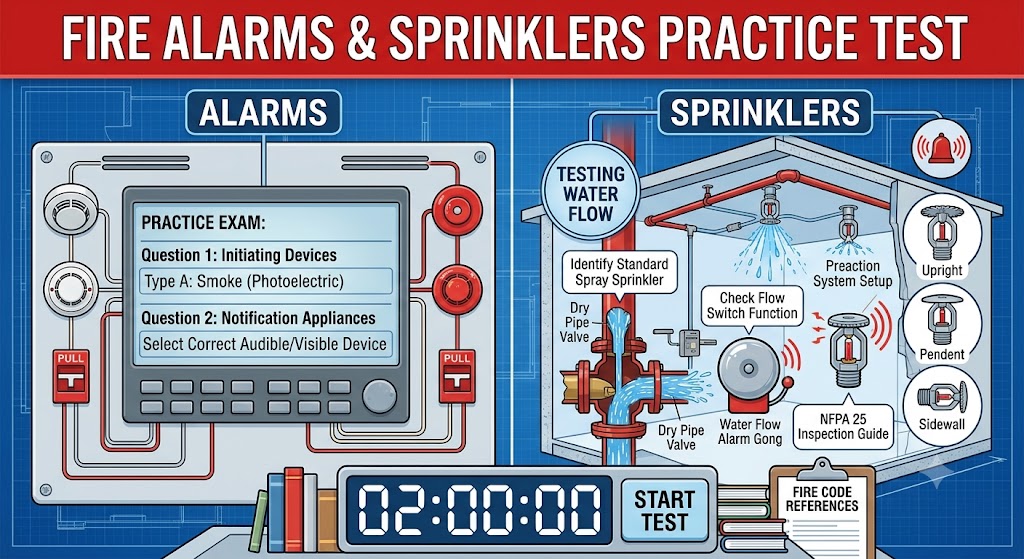
Additional Information
What the Course Entails and Exam Details
This comprehensive program covers the fundamental principles and advanced mechanics of modern fire protection systems.
You will dive deeply into crucial national standards, primarily focusing on the National Fire Alarm and Signaling Code (NFPA 72) and the Standard for the Installation of Sprinkler Systems (NFPA 13).
The syllabus thoroughly explores fire alarm system components, circuit types, initiating devices, and notification appliances.
Furthermore, you will master sprinkler system varieties, hydraulic calculations, water supply requirements, and intricate piping arrangements.
The coursework guarantees you are well-versed in both the electrical wiring and the mechanical plumbing aspects of commercial fire safety.
What to Expect in the Final Exam
The final certification exam is designed to rigorously test both your theoretical knowledge and your practical application skills.
It typically consists of 100 multiple-choice questions that must be completed within a strict two-hour to three-hour time limit.
Some variations of the exam may also include complex, scenario-based questions where you must troubleshoot system faults or accurately interpret architectural blueprints.
Candidates must achieve a minimum passing score of 70% or 75%, depending entirely on the specific certifying body (such as NICET) or your local state fire marshal's regulations.
Remember that these exams are often closed-book or strictly limited-reference, meaning you must have a strong, foundational recall of codes, terminology, and system standards.
How to Study and Exam Centers
Effective preparation requires a highly focused blend of rigorous code memorization and practical, hands-on application.
Start by thoroughly reading the relevant NFPA codebooks and highlighting key installation requirements and testing frequencies.
Taking multiple practice exams is undoubtedly the most effective way to familiarize yourself with the tricky question formats and substantially improve your time management skills.
Consider forming a dedicated study group or joining online trade forums to discuss complex hydraulic calculations, circuit design problems, and code interpretations.
When you feel confident and ready, exams are typically administered through authorized third-party testing providers, such as Pearson VUE or Prometric.
You can easily schedule your test online and choose a physical, proctored testing center near your location, or in some specialized cases, opt for a securely proctored online exam from your home.
Job Opportunities from the Course
Achieving this certification officially opens the door to a wide variety of lucrative, high-demand, and stable career paths in the fire safety sector.
Here are some of the specialized job opportunities and career advancements you can seamlessly pursue:
Fire Alarm Technician
Sprinkler System Installer and Pipefitter
Fire Protection Engineer
Life Safety Systems Inspector
Municipal Building Code Official
Commercial Facilities Maintenance Manager
Independent Fire Safety Consultant
Frequently Asked Questions
Reviews
5.0
Based on 0 reviews
Leave a Review
No reviews yet. Be the first to review!