
Fire and Emergency Services Instructor Practice Exam
$69.00
- Buy to unlock unlimited access to all Quiz questions and Answers in this Quiz.
- After purchase you can print a PDF of the whole quiz at any point. The PDF will contain the questions and the correct answers.
About this Exam
The Fire and Emergency Services Instructor certification is a premier credential designed for dedicated first responders who are ready to step into educational leadership roles.
This exam verifies your ability to effectively train, guide, and assess the next generation of emergency personnel.
It is specifically tailored for firefighters, EMS providers, and rescue workers who want to transition from active fieldwork into instructional, training, and safety-focused positions.
By earning this certification, you prove that you possess both the field experience and the pedagogical skills required to deliver life-saving educational programs.
Whether you are aiming to teach at a local academy or lead department-wide drills, this credential sets the foundation for your career in emergency services education.
Ready to test your knowledge?
Buy Now to Access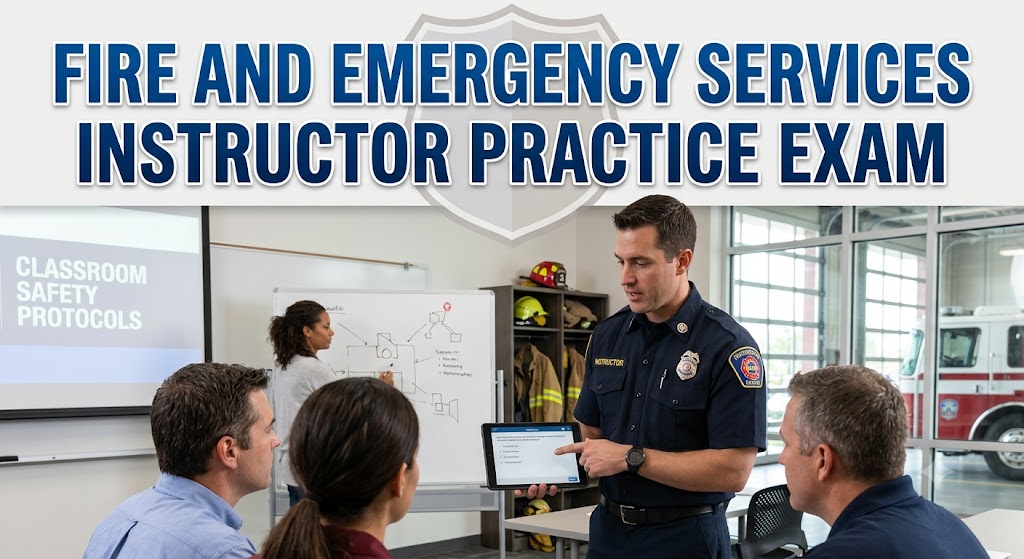
Additional Information
What the Course Entails and Exam Details
The course syllabus is strictly aligned with the National Fire Protection Association (NFPA) 1041 standard, which outlines the professional qualifications for fire service instructors.
Candidates will dive deeply into adult learning principles, discovering how adult students process, retain, and apply high-stakes information.
You will master the art of instructional planning, learning how to adapt existing lesson plans to meet the unique needs of your specific fire department or rescue squad.
The curriculum also covers the effective use of instructional media, from practical training props to digital presentations.
Furthermore, you will be trained in evaluation and testing methodologies to ensure your future students are genuinely absorbing the critical material.
Finally, a heavy emphasis is placed on safety during training evolutions, ensuring you can manage high-risk practical exercises without compromising student well-being.
What to Expect in the Final Exam
The final certification exam typically consists of two distinct phases: a written cognitive test and a practical skills evaluation.
The written exam is a multiple-choice test that evaluates your knowledge of NFPA 1041 standards, classroom management, and learning theories.
You will generally face between 50 and 100 multiple-choice questions, depending on your state or accrediting body.
Most jurisdictions mandate a strict passing score of 70% or 80% to achieve certification.
Time limits are strictly enforced, normally giving candidates about two hours to complete the written portion of the exam.
For the practical evaluation, you will be required to deliver a live teaching presentation, demonstrating your ability to communicate effectively, manage a classroom, and evaluate student performance under the observation of a certified proctor.
How to Study and Exam Centers
Success on this exam requires a balanced blend of academic studying and hands-on teaching practice.
We highly recommend utilizing a high-quality practice exam to familiarize yourself with the multiple-choice format and the specific phrasing of NFPA-based questions.
Create flashcards for core educational terminologies, adult learning theories, and safety protocols to reinforce your memory.
For the practical portion, record yourself delivering a lesson plan and have current instructors critique your body language, clarity, and pacing.
When you are ready to test, exams are typically administered through your state’s fire training academy or local community colleges with accredited fire science programs.
Additionally, many states utilize Pro Board or IFSAC accredited testing centers, and the written cognitive portion may even be available at digital testing hubs like Pearson VUE.
Job Opportunities from the Course
Earning this certification unlocks a wide variety of rewarding and upwardly mobile career paths within the emergency services sector.
Below are the primary job titles you can pursue once certified:
Training Officer: Lead the ongoing education, drills, and recertification processes for an entire fire department or EMS agency.
Fire Academy Instructor: Teach incoming recruits the foundational skills they need to survive and thrive in their new careers.
Health and Safety Officer (HSO): Utilize your knowledge of training safety to oversee department-wide risk management and compliance.
Adjunct Fire Science Professor: Work with community colleges or universities to teach specialized fire science and emergency management degree courses.
Corporate Safety Trainer: Transition into the private sector to train corporate emergency response teams in fire prevention and first aid.
EMS Educator: Guide paramedics and EMTs through rigorous medical training protocols and continuing education credits.
Frequently Asked Questions
Reviews
5.0
Based on 0 reviews
Leave a Review
No reviews yet. Be the first to review!