
Fire Apparatus Driver/Operator Practice Test
$69.00
- Buy to unlock unlimited access to all Quiz questions and Answers in this Quiz.
- After purchase you can print a PDF of the whole quiz at any point. The PDF will contain the questions and the correct answers.
About this Exam
Embarking on a career as a Fire Apparatus Driver/Operator is a crucial step in the fire service. This certification is designed for dedicated individuals who want to safely and skillfully operate one of the department's most essential tools: the fire apparatus. The practice test presented here is your comprehensive study companion, providing a powerful simulation of the core knowledge required for this significant role. It is an ideal resource for both aspiring firefighters preparing for their first driver/operator role and current professionals looking to validate their skills and potentially advance their careers through promotion or lateral movement. Our practice exam is a dynamic tool to test your understanding, identify knowledge gaps, and build the confidence necessary to succeed.
Ready to test your knowledge?
Buy Now to Access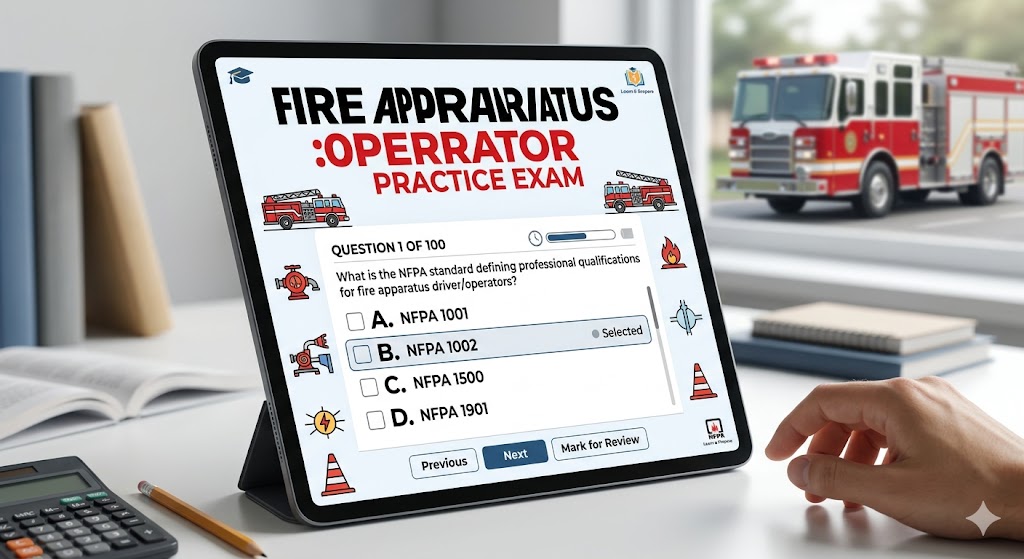
Additional Information
What the Course Entails and Exam Details
A proper course and the corresponding Fire Apparatus Driver/Operator (e.g., Pumper, Aerial, or a generalized level often referenced to NFPA 1002 standards) certification examine a blend of theoretical knowledge and practical driving and operating skills. Coursework typically delves deep into:
Regulations and Standards: Understanding the legal requirements, safety codes (including NFPA), and department policies that govern apparatus operation and emergency response.
Preventative Maintenance: Mastering pre- and post-trip inspections, routine checks, and basic troubleshooting to ensure the vehicle is always in optimal response condition.
Driving Skills and Techniques: Developing expertise in apparatus handling, navigation, dynamic driving under varying road and traffic conditions, backing techniques, and tactical positioning on a fire scene.
Hydraulics and Pumping Operations: For pump-equipped apparatus, understanding fluid dynamics, calculating required pressure and flow, operating fire pumps from various water sources (hydrants, static sources, drafting), and producing effective fire streams.
Aerial Device Operation: For aerial apparatus, mastering the safe and precise operation of ladders, platforms, and related stabilization and safety systems.
Emergency Response & Scene Safety: Understanding emergency lighting and siren use, communication procedures, defensive driving, and tactical apparatus placement.
The exam details, while varying by specific jurisdiction or organizing body, generally encompass both a written, cognitive component and a practical, hands-on skills test. The written portion, which this [Practice Test] aims to prepare you for, typically consists of multiple-choice questions assessing your grasp of all these critical knowledge areas. The practice test serves as a crucial tool for mastering the theoretical material.
What to Expect in the Final Exam
When it comes to the real, official Fire Apparatus Driver/Operator certification exam, you must expect a rigorous two-part assessment designed to ensure you possess the required skills and knowledge for this demanding role:
The Written, Cognitive Exam:
This is a proctored, typically computer-based or paper exam. You will encounter between 70 and 100 or more multiple-choice questions, which evaluate your theoretical understanding of:
Department and safety regulations.
Vehicle mechanics and systems.
Hydraulics calculations and pumping theory.
Aerial device principles and safety procedures.
Scene positioning and safe driving practices.
You can expect to have a specific time limit (often ranging from 1 to 2 hours) to complete this section. The required passing score for this written part generally falls between 70% and 80%, depending on the specific state, agency, or national standard you are testing against. Success on this written component is typically a prerequisite to attempting the practical skills portion.
The Practical Skills Exam:
Upon passing the written test, you will then be required to demonstrate proficiency in a real-world setting. A panel of experienced instructors will evaluate your hands-on abilities, including:
Conducting a complete and accurate pre-trip vehicle inspection.
Safely navigating a prescribed driving course that simulates various road situations, intersection crossings, and tight maneuvering challenges.
Backing the apparatus accurately into a designated space.
(For Pumper) Setting up and executing pump operations from diverse water sources, producing effective and correctly pressurized fire streams.
(For Aerial) Stabilizing and operating an aerial device precisely to a targeted objective, following all safety procedures.
The practical portion is often scored on a pass/fail basis, or requires a very high level of proficiency (e.g., demonstrating all critical safety items perfectly and achieving over 90% in other components). Any significant safety violation or failure to execute a core skill may result in an immediate failure.
How to Study and Exam Centers
Effective preparation is the key to conquering this challenging exam. Here’s a strategic approach:
Actionable Study Strategies:
Master the Curriculum and Texts: Obtain and thoroughly study the specific course materials, textbook (often standard fire service manuals, e.g., IFSTA), and local, state, and national standards (like NFPA 1002).
Identify Your Learning Objectives: Look at the test syllabus and know precisely what skills and knowledge points are expected at each level.
Leverage Online Practice Tests: Actively use online resources like this [Fire Apparatus Operator Practice Exam] to regularly test yourself, simulate the exam experience, and quickly pinpoint areas where you need more study. Look for a large bank of diverse, representative questions.
Create Flashcards & Study Guides: Condense key information, hydraulic formulas, maintenance items, and regulations into memorable formats.
Practice Practical Skills: Whenever possible, safely practice pre-trip inspections, basic driving (in a large, empty area or under supervision), and, if applicable, pumping or aerial operations. Practical time is irreplaceable.
Form Study Groups: Collaborating with colleagues can enhance your understanding and provide different perspectives.
Exam Centers: Where to Take the Real Test
Please understand that the [Practice Test] we provide is a simulated exam taken entirely online. It is an excellent study tool, but it is not the actual official certification exam. To take the real Fire Apparatus Driver/Operator exam, you typically need to connect with:
State Fire Academies or Training Agencies: Each state generally has an authorized body for fire service training and certification. They will have specific procedures, dates, and locations for officially proctored exams, which could be at physical training academies or designated local sites.
College or Technical School Programs: Many educational institutions offer certified fire service training and administer these examinations.
Regional Testing Centers: Specific centers associated with fire service organizations may be authorized to administer official exams, sometimes including specialized national standards like those of Pro Board or IFSAC.
Your Fire Department’s Training Division: In many cases, larger departments are authorized to conduct the training and examine their own members internally. Your department's training coordinator or chief can advise you on the process.
The actual official exam will involve both a strictly proctored written test (potentially in a testing facility with computers or physically at a training site) and a distinct hands-on practical skills test in a suitable practical environment.
Job Opportunities from the Course
A Fire Apparatus Driver/Operator certification, especially with specialized levels like Pumper or Aerial, significantly enhances your career prospects and opens doors within the fire service. Here are specific roles and paths this certification unlocks and advances:
Job Titles and Career Paths:
Fire Apparatus Driver/Operator (Generalist)
Fire Engineer
Chauffeur (Specific title common in some departments)
Pumper Driver/Operator
Aerial Apparatus Driver/Operator
Tender/Tanker Driver/Operator
Squad Driver/Operator
Ladder Driver/Operator
Specialized Unit Operator (e.g., Rescue, Hazmat)
Fire Instructor (Specifically teaching driver/operator courses)
Promotion to Supervisory Roles (Engineer/Operator is often a key stepping stone to higher ranks like Captain or Chief Officer)
Increased Marketability: This certification is widely recognized and frequently required for positions, making you a more competitive candidate for both initial hire and lateral transfers between fire departments.
Opportunities in Airport, Industrial, or Wildland Fire Services: Specialized forms of apparatus operation are required in distinct settings outside of traditional municipal fire departments, with this certification often serving as a strong foundation.
Frequently Asked Questions
Reviews
5.0
Based on 0 reviews
Leave a Review
No reviews yet. Be the first to review!