
Fire Civil Service Practice Exam
$69.00
- Buy to unlock unlimited access to all Quiz questions and Answers in this Quiz.
- After purchase you can print a PDF of the whole quiz at any point. The PDF will contain the questions and the correct answers.
About this Exam
The Fire Civil Service Exam is the critical gateway for individuals aspiring to join a fire department as a professional firefighter. This mandatory standardized test is a fundamental part of the recruitment process used by municipalities and jurisdictions across the United States. Its primary purpose is to identify and select the most qualified candidates based on objective metrics. Rather than testing specific technical knowledge like apparatus operation or chemical properties (which are taught after hiring), this exam evaluates essential cognitive skills, basic knowledge, and inherent abilities required for the demanding nature of fire service. It is designed for entry-level candidates who seek a challenging and rewarding career as a first responder and have the dedication required to protect their community.
Ready to test your knowledge?
Buy Now to Access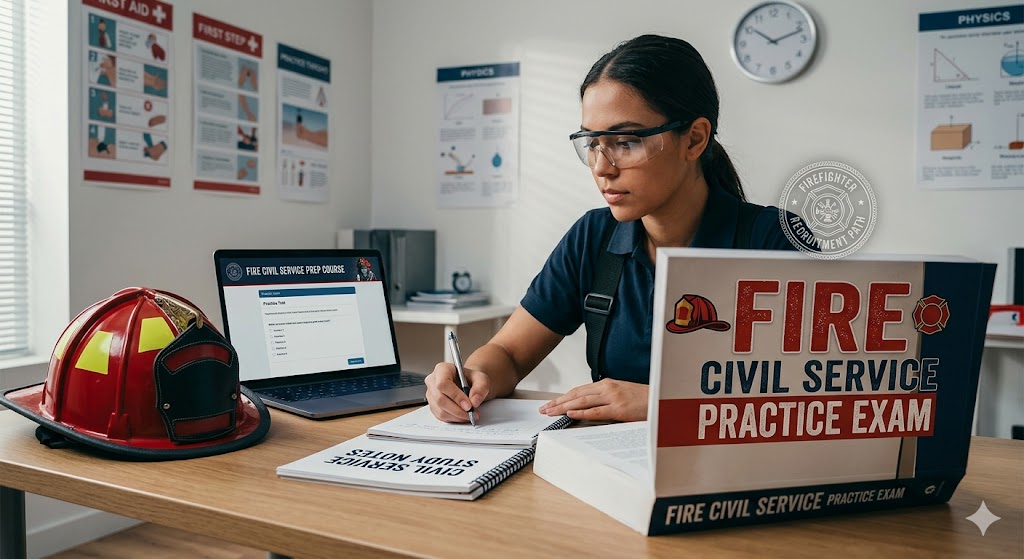
Additional Information
What the Course Entails and Exam Details
While the exact composition of the test can vary by local jurisdiction, a comprehensive prep course and practice exam cover the core universal domains tested. These key academic and skill areas ensure a foundational competency needed for academy training and on-the-job success. Candidates must possess a high level of reading comprehension to interpret complex technical materials, manuals, and protocols efficiently. Strong mathematical reasoning is essential, as firefighters frequently perform quick calculations related to hydraulics, pump pressures, and staffing. Mechanical reasoning sections assess your spatial visualization and understanding of how tools, gears, and physical objects interact. Other common core areas include situational judgment, which measures logical decision-making in high-stress scenarios, observation and memory, data analysis, and basic general knowledge. The primary focus is to ensure you possess the prerequisite intellectual skills before investing resources in your practical training.
What to Expect in the Final Exam
The official Fire Civil Service Exam is overwhelmingly administered as a rigorous, timed, written test. It most commonly follows a multiple-choice format to ensure standardized, fair grading. A strict time limit is applied, ranging usually from two to four hours, which tests your efficiency and ability to perform accurately under pressure. It is designed to be challenging, often forcing you to answer many questions in a limited window. To advance to the next stage of the hiring process (which often includes physical ability and interviews), candidates must achieve a passing score, which is typically set at 70%, though hiring is highly competitive and often depends on where your score ranks relative to others. Specific logistics, such as allowed materials (calculators are almost always banned), the exact composition, and scheduling, are handled directly by the local civil service board.
How to Study and Exam Centers
Effective preparation is the key to success and usually requires months of dedicated study. The most powerful strategy is to utilize structured practice exams that closely mimic the format and content of the official test. Regular practice under timed conditions builds speed and stamina while reducing test-day anxiety. Analyze your results after each attempt to pinpoint weak areas and focus your energy on reinforcing those specific domains. Consistent review of the core subjects—math, physics/mechanics, and comprehension—is vital. To take the exam, you must first apply through the specific municipal, county, or state government hiring body you are interested in joining. They will provide information regarding authorized testing centers, which are often local high schools, colleges, or dedicated government facilities. Some larger entities may offer testing options through established testing networks like Pearson VUE, but this varies widely by region.
Job Opportunities from the Course
Passing the Fire Civil Service Exam is the essential first credential that unlocks access to the extensive hiring process. A high score dramatically improves your ranking and chances of being selected for subsequent steps, such as the interview panels and the physical assessment test. Upon successful completion of all recruitment phases, including the fire academy training program, candidates officially start their careers. This foundational step is the mandatory gatekeeper for nearly all entry-level career roles in public fire departments.
Job Opportunities Include:
Probationary Firefighter
Career Firefighter
EMT/Paramedic (often integrated)
Fire Inspector (long-term career progression)
Fire Investigator (long-term career progression)
Driver/Operator (Engine or Ladder)
Wildland Firefighter
Airport Firefighter
Hazardous Materials Specialist
Frequently Asked Questions
Reviews
5.0
Based on 0 reviews
Leave a Review
No reviews yet. Be the first to review!