
Fire Control Specialist (13J) Practice Test
$69.00
- Buy to unlock unlimited access to all Quiz questions and Answers in this Quiz.
- After purchase you can print a PDF of the whole quiz at any point. The PDF will contain the questions and the correct answers.
About this Exam
The Fire Control Specialist (13J) qualification is one of the most critical, tech-forward roles within the United States Army Field Artillery branch.
Often referred to as the "brains of the artillery," this military occupational specialty is designed for individuals who excel under pressure, have a strong aptitude for mathematics, and possess excellent technological proficiency.
This practice exam and study guide are designed for Army recruits, current service members looking to reclassify, and ROTC cadets preparing for their Advanced Individual Training (AIT).
By preparing effectively, you ensure that you are ready to master the complex tactical data systems required to safely and accurately process fire missions in a high-stakes combat environment.
Ready to test your knowledge?
Buy Now to Access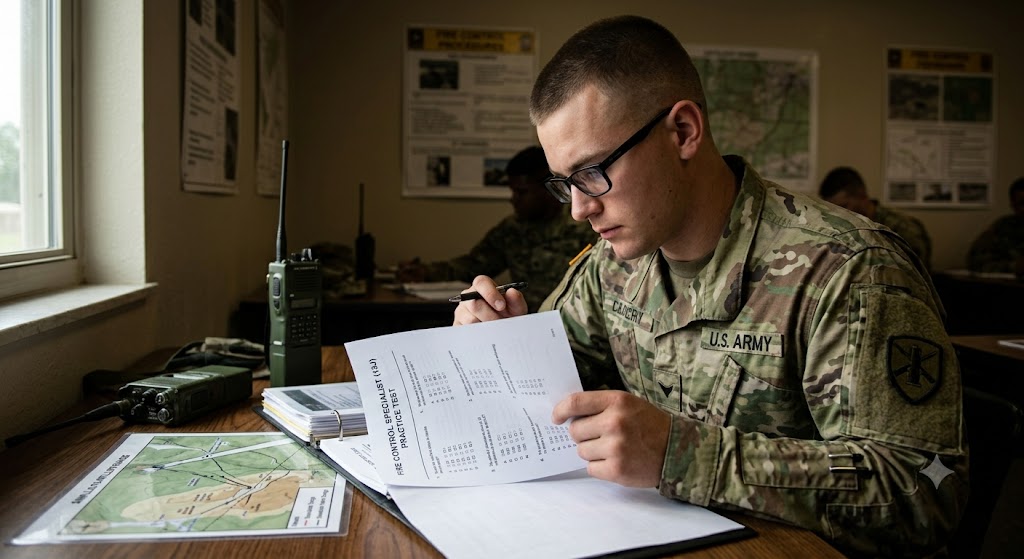
Additional Information
What the Course Entails and Exam Details
Becoming a 13J requires completing a rigorous training course that blends classroom instruction with intense, hands-on practical application.
The core syllabus revolves around mastering the Advanced Field Artillery Tactical Data System (AFATDS), which is the primary computer network used to orchestrate complex artillery strikes.
Students will dive deep into subjects like gunnery mathematics, meteorology, ballistics, and ammunition data.
Furthermore, the course covers tactical communications, teaching you how to securely receive target information from forward observers and transmit firing solutions to the gunlines.
You will also develop expert-level map reading skills, spatial awareness, and an understanding of how environmental factors like wind and temperature affect projectile trajectories.
What to Expect in the Final Exam
The final examinations for a Fire Control Specialist are rigorous, combining traditional written tests with high-stress practical evaluations.
During the written portion, you will face multiple-choice and short-answer questions testing your knowledge of ballistics, radio protocols, and artillery mathematics.
However, the most crucial component is the practical exam, where you must physically operate the AFATDS under simulated combat conditions.
You will be given strict time limits to receive a call for fire, input the meteorological and ammunition data, calculate the firing solution, and send the commands to the artillery batteries.
Passing requires not only 100?curacy—as safety is paramount in field artillery—but also meeting stringent speed requirements dictated by Army Training and Doctrine Command (TRADOC) standards.
How to Study and Exam Centers
Preparation for the 13J exams begins long before you touch a tactical computer, starting with a strong performance on the Armed Services Vocational Aptitude Battery (ASVAB), specifically aiming for a high score in the Field Artillery (FA) line area.
To study effectively for your AIT exams, rely heavily on flashcards to memorize complex military acronyms and communications brevity codes.
Group study is highly encouraged; practice verbalizing the fire mission process with your peers to build muscle memory for radio operations.
Your actual training and official examinations will take place at the United States Army Fires Center of Excellence, located at Fort Sill, Oklahoma.
While at Fort Sill, take full advantage of the authorized simulator labs and physical testing centers during your free time to practice data entry and interface navigation until it becomes second nature.
Job Opportunities from the Course
Successfully completing this training and passing your exams unlocks a highly rewarding career path both inside and outside the military.
Within the armed forces, you will immediately step into roles such as a Fire Direction Specialist, with clear pathways to becoming a Fire Control Non-Commissioned Officer (NCO), Platoon Sergeant, or even a Targeting Officer.
In the civilian world, the skills you acquire translate seamlessly into high-paying, data-driven careers.
Your expertise in operating complex communication networks makes you an ideal candidate for roles like Emergency Communications Dispatcher or 911 Operations Manager.
The heavy emphasis on mapping, spatial data, and meteorology perfectly aligns with careers as a Geographic Information Systems (GIS) Technician, Land Surveyor, or Logistics Operations Coordinator.
Additionally, your ability to quickly process data under pressure is highly valued in fields like IT Operations Management and Data Processing Management.
Frequently Asked Questions
Reviews
5.0
Based on 0 reviews
Leave a Review
No reviews yet. Be the first to review!