
Fire Controlman (FC) "A" School Practice Test
$69.00
- Buy to unlock unlimited access to all Quiz questions and Answers in this Quiz.
- After purchase you can print a PDF of the whole quiz at any point. The PDF will contain the questions and the correct answers.
About this Exam
The Navy Fire Controlman (FC) "A" School is a rigorous and highly technical training program designed for enlisted sailors in the Fire Controlman rating. This program provides the foundational knowledge required to operate, maintain, and troubleshoot advanced radar, fire control systems, and weapon launching systems aboard U.S. Navy surface ships. Students learn essential principles of electronics, computer architecture, radar systems, and complex electromechanical devices. Passing the examinations at the end of the school is crucial for advancement and official designation as an FC. This practice test is an educational tool created to help students and aspiring sailors review core concepts, identify knowledge gaps, and prepare effectively for the academic challenges of the actual course. It aims to simulate the style and technical difficulty of typical 'A' school assessments, though it is not an official Navy evaluation.
Ready to test your knowledge?
Buy Now to Access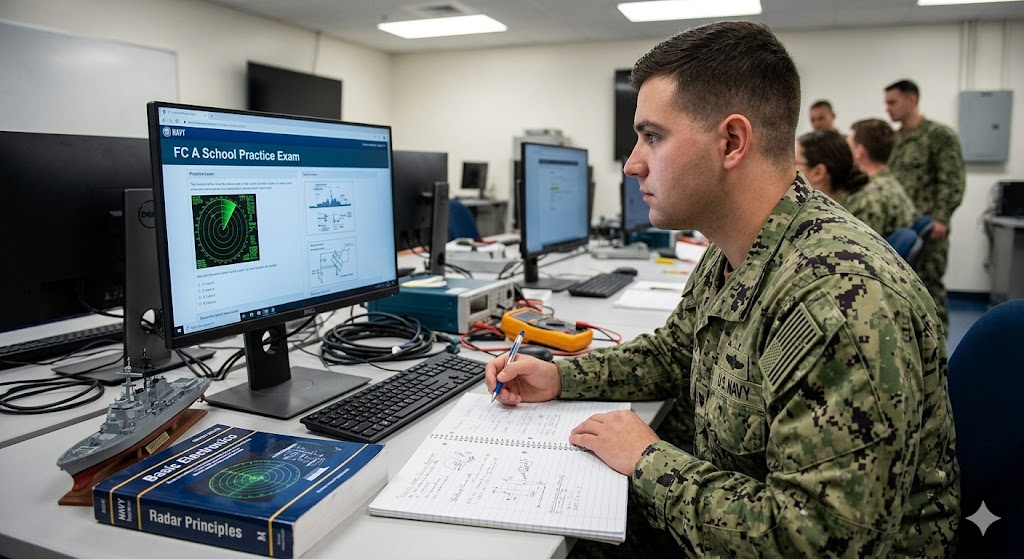
Additional Information
What the Course Entails and Exam Details
The Fire Controlman "A" School curriculum covers a broad range of technical topics critical to the rating. Core subjects typically include:
Basic and advanced electronics, circuitry, and troubleshooting techniques.
Fundamentals of network and computer systems.
Radar theory, including microwave principles and wave propagation.
Basic principles of fire control and weapons system operations.
System-level maintenance procedures and technical documentation. The official school is structured with multiple phases and modules, each concluding with an exam. These exams are comprehensive for the respective areas and determine progress. Failure to pass key milestones may result in remediation or being dropped from the course. The 'A' School training is primarily conducted in a classroom and lab environment at the training command. Successful completion is the gateway to follow-on specialized 'C' schools for specific weapon and sensor systems.
What to Expect in the Final Exam
The actual "A" School final examinations are primarily multiple-choice tests, often administered on computers. However, students should also expect practical application exams in a lab setting where they must demonstrate hands-on skills in maintenance or troubleshooting. The tests are challenging, and questions are meticulously designed to assess both theoretical understanding and practical application. Passing scores are high, and students are expected to achieve a high level of proficiency in all subject matters. Time limits are strictly enforced, and there are specific academic rules and integrity standards that all sailors must adhere to. The comprehensive nature of the final exams requires consistent study throughout the entire course. Performance on these exams significantly impacts a sailor's career trajectory and choice of future assignments.
How to Study and Exam Centers
Preparation for the FC "A" School exams should begin long before the final assessments. Actionable study strategies include:
Thoroughly reviewing all lecture notes, handouts, and textbooks provided by the Navy.
Utilizing military technical manuals (TASM/COMNAVSEASYSCOM publications) whenever possible.
Creating and using flashcards for key terms, equations, and system components.
Taking advantage of any practice materials, study groups, and instructor assistance available at the training command.
Reviewing lab procedures and practical knowledge regularly. Practicing with simulated exams (like this conceptual one) can build test-taking speed and confidence. Regarding exam centers, the official Navy FC "A" School examinations are not taken at external testing centers. The entire course, including all examinations, is conducted internally at the Navy training command (e.g., Center for Surface Combat Systems Unit (CSCSU) Great Lakes, Illinois). Students must attend the school and pass the internal tests to complete the program. There is no online portal or public exam center where the official Navy final exam can be taken for certification outside of military training.
Job Opportunities from the Course
Graduating from Fire Controlman "A" School unlocks numerous career paths within the U.S. Navy. Graduates typically advance to specialized system training and then deploy on various surface combatant ships. Specific roles and career paths include:
Fire Controlman (FC): The primary role involving the operation and maintenance of sophisticated weapons and sensor systems.
System Specialist: Specializing in systems like the Tomahawk Cruise Missile System, Aegis Weapon System, Close-In Weapon System (CIWS), or Mk 92 Fire Control System (FCS).
Radar Technician: Operating and repairing advanced shipboard radar systems.
Guided Missile System Technician: Working specifically on missile launch and guidance systems.
Leading Technical Teams: Advancing to senior enlisted leadership positions overseeing technical departments and personnel.
Instructor Duty: Opportunities to return as an instructor to train future FCs. Furthermore, the advanced electronics and systems maintenance skills gained are highly sought after in the civilian sector, potentially leading to careers as engineering technicians, radar engineers, field service representatives, and electronics specialists in various industries.
Frequently Asked Questions
Reviews
5.0
Based on 0 reviews
Leave a Review
No reviews yet. Be the first to review!