
Fire Controlman Second Class (FC2) Advancement Practice Test
$69.00
- Buy to unlock unlimited access to all Quiz questions and Answers in this Quiz.
- After purchase you can print a PDF of the whole quiz at any point. The PDF will contain the questions and the correct answers.
About this Exam
The Fire Controlman Second Class (FC2) designation is a critical advancement milestone for US Navy sailors specializing in the operation and maintenance of complex weapon systems. This exam is specifically designed for Fire Controlmen Third Class (FC3) who have demonstrated proficiency and are seeking to advance in rank and responsibility. It validates a sailor’s technical competence, leadership potential, and readiness to manage integrated combat systems. Preparing for the FC2 exam ensures that candidates possess the specialized knowledge required to maintain fleet readiness and successfully operate sophisticated defense technologies. This practice test serves as a crucial preparatory tool for sailors aiming to excel in the upcoming Navy-Wide Advancement Exam (NWAE).
Ready to test your knowledge?
Buy Now to Access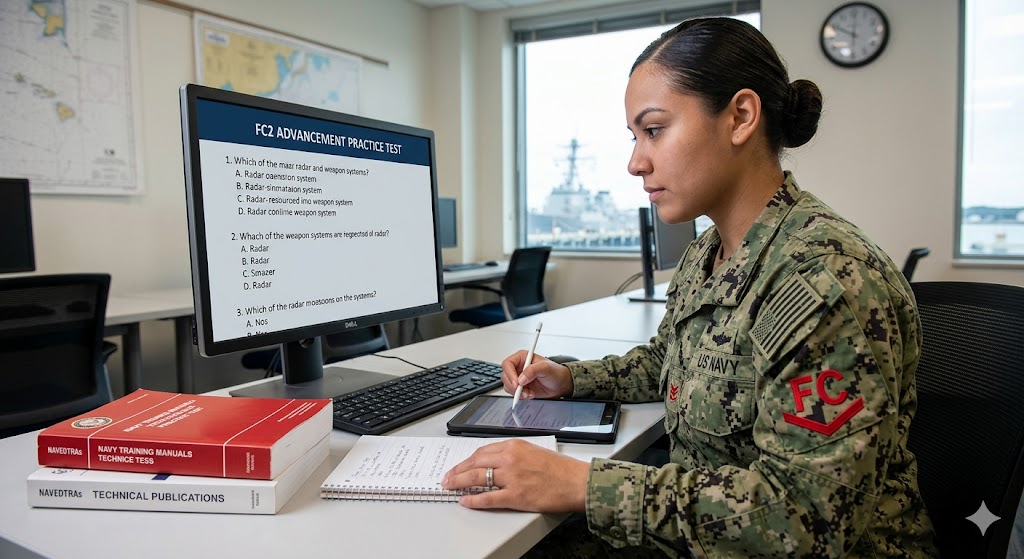
Additional Information
What the Course Entails and Exam Details
The content required for FC2 advancement is extensive, reflecting the increased technical sophistication expected at this paygrade. The exam curriculum covers advanced subjects including complex radar fundamentals, theory of operation for specific weapon systems (like Aegis or CIWS), digital electronics, and integrated combat systems troubleshooting. Candidates must also master topics related to data links, electricity and electronics theory, and the administration of technical programs. Beyond technical skills, the material includes supervision and leadership principles, divisional management, safety protocols, and standard operating procedures critical for leading a team of junior technicians. All material is derived from current US Navy technical manuals, NAVEDTRA courses, and fleet instructions.
What to Expect in the Final Exam
The actual Navy-Wide Advancement Exam (NWAE) for FC2 is a rigorous, standardized test administered in a physical setting at designated military facilities. The exam typically consists of 175 multiple-choice questions, divided between rating-specific technical knowledge and professional military knowledge. Candidates are allotted a strict time limit of three hours (180 minutes) to complete the test. Scoring is competitive, utilizing a raw score which is then converted into a Standard Score (SS) relative to all other peers taking the same exam. Advancement is not based on a static passing percentage but rather on the Final Multiple Score (FMS), which combines the exam SS with other factors like performance evaluations, time in rate, and awards. Strict military testing protocols apply, and no external materials or electronic devices are permitted.
How to Study and Exam Centers
Effective preparation for the FC2 exam requires a disciplined and structured study plan centered on the specific Navy Advancement Bibliographies (Bibs). The Bibs are the definitive list of references used to create the exam and are published for every test cycle. Utilize available online Navy advancement portals for official study guides and access to digital versions of the required NAVEDTRA manuals and technical publications. The most critical study strategy involves consistent practice with established FC2 Advancement Practice Tests, which simulate the actual exam format and time constraints while identifying knowledge gaps. Create flashcards for complex technical data, such as radar frequencies or system specs. The NWAE is not taken at civilian testing centers; it is administered exclusively on-base at physical testing centers, designated command spaces, or deployed locations, coordinated by your Command Career Counselor (CCC) and the Educational Services Officer (ESO).
Job Opportunities from the Course
Advancing to Fire Controlman Second Class significantly enhances a sailor’s career trajectory, providing immediate increases in leadership, authority, and compensation. Within the US Navy, an FC2 is qualified to supervise workcenters and lead critical maintenance teams, often filling roles such as:
Weapons System Workcenter Supervisor
Lead Missile System Technician
Close-In Weapon System (CIWS) Technician (Senior)
Aegis System Technician (Supervisor)
Gunfire Control System Lead Technician
The technical expertise gained from achieving FC2 status is also highly valued in the civilian defense and aerospace sectors, leading to careers in:
Defense Contractor Technical Representative
Aerospace Electronics Technician
Combat Systems Integration Engineer (Junior)
Precision Maintenance Supervisor
Field Service Engineer for Advanced Radar Systems
Frequently Asked Questions
Reviews
5.0
Based on 0 reviews
Leave a Review
No reviews yet. Be the first to review!