
Fire Fighter 1 Practice Exam
$69.00
- Buy to unlock unlimited access to all Quiz questions and Answers in this Quiz.
- After purchase you can print a PDF of the whole quiz at any point. The PDF will contain the questions and the correct answers.
About this Exam
The Fire Fighter 1 certification is the foundational credential for anyone looking to build a career in the fire service.
It is designed for entry-level candidates, volunteers, and aspiring professionals who want to demonstrate their competency in basic firefighting operations.
Earning this certification proves that you have mastered the essential knowledge and physical skills required to safely and effectively operate on a fireground under direct supervision.
Whether you are fresh out of high school or transitioning into a thrilling new career, this certification is your critical first step toward becoming a recognized first responder.
Ready to test your knowledge?
Buy Now to Access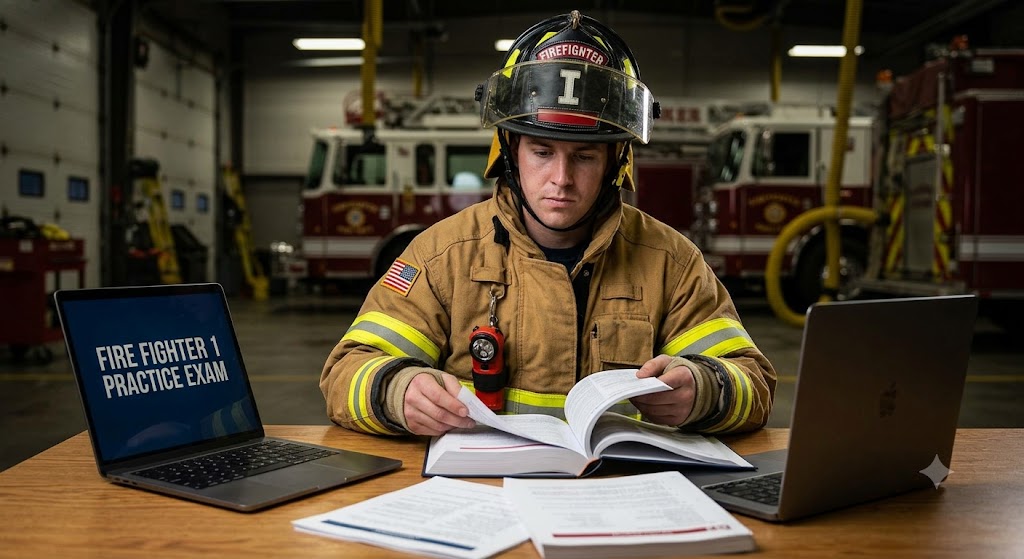
Additional Information
What the Course Entails and Exam Details
The Fire Fighter 1 curriculum is strictly aligned with the National Fire Protection Association (NFPA) 1001 Standard for Fire Fighter Professional Qualifications.
During your coursework, you will dive deep into the science of fire dynamics, learning exactly how fires start, spread, and are ultimately extinguished.
The syllabus covers a robust range of technical topics, including building construction, proper use of Personal Protective Equipment (PPE), and Self-Contained Breathing Apparatus (SCBA) management.
You will also develop hands-on skills in critical areas such as search and rescue, ventilation, structural fire attack, water supply, and hazardous materials (HazMat) awareness.
Every module is designed to build your situational awareness, ensuring you can make split-second decisions in high-stress environments.
What to Expect in the Final Exam
The final evaluation generally consists of two distinct components: a written cognitive exam and a hands-on practical skills test.
The written exam typically features between 100 and 150 multiple-choice questions, which evaluate your theoretical understanding of fire service operations.
You will usually be given a time limit of two to three hours to complete this computer-based or paper test.
To pass, most state fire training agencies and certifying bodies require a minimum score of 70% or 75%.
In addition to the written portion, you must successfully pass the practical exam, where evaluators will observe you performing specific firefighting tasks, such as raising ladders or tying specialized knots, with strict adherence to safety rules.
How to Study and Exam Centers
Success on the Fire Fighter 1 exam requires a mix of theoretical study and practical muscle memory.
Start by thoroughly reading the IFSTA "Essentials of Fire Fighting" manual, as it is the primary textbook used for exam questions.
Taking multiple practice exams is highly recommended to familiarize yourself with the phrasing of multiple-choice questions and to identify areas where you need more review.
Forming study groups with your academy classmates can also help reinforce complex concepts and provide motivation.
When it comes time to test, written exams are typically administered at authorized testing centers, such as local community colleges, state fire academies, or through third-party proctors like Pearson VUE.
Your practical skills test will almost always be held at a designated regional fire training facility equipped with burn buildings and training towers.
Job Opportunities from the Course
Earning your Fire Fighter 1 certification opens the door to a rewarding and dynamic career in emergency services.
The most common path is becoming a Municipal Firefighter, where you will serve local city or county departments protecting civilian lives and property.
It also qualifies you for roles as an Industrial Firefighter, working to safeguard specialized facilities like refineries, manufacturing plants, or airports.
If you are passionate about community service but not looking for full-time work, this credential allows you to serve as a highly trained Volunteer Firefighter in your local district.
Furthermore, having this foundational certification acts as a critical stepping stone toward specialized roles, such as a Wildland Firefighter or a Fire Apparatus Operator, as you continue to gain experience and further your education.
Frequently Asked Questions
Reviews
5.0
Based on 0 reviews
Leave a Review
No reviews yet. Be the first to review!