
Fire instructor 2 Practice Exam
$69.00
- Buy to unlock unlimited access to all Quiz questions and Answers in this Quiz.
- After purchase you can print a PDF of the whole quiz at any point. The PDF will contain the questions and the correct answers.
About this Exam
The Fire Instructor II certification is a crucial milestone for experienced fire service professionals who want to elevate their teaching capabilities and leadership skills.
This advanced credential is specifically designed for Fire Instructor I certificate holders who are ready to take on greater responsibilities in training program management.
It demonstrates your ability to develop customized lesson plans, evaluate fellow instructors, and manage complex training resources effectively.
Stepping up to this advanced level proves your dedication to shaping the next generation of highly capable, safe, and efficient firefighters.
Ready to test your knowledge?
Buy Now to Access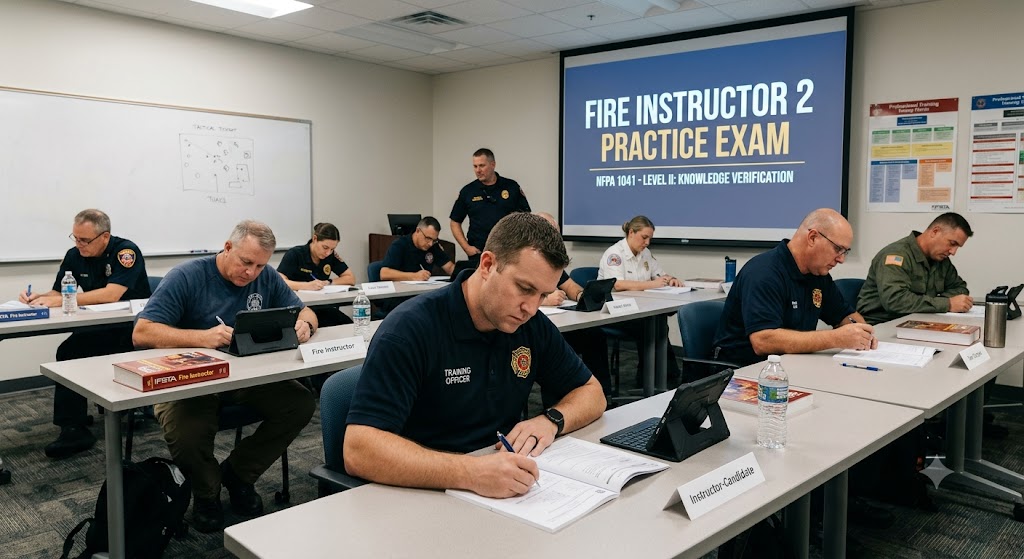
Additional Information
What the Course Entails and Exam Details
The Fire Instructor II curriculum builds upon your foundational teaching skills and shifts the focus heavily toward curriculum development and instructional leadership.
Candidates will dive deep into advanced instructional methodology, learning exactly how to design comprehensive lesson plans and original training materials.
You will learn the intricacies of scheduling training sessions, managing departmental instructional resources, and supervising other instructors in the field.
Furthermore, the course covers the detailed development of evaluation instruments, ensuring that you can accurately assess both student performance and the overall effectiveness of your training programs.
What to Expect in the Final Exam
The Fire Instructor II final exam rigorously tests both your theoretical knowledge and your practical application of advanced instructional concepts.
You can expect a computerized cognitive exam consisting of 50 to 100 multiple-choice questions, depending on your specific state's certifying body.
Candidates are typically given a strict time limit of one to two hours to complete the written portion of the test.
In addition to the written cognitive exam, you must pass a demanding practical skills evaluation.
During this practical portion, you will demonstrate your ability to develop a lesson plan, create an assessment tool, and supervise a mock training evolution.
A minimum passing score of 70% or 75% is standard for the written test, while the practical portion is usually graded strictly on a pass or fail basis.
How to Study and Exam Centers
Preparing for the Fire Instructor II exam requires a highly strategic blend of textbook review and practical, hands-on application.
Start by thoroughly reading the IFSTA Fire and Emergency Services Instructor manual or the Jones & Bartlett equivalent, focusing heavily on the chapters dedicated specifically to level II objectives.
Taking multiple practice exams is one of the most effective ways to familiarize yourself with the question formats, pace your timing, and identify your weak areas.
When you are ready to test, you will generally need to register through your state's fire marshal office or fire commission portal.
The cognitive exams are often administered at approved regional fire academies, community colleges, or professional third-party testing centers like Pearson VUE.
Job Opportunities from the Course
Earning your Fire Instructor II certification unlocks several advanced career pathways and promotional opportunities within the fire service and emergency management sectors.
Lead Fire Service Instructor: Oversee training academies, develop advanced curriculum, and mentor level I instructors.
Department Training Officer: Manage complete departmental training schedules, ensure compliance with state mandates, and track personnel certifications.
Safety Officer: Utilize your advanced evaluation skills to ensure department-wide adherence to safety protocols during live-fire training and actual incident responses.
Emergency Management Coordinator: Apply your high-level program management skills to organize and implement community and regional emergency preparedness training.
Adjunct Fire Academy Faculty: Teach advanced, specialized courses at community colleges, universities, or state-run fire academies.
Frequently Asked Questions
Reviews
5.0
Based on 0 reviews
Leave a Review
No reviews yet. Be the first to review!