
Fire Instructor 3 Practice Exam
$69.00
- Buy to unlock unlimited access to all Quiz questions and Answers in this Quiz.
- After purchase you can print a PDF of the whole quiz at any point. The PDF will contain the questions and the correct answers.
About this Exam
The Fire Instructor III certification represents the pinnacle of educational achievement within the fire service professional development track.
This elite program is specifically designed for experienced training officers, administrative chiefs, and fire service educators who are transitioning into executive-level training management.
Achieving this certification proves your mastery in developing comprehensive training programs, managing agency-wide educational resources, and leading a team of junior instructors.
If you are a seasoned fire professional looking to shape the future of your department's training culture, this credential is an absolute must-have for your career progression.
Ready to test your knowledge?
Buy Now to Access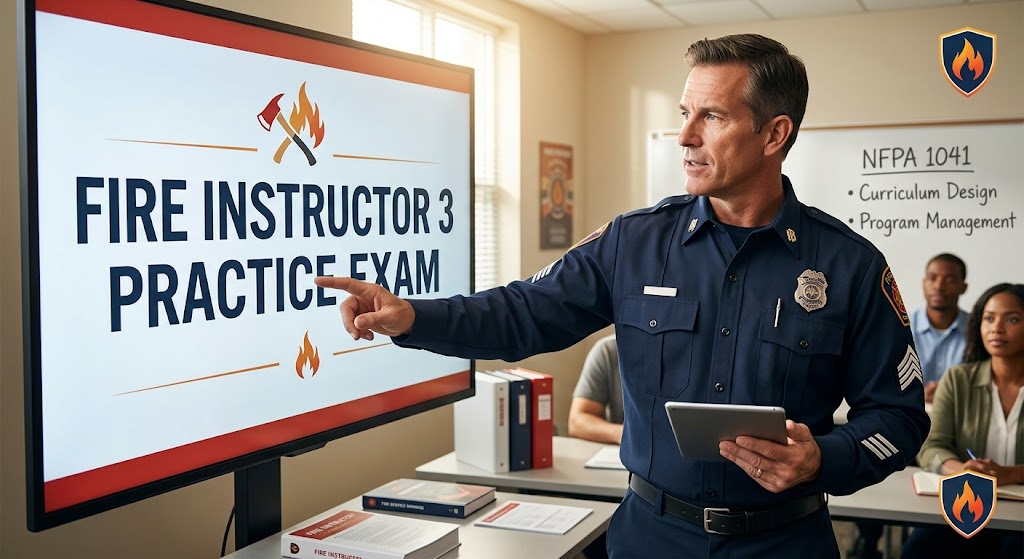
Additional Information
What the Course Entails and Exam Details
The Fire Instructor 3 course curriculum is heavily rooted in the rigorous standards set forth by NFPA 1041 (Standard for Fire and Emergency Services Instructor Professional Qualifications).
Unlike earlier instructor levels that focus on classroom delivery or basic lesson planning, this advanced syllabus dives deep into program administration and curriculum design.
You will master complex topics such as conducting organizational needs analyses, designing comprehensive training curricula, and developing agency-specific evaluation strategies.
Additionally, the course covers the administrative side of fire service education, including budget development, record-keeping management, and the legal aspects of emergency services training.
By the end of the course, you will have the skills necessary to oversee an entire department's training division and ensure compliance with state and federal mandates.
What to Expect in the Final Exam
The final examination process for Fire Instructor III typically involves both a comprehensive written test and an extensive practical evaluation.
The written exam generally consists of 50 to 100 multiple-choice questions, depending on your specific state fire marshal's office or certifying body (such as ProBoard or IFSAC).
You can expect strict time limits, usually capping at about two hours to complete the multiple-choice portion.
The passing score requirement is typically set at 70% to 80%, demanding a thorough understanding of the material.
Beyond the written test, you will also be required to submit a practical project or portfolio.
This practical component often involves drafting a complete training curriculum, creating a budget proposal, or conducting a formal needs assessment to prove you can apply the theoretical knowledge in a real-world fire department scenario.
How to Study and Exam Centers
Success on the Fire Instructor 3 exam requires a strategic, disciplined approach to your study habits.
Your primary study resource should be the IFSTA Fire and Emergency Services Instructor manual, paying special attention to the chapters dedicated to Level III administration and curriculum development.
Taking a high-quality practice exam is one of the most effective ways to identify your weak points and get comfortable with the wording of advanced NFPA-based questions.
You should also practice drafting mock training budgets and course outlines to prepare for the practical portfolio portion of your evaluation.
When you are ready to test, exams are typically administered through authorized regional fire training academies, community college fire science programs, or official state fire marshal testing facilities.
Many jurisdictions also utilize digital testing centers like Pearson VUE for the written exam, allowing you to schedule your test at a convenient, highly secure computer lab in your local area.
Job Opportunities from the Course
Earning your Fire Instructor 3 certification opens the door to top-tier administrative and educational roles across the emergency services sector.
You will be highly qualified for the position of Training Chief or Director of Training within a municipal fire department.
It also paves the way for a career as a State Fire Academy Director, overseeing statewide educational initiatives and certification programs.
Many graduates find lucrative opportunities as Curriculum Developers for private fire service publishers or emergency management consulting firms.
Additionally, this certification is ideal if you aspire to become a Master Instructor or an Adjunct Professor teaching fire science and emergency management at the university level.
Ultimately, this credential positions you as a leading authority in fire service education, giving you the power to influence safety and operational excellence on a massive scale.
Frequently Asked Questions
Reviews
5.0
Based on 0 reviews
Leave a Review
No reviews yet. Be the first to review!