
Fire Officer 1 Practice Exam
$69.00
- Buy to unlock unlimited access to all Quiz questions and Answers in this Quiz.
- After purchase you can print a PDF of the whole quiz at any point. The PDF will contain the questions and the correct answers.
About this Exam
The Fire Officer 1 certification represents a pivotal stepping stone in a firefighter’s career, marking the transition from a first responder to a leader within the fire service.
This comprehensive certification is specifically designed for frontline personnel, such as Lieutenants or aspiring Captains, who are preparing to take on corporate management and leadership responsibilities.
Earning this credential validates your knowledge of essential supervisory practices and ensures you possess the critical decision-making skills required to manage a fire company effectively.
A Fire Officer 1 practice exam is a crucial resource for any candidate, providing the rigorous prep needed to confidently master this demanding assessment.
Ready to test your knowledge?
Buy Now to Access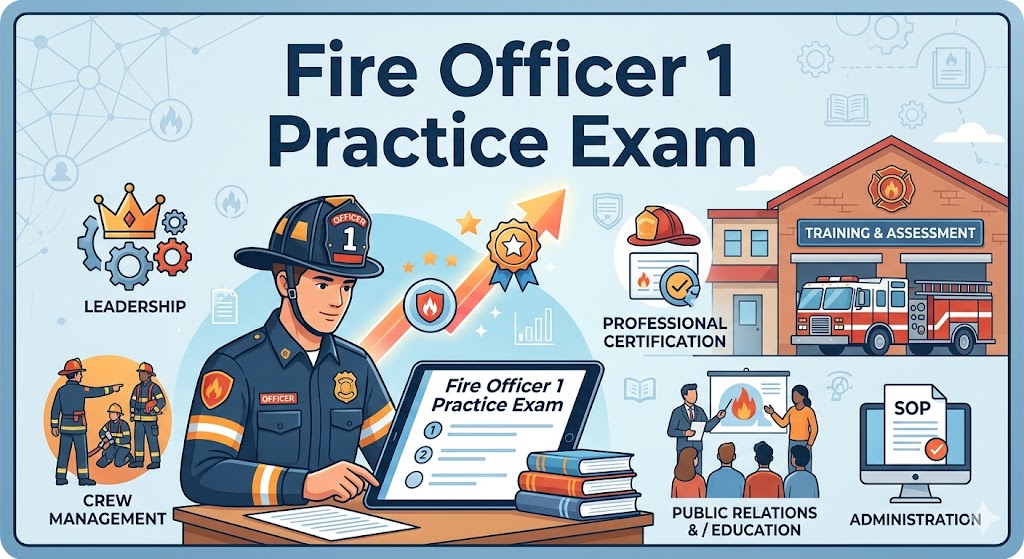
Additional Information
What the Course Entails and Exam Details
The Fire Officer 1 curriculum is deeply rooted in the National Fire Protection Association (NFPA) 1021, Standard for Fire Officer Professional Qualifications.
This standard outlines the fundamental job performance requirements (JPRs) that a candidate must demonstrate.
The comprehensive syllabus focuses on several core competencies, including effective human resources management, establishing community and government relations, and implementing vital occupational health and safety programs.
In addition to management skills, the course provides an in-depth exploration of tactical operations, specifically focusing on building construction, advanced fire behavior, and fire suppression strategies.
Candidates will learn to safely and efficiently manage an initial response emergency scene, ensuring both the public's and the crew’s safety.
What to Expect in the Final Exam
The Fire Officer 1 final exam is a comprehensive assessment that evaluates both technical knowledge and practical application skills.
The evaluation process typically includes a written examination composed of 100 to 125 multiple-choice questions.
Candidates are usually allotted two to three hours to complete this portion, demanding not just accuracy but also time-management skills.
To achieve certification, a minimum passing score—often 70% or higher, depending on the accrediting body—is strictly enforced.
Additionally, some jurisdictions and accrediting organizations may require a skills-based or practical evaluation, where you must successfully demonstrate key tasks such as leading a group presentation or managing a simulated structure fire incident.
This exam is the definitive test of your readiness for professional leadership within the fire service.
How to Study and Exam Centers
Preparation for this challenging exam requires a strategic, multi-faceted approach.
A Fire Officer 1 practice exam should be a primary component of your study plan. Repeatedly taking practice tests helps you identify critical knowledge gaps, get accustomed to the question phrasing, and build the mental stamina required for the full-length assessment.
Beyond practicing, candidates should engage in deep review of the official NFPA 1021 textbook and participate in organized study groups or peer-review sessions.
Utilizing flashcards for key definitions and practicing fire ground command scenarios are also highly effective techniques.
Regarding administration, the Fire Officer 1 exam is rarely taken at generic third-party testing centers. Instead, it is usually managed directly by a state or regional fire training academy.
The examination often concludes a state-approved Fire Officer training program, with tests administered by authorized state personnel or representatives from accrediting bodies like IFSAC or Pro Board.
Job Opportunities from the Course
Earning the Fire Officer 1 certification is a game-changer, fundamentally changing your career trajectory within the fire service.
This essential credential unlocks significant professional development and opens doors to highly sought-after leadership roles.
Below is a clear list of the specific job opportunities and career paths this achievement makes accessible:
Fire Lieutenant (the most common immediate promotion).
Company Officer (the primary leader of an engine or ladder company).
Station Officer/Station Captain (depending on department size).
Fire Inspector (leading a specialized prevention or inspection bureau).
Training Officer (developing and delivering professional instruction).
Fire Marshal (in smaller or rural jurisdictions).
Emergency Medical Services (EMS) Supervisor (in combined fire/EMS systems).
Frequently Asked Questions
Reviews
5.0
Based on 0 reviews
Leave a Review
No reviews yet. Be the first to review!