
Fire Support Team (FIST) Certification Practice Exam
$69.00
- Buy to unlock unlimited access to all Quiz questions and Answers in this Quiz.
- After purchase you can print a PDF of the whole quiz at any point. The PDF will contain the questions and the correct answers.
About this Exam
The Fire Support Team (FIST) Certification is a critical milestone for military personnel aiming to specialize as forward observers and fire support specialists.
This rigorous exam evaluates your ability to accurately request, adjust, and control artillery, mortar, and naval surface gunfire in high-stakes environments.
It is specifically designed for soldiers and marines whose primary mission is to integrate indirect fires into combat operations seamlessly.
Passing this certification proves that you have the precision, communication skills, and tactical awareness necessary to support front-line maneuver units effectively.
Ready to test your knowledge?
Buy Now to Access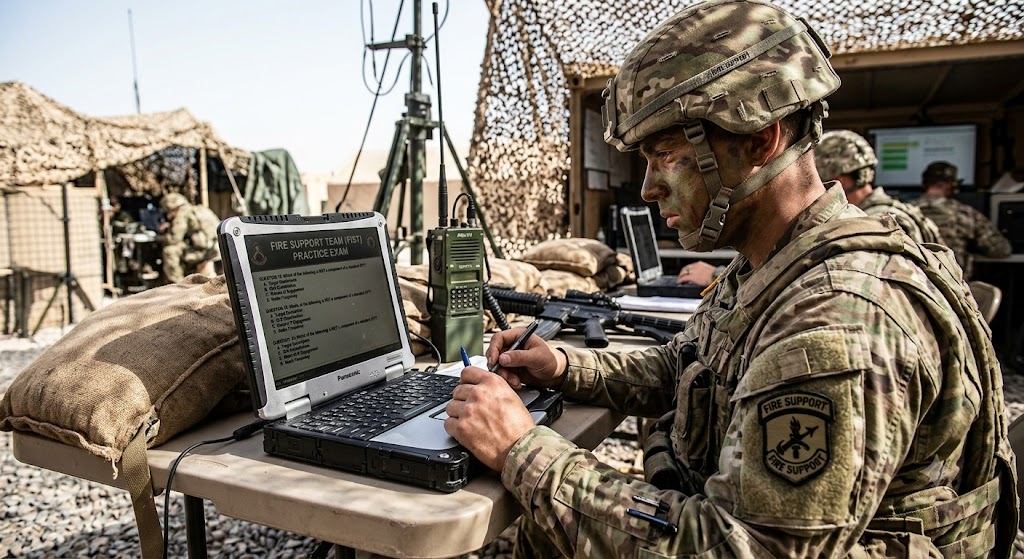
Additional Information
What the Course Entails and Exam Details
The FIST certification course provides comprehensive training in indirect fire procedures and tactical battlefield operations.
Candidates must master the Call for Fire (CFF) process, including grid, polar, and shift from known point mission types.
The syllabus extensively covers advanced map reading, terrain sketching, and target location methods using specialized optical equipment.
You will also learn how to establish secure communications, properly format radio transmissions, and conduct crater analysis to determine enemy artillery positions.
Furthermore, the curriculum integrates close air support (CAS) coordination and the proper utilization of joint fire assets on the modern battlefield.
What to Expect in the Final Exam
The final FIST certification exam is designed to test both your theoretical knowledge and your ability to perform under immense pressure.
You can expect a hybrid format consisting of a written multiple-choice section and an intensive hands-on practical exercise.
The written portion tests your understanding of ballistics, munitions, communication protocols, and doctrinal regulations.
During the practical evaluation, you will likely use a Call for Fire Trainer (CFFT) simulator or participate in a live-fire field exercise to prove your competence.
Candidates are usually required to achieve a minimum passing score of 80% on the written test and perfectly execute the mandatory steps in the practical simulation.
Strict time limits are enforced for transmitting initial fire requests and sending subsequent adjustments, reflecting the urgency of real combat scenarios.
How to Study and Exam Centers
Preparation requires a balanced approach between studying doctrinal manuals and practicing hands-on communication skills.
Your primary study materials should include official field artillery manuals and your unit's specific fire support tactical standing operating procedures.
Creating flashcards for standard radio templates and munition types is highly recommended to build rapid recall abilities.
Whenever possible, spend extra hours in the simulator to build muscle memory and improve your reaction time before the actual test.
Testing is generally conducted at designated military installations, specialized artillery training schools, or directly through your battalion's master gunner.
You will need to coordinate with your unit's training non-commissioned officer to schedule your evaluation in the appropriate testing facility or field environment.
Job Opportunities from the Course
Earning your FIST certification unlocks highly respected and specialized career paths within the armed forces.
It significantly enhances your promotion potential and prepares you for advanced tactical roles.
Here are the specific job titles and career paths this certification can lead to:
Fire Support Specialist
Forward Observer
Joint Fires Observer (JFO)
Fire Support Non-Commissioned Officer (FSNCO)
Targeting NCO
Artillery Operations Specialist
Fire Support Master Gunner
Frequently Asked Questions
Reviews
5.0
Based on 0 reviews
Leave a Review
No reviews yet. Be the first to review!