
Fire Support Team (FiST) MQF Skill Level 3 (SL3) Certification Practice Test
$69.00
- Buy to unlock unlimited access to all Quiz questions and Answers in this Quiz.
- After purchase you can print a PDF of the whole quiz at any point. The PDF will contain the questions and the correct answers.
About this Exam
The Fire Support Team (FiST) MQF Skill Level 3 (SL3) Certification is the next significant milestone for forward observers and artillery specialists seeking leadership roles.
This advanced certification validates your ability to master complex tactical scenarios and manage fire support assets on the battlefield.
It is designed specifically for personnel who have already mastered the fundamentals and are moving toward supervisory positions within the FiST.
This practice test serves as an essential tool to measure your readiness for the ultimate examination.
By taking this test, you are proving your commitment to advancing your military career and leading your team effectively.
Ready to test your knowledge?
Buy Now to Access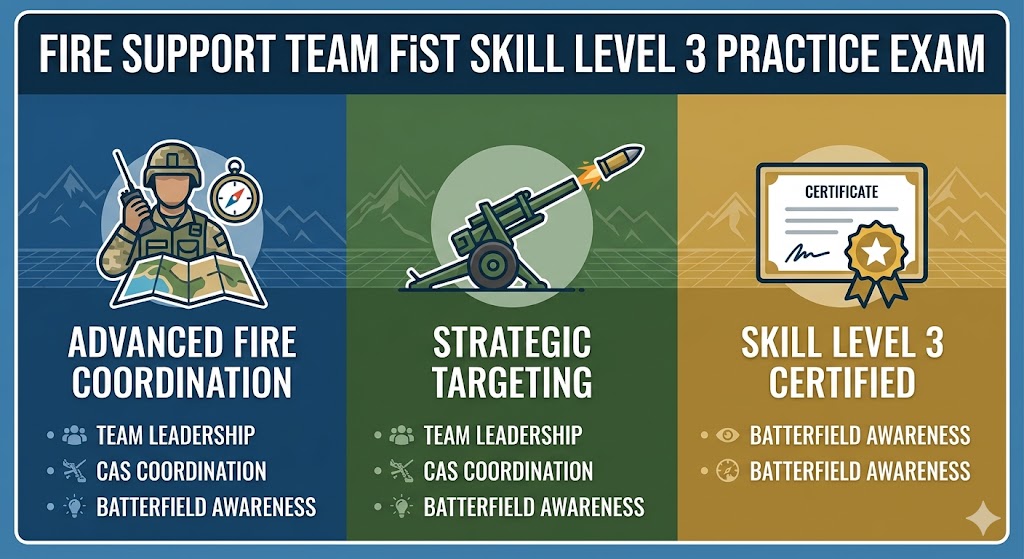
Additional Information
What the Course Entails and Exam Details
The curriculum for the FiST Skill Level 3 certification advances far beyond basic call-for-fire procedures.
Candidates are expected to demonstrate deep knowledge in integrating all available indirect fire assets into ground maneuver plans.
Core topics include coordinating artillery, mortars, naval surface fire support, and close air support.
The exam details crucial skills such as terrain analysis, advanced target acquisition, and the technical application of fire support planning.
You will also be tested on your ability to supervise junior FiST members and ensure technical proficiency across the team.
Mastery of digital fire support systems and communications architecture is a non-negotiable requirement for passing.
What to Expect in the Final Exam
The final certification exam is a rigorous assessment of both theoretical knowledge and practical application.
Candidates should prepare for a significant comprehensive multiple-choice section that evaluates technical understanding.
There is also typically a practical component involving simulated scenarios or computerized trainers.
The practical phase often requires a high degree of precision when executing complicated call-for-fire missions.
While specific time limits can vary by command, the multiple-choice section is generally timed, requiring decisive action.
A high passing score, often exceeding 80%, is required because fire support coordination admits zero margin for error in the field.
Specific rules often dictate that all materials used in the exam room, outside authorized technical manuals, are strictly prohibited.
How to Study and Exam Centers
Successful preparation requires a multi-pronged strategy that blends study with repetition.
Utilize all official army doctrine manuals and technical guides related to fire support planning and execution.
Re-read and memorize key aspects of the FiST leader’s guide and relevant battlefield operating procedures.
Take this practice test repeatedly to identify your critical weak points.
Dedicate significant time to utilizing simulators like the Call-For-Fire Trainer (CFFT) to refine your practical skills in a low-risk environment.
To take the official exam, personnel usually register through their unit’s training officer (S-3) or an authorized digital platform.
The actual certification exam is almost exclusively proctored within a dedicated military training facility or authorized testing centers on base.
Ensure you verify the registration window with your leadership well in advance.
Job Opportunities from the Course
Earning your FiST Skill Level 3 certification drastically accelerates your career trajectory within the artillery and forward observation communities.
This credential is often mandatory for advancing to higher leadership and specialized roles.
The primary job opportunities and career paths this certification unlocks include:
Fire Support Team Leader
Company Fire Support Officer (FSO) Non-Commissioned Officer (NCO)
Battalion Fire Support NCO
Joint Terminal Attack Controller (JTAC) candidate (as it provides the prerequisite fire support knowledge)
Military Fire Support Instructor at training schools
Civilian Fire Support Subject Matter Expert (SME) or contractor for defense simulation systems
Frequently Asked Questions
Reviews
5.0
Based on 0 reviews
Leave a Review
No reviews yet. Be the first to review!