
Fire Team Operations Corporals Course Practice Test
$69.00
- Buy to unlock unlimited access to all Quiz questions and Answers in this Quiz.
- After purchase you can print a PDF of the whole quiz at any point. The PDF will contain the questions and the correct answers.
About this Exam
The Fire Team Operations Corporals Course is a pivotal professional development program, primarily used within the United States Marine Corps (USMC), designed to elevate high-performing Lance Corporals to the rank of Corporal. This course functions as a critical bridge, transforming individual contributors into Non-Commissioned Officers (NCOs) who are capable of leading small tactical units. It is specifically tailored for Marines who have demonstrated leadership potential and are preparing to assume the responsibilities of a Fire Team Leader. This certification is a prerequisite for advancing in rank and taking on command at the small-unit level, focusing on the core Marine Corps values of honor, courage, and commitment, while providing the practical skills to lead under pressure.
Ready to test your knowledge?
Buy Now to Access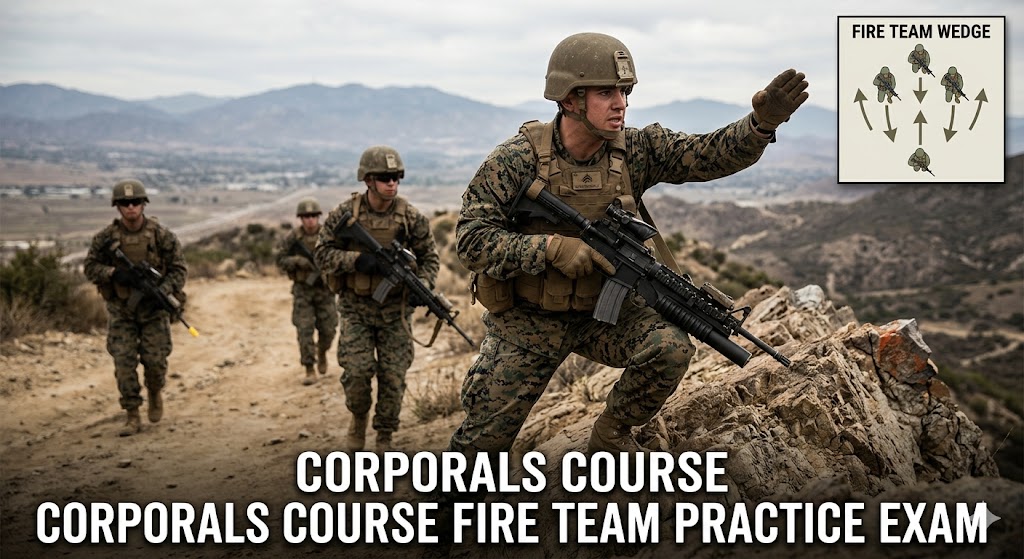
Additional Information
What the Course Entails and Exam Details
The curriculum of the Fire Team Operations Corporals Course is a robust blend of theoretical leadership, practical field application, and tactical proficiency. Students are immersed in a comprehensive syllabus that focuses on the core mission of the Marine rifle squad: to locate, close with, and destroy the enemy by fire and maneuver, or repel the enemy's assault by fire and close combat.
Key areas of focus include:
Small Unit Leadership: Mastery of the roles, responsibilities, and ethics of an NCO, including troop welfare, discipline, and operational risk management.
Fire Team Operations: A deep dive into the organization of the four-person fire team (Team Leader/Grenadier, Automatic Rifleman, Assistant Automatic Rifleman, and Rifleman) and the standard 13-man rifle squad.
Tactics and Maneuver: Comprehensive instruction on offensive and defensive tactics, including fire and maneuver, ambush techniques, and patrolling.
Weapons and Fire Discipline: Technical knowledge and employment of the organic weapons within a fire team, including the M4/M16, M203 grenade launcher, and the M249 Squad Automatic Weapon (SAW) or M27 Infantry Automatic Rifle (IAR).
Combat Formations and Signals: Mastery of hand-and-arm signals, voice commands, and the four standard fire team formations (Column, Wedge, Skirmishers Right/Left, Echelon Right/Left) for various terrain and enemy contact scenarios.
Land Navigation: Basic map reading, compass use, and land navigation practical application.
What to Expect in the Final Exam
The Final Exam for the Fire Team Operations module is a comprehensive assessment that tests both knowledge and application. While individual course iterations may have slight variations, students can typically expect a standard formal examination.
Written/Computerized Knowledge Test: This component often consists of multiple-choice, true/false, and short-answer questions. It will cover academic knowledge, such as weapon specifications, formation purposes, standard mission statements (e.g., the mission of the Marine rifle squad), and the specific roles and responsibilities of each team member.
Practical Application: Students must often demonstrate proficiency in a controlled environment. This may include leading a fire team through a series of combat formations using only hand-and-arm signals, executing a fire and maneuver scenario, or correctly employing and troubleshooting weapons.
Passing Score and Time Limits: Standard military testing protocols apply. A minimum passing score (often 80% or higher) is required for both the written and practical portions. Time limits are typically enforced to simulate the speed and stress of a tactical environment.
How to Study and Exam Centers
Success on the Fire Team Operations practice test and final exam requires a disciplined, multifaceted study approach. This is not a "cram" exam; it demands genuine understanding and muscle memory.
Actionable Study Strategies:
Utilize Course Materials: Your primary resource is the official student handout or instructional material provided at the start of the course. Highlight key concepts, definitions, and mission statements.
Rote Memorization and Flashcards: Commit all technical data, weapon capabilities (ranges, rates of fire), and the four standard formations and their purposes to memory. Flashcards are highly effective for this.
Practice Signals: Do not just read about hand-and-arm signals. Physically practice them until they are immediate and instinctive. Partner with fellow students to "test" each other.
Visualize Formations: Sketch the fire team formations on paper and visualize how your team would move through different types of terrain using each one. Understand the "why" behind every formation.
Use Practice Tests: The most effective tool is a realistic [Fire Team Operations Corporals Course Practice Test]. These simulate the exam environment and identify specific knowledge gaps. Take them repeatedly, focusing on explaining why the correct answer is right.
Exam Centers:
This is an internal military professional military education (PME) certification. As such, you will not take this exam at a public testing facility like Pearson VUE. The written and practical exams are conducted in-house by the staff of the specific Corporal’s Course Academy or instructional facility where you are assigned. This will be on your military installation, likely in a dedicated classroom and a nearby tactical training area.
Job Opportunities from the Course
The successful completion of the Fire Team Operations Corporals Course is the key milestone that unlocks direct leadership opportunities and sets you on a path to a long and successful military career. It transitions you from a guided individual to a trusted leader of Marines.
Specific job titles and career paths this certification enables:
Fire Team Leader: Your immediate role upon completion and promotion. You will be directly responsible for the discipline, training, welfare, and tactical employment of three other Marines in combat or training environments.
Primary Marksmanship Instructor (PMI): Corporals often serve in this role, leading range details.
Squad Leader (Future): This course is the prerequisite and foundation for the next leadership step, Squad Leader (usually a Sergeant).
Section Chief: In specialized units (artillery, armor), Corporals with this training may lead operational sections.
Specialized Platoon Leadership: Can lead to roles in specialized reconnaissance or scout sniper platoons.
Frequently Asked Questions
Reviews
5.0
Based on 0 reviews
Leave a Review
No reviews yet. Be the first to review!