
Firefighter Aptitude and Character Test (FACT) Practice Test
$69.00
- Buy to unlock unlimited access to all Quiz questions and Answers in this Quiz.
- After purchase you can print a PDF of the whole quiz at any point. The PDF will contain the questions and the correct answers.
About this Exam
The Firefighter Aptitude and Character Test (FACT) is a comprehensive, entry-level screening examination designed to identify the most highly qualified candidates for a career in the fire service.
This test is specifically formulated for aspiring firefighters who are looking to secure a position within a municipal, state, or federal fire department.
Instead of focusing on prior firefighting knowledge, the FACT evaluates an applicant's baseline cognitive abilities, reading comprehension, and essential behavioral traits.
It ensures that candidates possess the necessary mental acuity, problem-solving skills, and personal integrity required to handle the high-stress, fast-paced environment of emergency response.
Ready to test your knowledge?
Buy Now to Access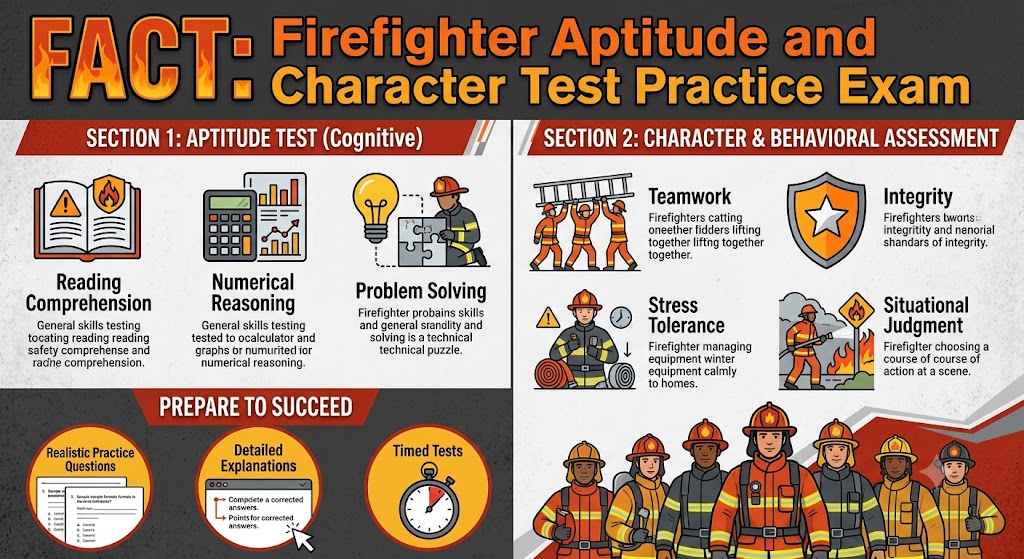
Additional Information
What the Course Entails and Exam Details
While the FACT is a pre-employment screening test rather than a traditional academic course, preparing for it involves mastering several distinct cognitive and character-based domains.
The cognitive portion of the syllabus typically covers reading ability, mathematical reasoning, map reading, and writing skills.
You will be expected to read and interpret technical manuals, understand safety directives, calculate basic mathematical problems related to water pressure or distance, and navigate complex city grids.
The character and behavioral portion of the assessment evaluates your human relations skills, teamwork, work ethic, and emotional stability.
This section entails situational judgment questions where you must determine the most appropriate response to common interpersonal and ethical dilemmas faced in a firehouse or during an emergency call.
What to Expect in the Final Exam
The FACT is typically administered as a rigorous, timed, multiple-choice examination.
Candidates usually have between two to two-and-a-half hours to complete the test, which generally consists of 100 to 150 questions.
The passing score requirements are strictly enforced and vary slightly by the specific hiring department, though an overall score of 70% to 80% is the standard minimum threshold for advancing to the next round of hiring.
The exam environment is highly controlled; calculators, smartphones, and outside reference materials are strictly prohibited.
Expect the character assessment questions to include "distractor" options that seem plausible but test your adherence to strict safety protocols and chain-of-command rules.
How to Study and Exam Centers
Success on the FACT requires a balanced study strategy that addresses both academic skills and situational awareness.
Begin by taking full-length, timed practice exams to build your testing endurance and familiarize yourself with the phrasing of multiple-choice questions.
Focus heavily on basic algebra, geometry, and reading comprehension exercises, as these are areas where candidates frequently lose points.
For the behavioral section, review standard fire department core values such as integrity, public service, and teamwork, and answer practice questions through that specific lens.
The FACT is not taken at a standard commercial testing center; rather, it is usually administered directly by the hiring fire department, local government civil service commissions, or through specialized public safety testing agencies like Fire & Police Selection, Inc. (FPSI) at designated local schools or civic centers.
Always check your specific fire department's recruitment portal for exact registration instructions and testing dates.
Job Opportunities from the Course
Passing the Firefighter Aptitude and Character Test is the vital first step that unlocks a rewarding and dynamic career in emergency services.
While the immediate outcome is qualifying for an entry-level position, it opens the door to a wide hierarchy of specialized roles.
You can expect to pursue the role of a Probationary Firefighter, which transitions into a fully tenured Firefighter role upon completion of a fire academy.
With additional experience and specialized training, you can advance to a Fire Apparatus Engineer or Driver/Operator, responsible for managing the complex water pumps and driving the fire engine.
Other career paths include becoming a Fire Inspector, where you will enforce local fire codes and conduct building safety evaluations.
You may also pursue a career as a Fire Investigator, analyzing fire scenes to determine the origin and cause of the blaze.
Additionally, many candidates use this foundational step to cross-train as Emergency Medical Technicians (EMTs) or Paramedics, roles that are often heavily integrated into modern fire department response teams.
Frequently Asked Questions
Reviews
5.0
Based on 0 reviews
Leave a Review
No reviews yet. Be the first to review!