
Firefighter HAZMAT Operations Practice Exam
$69.00
- Buy to unlock unlimited access to all Quiz questions and Answers in this Quiz.
- After purchase you can print a PDF of the whole quiz at any point. The PDF will contain the questions and the correct answers.
About this Exam
The Firefighter HAZMAT Operations certification is a critical credential designed for first responders who proceed beyond the basic "awareness" level to take defensive action during a hazardous materials incident.
This exam validates that a firefighter has the necessary knowledge to assess risks, identify substances, and implement defensive containment measures without coming into direct contact with the release.
The certification is intended primarily for operational personnel such as firefighters, emergency medical responders, and rescue personnel who are tasked with initiating the incident response sequence.
Successfully achieving this certification is a prerequisite for advancing to offensive specialist roles like Hazardous Materials Technician and is vital for anyone responding in an all-hazards capacity.
Ready to test your knowledge?
Buy Now to Access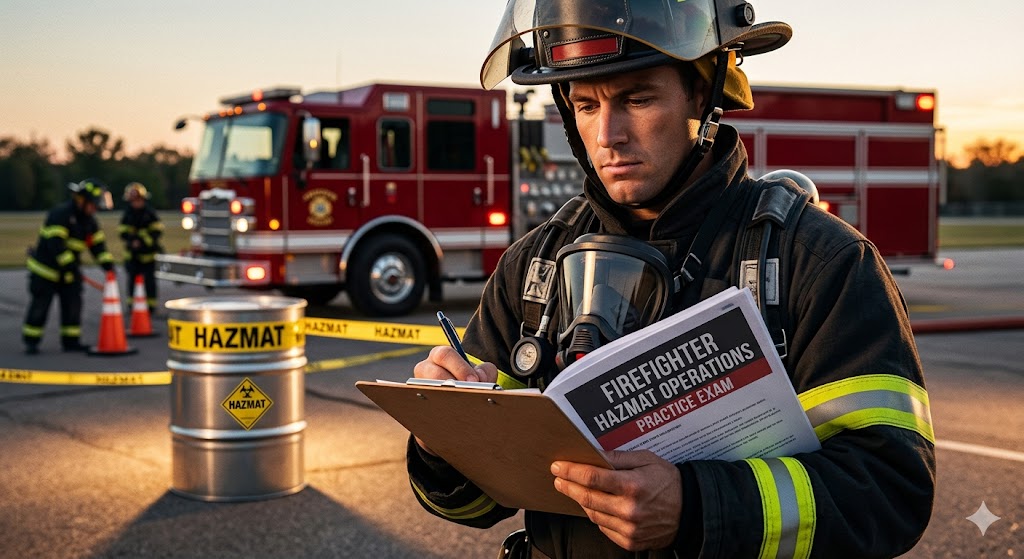
Additional Information
What the Course Entails and Exam Details
The core topics and skills covered are centered on proactive defensive strategies and safety procedures at the scene of a hazardous materials incident.
This includes advanced recognition and identification techniques, such as analyzing hazmat labeling systems, shipping documents, and utilizing safety data sheets (SDS).
Participants learn how to predict the behavior of hazardous materials and the potential outcomes based on physical and chemical properties.
Crucially, the curriculum focuses on scene control procedures, defining isolation perimeters, and implementing immediate defensive actions like damming, diking, diverting, and absorption.
The course also covers selecting and utilizing appropriate personal protective equipment (PPE), understanding the principles of gross decontamination (decon), and managing operational risks.
The cognitive exam details generally involve questions derived from these core domains, ensuring a thorough understanding of mitigation tactics and responder safety.
What to Expect in the Final Exam
Candidates should expect a two-part assessment consisting of a cognitive (written) portion and a manipulative (practical skills) demonstration.
The cognitive portion is typically a computer-based or paper-based test consisting of 50 to 100 multiple-choice questions.
A passing score of 70% or higher is commonly required, though specific requirements may vary slightly by certifying agency.
A predetermined time limit, often around 60 to 90 minutes, will be enforced for the written exam.
The practical evaluation is pass/fail and requires candidates to demonstrate competence in several mandatory scenarios.
Practical tasks might include performing air monitoring, demonstrating gross decontamination of a responder, deploying a defensive spill control barrier, or donning specialized operations-level PPE.
Both the cognitive and practical evaluations are proctored by authorized state fire training officials or accredited third-party evaluators to ensure integrity and consistency.
How to Study and Exam Centers
Actionable study strategies are paramount for success, beginning with a comprehensive review of standard fire service textbooks dedicated to HAZMAT Operations.
Utilizing a comprehensive practice exam, such as the one described in this article, is one of the most effective methods for preparing for the cognitive section.
Practice exams identify knowledge gaps and familiarize candidates with the specific phrasing and style of questions they will encounter on test day.
Forming study groups with colleagues to review case studies and practice the analytical processes required for quick decision-making is highly recommended.
For the practical portion, repeatedly drilling on the required manipulative skills—such as deploying containment equipment and managing decon—ensuring speed and strict compliance with safety protocols.
Exam centers are typically managed by state or regional fire training agencies, often located at accredited fire academies or approved community college fire science campuses.
Testing availability is usually coordinated through these official training pathways, and candidates must register well in advance.
Online proctoring is becoming available for the cognitive portion through some accredited agencies, but the practical component must always be completed at a physical evaluation site.
Job Opportunities from the Course
A certification in Firefighter HAZMAT Operations is not just an indicator of specialized skill but is often a mandatory requirement for hiring and promotion within the emergency services sector.
Career paths this certification unlocks or supports include:
Career Firefighter (Minimum qualification in many jurisdictions)
Volunteer Firefighter (Common certification level for operations)
Industrial Fire Brigade Member
Hazardous Materials Specialist (Pre-requisite for Tech level)
ARFF (Aircraft Rescue and Fire Fighting) Specialist
Emergency Management Coordinator (Operational expertise support)
Private Sector EH&S (Environmental Health & Safety) Responder
State or Federal Agency Disaster Response Personnel
Frequently Asked Questions
Reviews
5.0
Based on 0 reviews
Leave a Review
No reviews yet. Be the first to review!