
Firestop Instructional Training (FIT) Level 2 Practice Test
$69.00
- Buy to unlock unlimited access to all Quiz questions and Answers in this Quiz.
- After purchase you can print a PDF of the whole quiz at any point. The PDF will contain the questions and the correct answers.
About this Exam
Unlock your potential and validate your advanced firestop knowledge with the comprehensive Firestop Instructional Training (FIT) Level 2 certification. This intermediate-level program is meticulously designed for professionals in the construction, inspection, and fire protection industries who have already gained a foundational understanding and are eager to elevate their expertise. Whether you are a dedicated installer aiming to enhance your technical skills, a meticulous inspector looking to refine your evaluation processes, or a project manager striving for impeccable compliance and quality, the FIT Level 2 certification provides the theoretical depth and practical insight required for success in complex firestop scenarios. The corresponding exam tests your understanding of sophisticated systems, code requirements, troubleshooting techniques, and inspection protocols, ensuring you can confidently and correctly implement effective passive fire protection measures. Achieving this certification not only demonstrates your commitment to safety but also distinguishes you as a highly skilled and knowledgeable professional within the field.
Ready to test your knowledge?
Buy Now to Access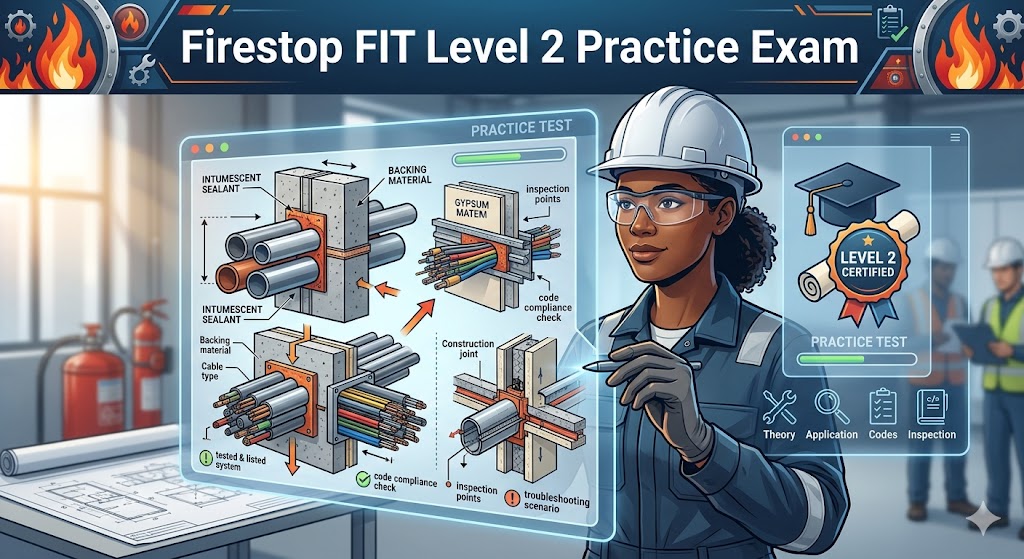
Additional Information
What the Course Entails and Exam Details
The FIT Level 2 curriculum delves significantly deeper into the world of firestopping than foundational courses, equipping you with the specialized knowledge needed for intricate applications. Key topics and areas of focus typically include:
Advanced Firestop Systems: Understanding and selecting complex through-penetration and joint firestop systems for diverse building constructions, materials, and potential movements.
Specific Application Challenges: Techniques for addressing challenging penetrations like large pipe bundles, multi-cable transits, non-metallic pipes, and intricate structural joints.
Code Compliance and Standards: In-depth knowledge of relevant building codes (e.g., IBC, NFPA), testing standards (e.g., UL 1479, ASTM E814, UL 2079), and industry best practices.
Material Selection and Properties: Detailed properties and optimal use cases for various firestop materials (intumescents, sealants, pillows, mortar, etc.) including compatibility and limitations.
Quality Control and QA: Procedures for ensuring proper installation, maintaining documentation, and conducting effective self-inspections.
Special Inspection Requirements: Gaining clarity on the requirements for third-party special inspections of firestop installations.
Interpretation of Listings and Engineering Judgments: How to accurately read, understand, and apply tested and listed system details, and when and how to appropriately seek engineering judgments.
Maintenance and Repair: Strategies for identifying issues, maintaining firestop system integrity over time, and performing effective repairs.
The associated final exam assesses your theoretical understanding and, sometimes, your practical application skills across these critical areas. Expect the exam to be challenging and designed to truly evaluate your competency. Typical exams may consist of:
Multiple Choice Questions: Testing your knowledge on theory, codes, materials, and system selection across various scenarios.
Scenario-Based Assessment: Presenting real-world installation or inspection situations where you must identify correct procedures, potential issues, or compliant solutions.
Interpretation of Technical Data: Analyzing system drawings, listings, or technical data sheets to make informed decisions.
Some programs may also include a practical demonstration or evaluation component where you must perform specific installation techniques correctly or conduct a mock inspection.
What to Expect in the Final Exam
The exact structure, timing, and passing score of your FIT Level 2 final exam will depend on the specific training provider and certification body. However, based on industry standards for similar intermediate certifications, you can generally anticipate the following:
Format: The primary component is likely to be a comprehensive multiple-choice examination. This could be supplemented by detailed situational analyses, plan review exercises, or, depending on the program's nature, a practical skills assessment.
Passing Score: Expect a relatively high benchmark for success, often requiring a minimum score in the range of 70% to 80% to demonstrate adequate mastery of the advanced material. Always verify the specific requirement with your training institution.
Time Limit: You will be provided with a reasonable but defined amount of time to complete the exam. This is usually several hours for a complex certification test, structured to evaluate not only your knowledge but also your ability to answer efficiently under pressure. Specific duration details will be confirmed by your provider.
General Rules: Standard exam protocol usually applies, including rules against the use of unauthorized materials, specific identification requirements, and procedures for remote proctoring if taken online or designated conduct rules for in-person testing centers.
How to Study and Exam Centers
Preparation is key to succeeding on your FIT Level 2 exam. Implement these actionable study strategies:
Review Training Materials Thoroughly: Your course provider should equip you with comprehensive materials, including textbooks, presentations, and perhaps video content. Dedicate significant time to reviewing these materials repeatedly, focusing on understanding the core concepts and principles, not just memorizing facts.
Utilize Practice Tests: Engaging with practice exams, such as the one described in this article's context, is invaluable. This helps you familiarize yourself with the question types, assess your knowledge gaps, manage your time effectively, and boost your confidence. Seek out practice questions specifically tailored to advanced firestop concepts and systems.
Study Relevant Codes and Standards: Obtain copies of the relevant building codes (like specific chapters of the IBC or NFPA standards) referenced in your course and study the applicable sections diligently. Understand how these codes directly influence firestop practices and requirements.
Engage with Official Study Guides and Resources: Many reputable organizations offer official study guides, flashcards, or interactive modules designed to reinforce key learning objectives and help you prepare systematically for their specific exams.
Practical Application: If possible, spend time observing or participating in complex firestop installations under proper supervision. Apply your theoretical knowledge to real-world scenarios to solidify your understanding. Even if you cannot install, studying complex cross-sections and real-world examples can be highly beneficial.
Form Study Groups: Collaborating with peers can be motivating and allow you to discuss challenging topics, share perspectives, and reinforce your learning through teaching others.
Exam administration methods for FIT Level 2 can vary. Your specific training provider or certification body will provide definitive instructions, but general expectations include:
Online Portals: Many certifications, especially theoretical components, can be taken remotely via secure online testing platforms provided by the training organization or an authorized testing partner. These are often proctored live or recorded for security.
Authorized Training Schools or Centers: Some providers may require you to take the exam in person at their specific physical locations, authorized trade schools, or designated testing centers. This is particularly common if a practical evaluation component is included.
Testing Networks: While less common for niche trade certifications than for broad professional exams, some specialized certifications might leverage established third-party testing center networks like Pearson VUE, especially for computer-based theoretical exams. However, you are more likely to take this type of exam directly through the training organization’s online systems or physical training sites.
Always check with your specific FIT Level 2 course provider for detailed information on exam registration, fees, scheduling, location options, and specific preparation resources available to you.
Job Opportunities from the Course
Earning your FIT Level 2 certification signifies a higher level of firestop competency, opening doors to advanced roles and enhanced career paths. Potential job titles and career opportunities unlocked by this certification include:
Certified Lead Firestop Installer: Take on more complex projects, lead installation teams, and ensure adherence to advanced specifications and compliance requirements.
Firestop Inspector / Specialist Inspector: Transition into a specialized inspector role, evaluating installations for compliance with complex codes and standards for regulatory bodies or specific projects.
Fire Protection Technician / Specialist: Apply advanced knowledge within broader fire protection service and installation companies, focusing specifically on sophisticated passive systems.
Quality Control / QA Specialist (Firestop focus): Manage quality assurance programs specifically for firestopping on large-scale construction projects or within large contracting firms.
Firestop Foreman / Supervisor: Take on leadership roles overseeing entire teams and projects, planning and managing advanced installation processes.
Project Manager (with Firestop Expertise): Manage construction projects with a significant fire protection scope, leveraging deep knowledge to ensure efficient, compliant, and high-quality firestop implementation.
Fire Engineering / Consulting Roles: Gain knowledge that can contribute significantly to fire engineering firms or provide specialized consulting on complex passive fire protection strategies.
Congratulations on considering this advanced step in your fire protection career! Thorough preparation and a dedication to understanding the sophisticated nuances of firestop systems will set you up for success on the exam and beyond. Best of luck!
Here is a comprehensive, SEO-optimized guide to preparing for your Firestop FIT Level 2 Practice Exam, followed by an educational image tailored to the certification.
Firestop FIT Level 2 Practice Exam
Description
Unlock your potential and validate your advanced firestop knowledge with the comprehensive Firestop Instructional Training (FIT) Level 2 certification. This intermediate-level program is meticulously designed for professionals in the construction, inspection, and fire protection industries who have already gained a foundational understanding and are eager to elevate their expertise. Whether you are a dedicated installer aiming to enhance your technical skills, a meticulous inspector looking to refine your evaluation processes, or a project manager striving for impeccable compliance and quality, the FIT Level 2 certification provides the theoretical depth and practical insight required for success in complex firestop scenarios. The corresponding exam tests your understanding of sophisticated systems, code requirements, troubleshooting techniques, and inspection protocols, ensuring you can confidently and correctly implement effective passive fire protection measures. Achieving this certification not only demonstrates your commitment to safety but also distinguishes you as a highly skilled and knowledgeable professional within the field.
What the Course Entails and Exam Details
The FIT Level 2 curriculum delves significantly deeper into the world of firestopping than foundational courses, equipping you with the specialized knowledge needed for intricate applications. Key topics and areas of focus typically include:
Advanced Firestop Systems: Understanding and selecting complex through-penetration and joint firestop systems for diverse building constructions, materials, and potential movements.
Specific Application Challenges: Techniques for addressing challenging penetrations like large pipe bundles, multi-cable transits, non-metallic pipes, and intricate structural joints.
Code Compliance and Standards: In-depth knowledge of relevant building codes (e.g., IBC, NFPA), testing standards (e.g., UL 1479, ASTM E814, UL 2079), and industry best practices.
Material Selection and Properties: Detailed properties and optimal use cases for various firestop materials (intumescents, sealants, pillows, mortar, etc.) including compatibility and limitations.
Quality Control and QA: Procedures for ensuring proper installation, maintaining documentation, and conducting effective self-inspections.
Special Inspection Requirements: Gaining clarity on the requirements for third-party special inspections of firestop installations.
Interpretation of Listings and Engineering Judgments: How to accurately read, understand, and apply tested and listed system details, and when and how to appropriately seek engineering judgments.
Maintenance and Repair: Strategies for identifying issues, maintaining firestop system integrity over time, and performing effective repairs.
The associated final exam assesses your theoretical understanding and, sometimes, your practical application skills across these critical areas. Expect the exam to be challenging and designed to truly evaluate your competency. Typical exams may consist of multiple choice questions, scenario-based assessments, and data interpretation exercises.
What to Expect in the Final Exam
The exact structure, timing, and passing score of your FIT Level 2 final exam will depend on the specific training provider and certification body. However, based on industry standards for similar intermediate certifications, you can generally anticipate the following:
Format: The primary component is likely to be a comprehensive multiple-choice examination. This could be supplemented by detailed situational analyses, plan review exercises, or, depending on the program's nature, a practical skills assessment.
Passing Score: Expect a relatively high benchmark for success, often requiring a minimum score in the range of 70% to 80% to demonstrate adequate mastery of the advanced material. Always verify the specific requirement with your training institution.
Time Limit: You will be provided with a reasonable but defined amount of time to complete the exam. This is usually several hours for a complex certification test, structured to evaluate not only your knowledge but also your ability to answer efficiently under pressure. Specific duration details will be confirmed by your provider.
General Rules: Standard exam protocol usually applies, including rules against the use of unauthorized materials, specific identification requirements, and procedures for designated conduct rules for in-person testing centers or remote proctoring if applicable.
How to Study and Exam Centers
Preparation is key to succeeding on your FIT Level 2 exam. Implement these actionable study strategies:
Review Training Materials Thoroughly: Your course provider should equip you with comprehensive materials. Dedicate significant time to reviewing these materials repeatedly, focusing on understanding the core concepts and principles.
Utilize Practice Tests: Engaging with practice exams, such as the one described in this context, is invaluable. This helps you familiarize yourself with the question types, assess your knowledge gaps, manage your time effectively, and boost your confidence.
Study Relevant Codes and Standards: Obtain copies of the relevant building codes referenced in your course and study the applicable sections diligently. Understand how these codes directly influence firestop practices.
Engage with Official Study Guides and Resources: Many reputable organizations offer official study guides or interactive modules designed to reinforce key learning objectives and help you prepare systematically for their specific exams.
Practical Application: If possible, spend time observing or participating in complex firestop installations under proper supervision to solidify your practical understanding. Even without direct participation, detailed study of advanced application scenarios is highly beneficial.
Form Study Groups: Collaborating with peers can be motivating and allow you to discuss challenging topics and reinforce your learning.
Exam administration methods for FIT Level 2 can vary. Your specific training provider or certification body will provide definitive instructions, but general expectations include online testing portals, specific physical testing centers or authorized trade schools, and potentially larger testing center networks for standardized theoretical exams.
Always check with your specific FIT Level 2 course provider for detailed information on exam registration, fees, scheduling, location options, and specific preparation resources available to you.
Job Opportunities from the Course
Earning your FIT Level 2 certification signifies a higher level of firestop competency, opening doors to advanced roles and enhanced career paths. Potential job titles and career opportunities unlocked by this certification include:
Certified Lead Firestop Installer
Firestop Inspector / Specialist Inspector
Fire Protection Technician / Specialist
Quality Control / QA Specialist (Firestop focus)
Firestop Foreman / Supervisor
Project Manager (with Firestop Expertise)
Fire Engineering / Consulting Roles
Frequently Asked Questions
Reviews
5.0
Based on 0 reviews
Leave a Review
No reviews yet. Be the first to review!