
First Aid for Corrections Officers Practice Test
$69.00
- Buy to unlock unlimited access to all Quiz questions and Answers in this Quiz.
- After purchase you can print a PDF of the whole quiz at any point. The PDF will contain the questions and the correct answers.
About this Exam
For corrections officers, first aid knowledge is not optional; it's an essential, life-saving skill set required in the unique, challenging environments of correctional facilities.
This certification ensures that corrections personnel can confidently and effectively respond to medical emergencies involving both staff and inmates.
The associated exam validates critical knowledge across various situations.
It is designed for new recruits entering the field and experienced officers needing to recertify.
Preparing with a practice test will significantly increase confidence and focus for the actual assessment.
Ready to test your knowledge?
Buy Now to Access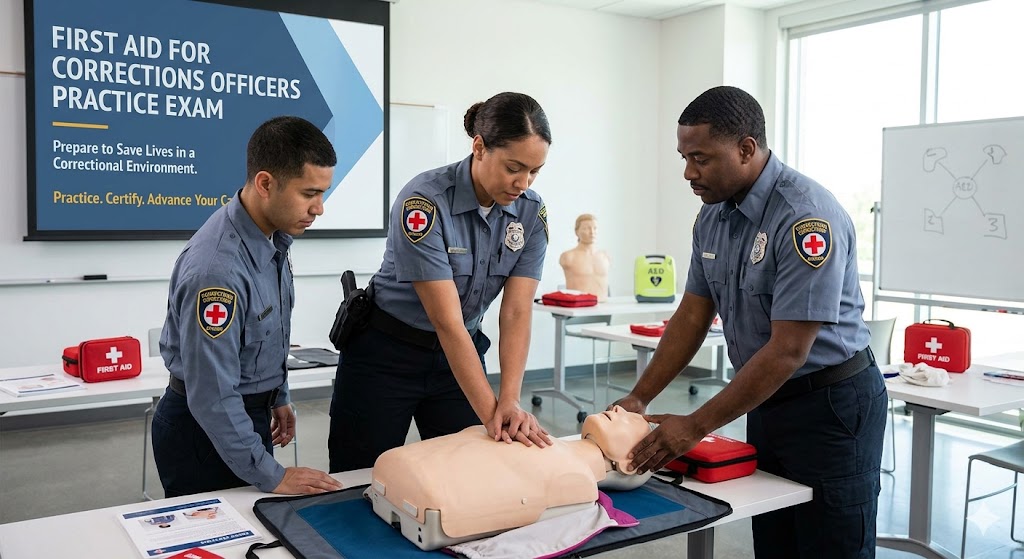
Additional Information
What the Course Entails and Exam Details
The comprehensive First Aid course for corrections officers covers a wide range of topics, combining standard first aid protocols with specific knowledge tailored to correctional settings.
Key areas include: recognizing and evaluating medical emergencies; performing Cardio-Pulmonary Resuscitation (CPR) on adults (and sometimes children); using an Automated External Defibrillator (AED); managing choking incidents; and controlling severe bleeding through techniques like applying pressure, wound packing, and using tourniquets.
The syllabus often includes treating different types of wounds, burns, and fractures.
Participants learn to assess and manage shock, handle environmental emergencies (like heatstroke or hypothermia), and respond to common medical issues such as heart attacks, strokes, and allergic reactions.
Specific to correctional environments, the course also addresses scenarios like responding to self-harm, handling potential drug overdoses (e.g., Naloxone administration), and managing injuries related to assaults or physical confrontations.
Theoretical knowledge of bloodborne pathogens is crucial and included in most curriculums.
What to Expect in the Final Exam
The final exam structure typically involves both a written assessment and potentially a practical skills demonstration.
The practice test focuses on the written component.
The real exam's written portion is commonly composed of multiple-choice questions designed to test your understanding of first aid principles and procedures.
Expect questions covering steps for assessments, identifying symptoms, correct treatments for different injuries and conditions, and safety protocols for responders.
While the exact number of questions varies, the exam will challenge your recall of the material.
Passing scores are generally around 70-80% for the written part.
There is often a set time limit, e.g., 60-90 minutes.
Depending on the specific certification, the practical part requires demonstrating proficiency in core skills, such as properly performing CPR and dressing a simulated wound under the observation of a certified instructor.
How to Study and Exam Centers
Effective studying is key to passing your first aid exam on the first attempt.
Start by thoroughly reviewing the official training materials and guidelines provided by authorized organizations, such as the American Red Cross or American Heart Association.
Consistent review of the topics through flashcards and summarizing key concepts will enhance retention.
Take advantage of practice tests to simulate the exam environment, identify knowledge gaps, and get accustomed to the question format.
Repeated practice of theoretical knowledge builds the confidence required for both written and potential practical evaluations.
The First Aid for Corrections Officers exam is typically administered through official training providers.
These can include accredited schools, dedicated training centers, and increasingly, online learning portals for the theoretical component.
However, the practical skills assessment almost always requires attendance in person at an authorized location for supervised demonstration.
Check with your department, the agency certifying you, or reputable training organizations to find specific testing locations near you. Many major cities have dedicated centers, and regional criminal justice training academies often host these courses.
Job Opportunities from the Course
A current First Aid and CPR certification is a standard requirement for almost all frontline positions within corrections.
Earning this certification opens up a variety of rewarding career opportunities. Here are some specific job titles and career paths this qualification unlocks:
Corrections Officer
Jailer / Detention Officer
Corrections Supervisor / Sergeant
Prison Transport Officer
Correctional Facility Administrator (with significant experience)
Correctional Emergency Response Team (CERT) Member
Court Security Officer (where first aid proficiency is mandatory)
Sheriff’s Deputy (in some jurisdictions with correctional duties)
Probation Officer (though not always mandatory, first aid is a highly valued asset)
Frequently Asked Questions
Reviews
5.0
Based on 0 reviews
Leave a Review
No reviews yet. Be the first to review!