
First Aid for Criminal Justice Officers Practice Exam
$69.00
- Buy to unlock unlimited access to all Quiz questions and Answers in this Quiz.
- After purchase you can print a PDF of the whole quiz at any point. The PDF will contain the questions and the correct answers.
About this Exam
The First Aid for Criminal Justice Officers certification is a specialized, life-saving training program designed exclusively for modern law enforcement and corrections personnel.
Because officers are often the very first to arrive at the scene of an emergency or violent incident, possessing advanced first aid skills is absolutely critical.
This credential ensures that first responders have the necessary expertise to stabilize trauma victims, manage medical crisis situations, and sustain life until professional emergency medical services (EMS) take over.
Whether you are a police academy recruit, a seasoned patrol officer, or a correctional facility guard, mastering this material and passing the exam empowers you to protect and serve your community with absolute confidence.
Ready to test your knowledge?
Buy Now to Access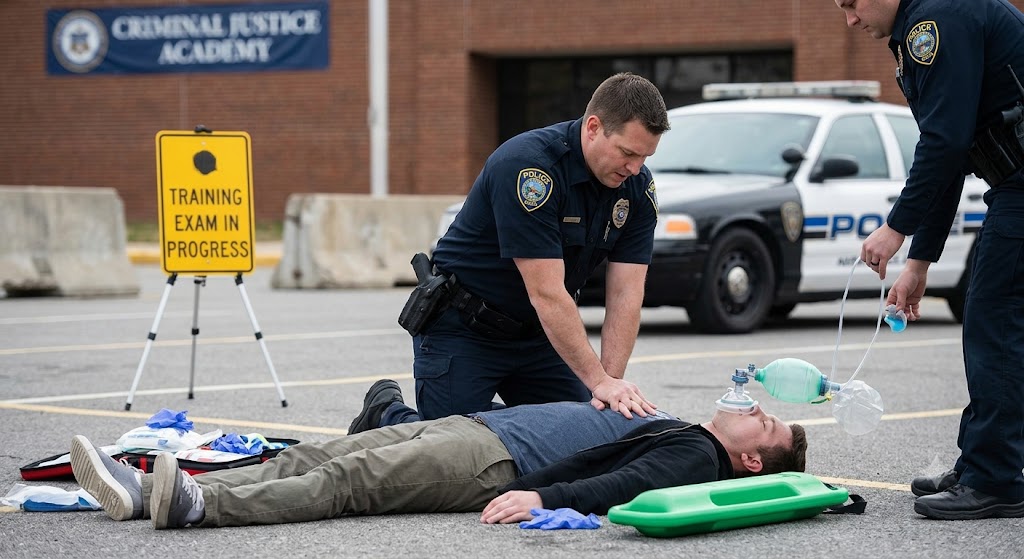
Additional Information
What the Course Entails and Exam Details
This comprehensive course provides a deep dive into high-stress medical interventions tailored specifically for the criminal justice environment.
The syllabus covers essential basic life support techniques, including cardiopulmonary resuscitation (CPR) and automated external defibrillator (AED) operation for adults, children, and infants.
Beyond the basics, you will learn tactical medical skills crucial for law enforcement, such as gunshot and stab wound management, rapid tourniquet application, and severe hemorrhage control.
Furthermore, the curriculum addresses modern occupational hazards, equipping you with the vital knowledge to handle opioid overdoses using Naloxone (Narcan), mitigate physiological shock, and properly treat exposure to hazardous materials or chemical crowd-control agents.
What to Expect in the Final Exam
The final examination rigorously evaluates both your theoretical medical knowledge and your ability to perform under immense pressure.
Typically, the test consists of a two-part assessment: a comprehensive written multiple-choice section and a hands-on practical skills demonstration.
The written multiple-choice portion generally features 40 to 50 questions testing your situational judgment, knowledge of triage, and medical protocols. The standard passing score is usually strictly set at 80% or higher.
For the practical component, you will be required to successfully execute life-saving maneuvers on medical training mannequins within a specific time limit. Examiners will grade your physical techniques, ensuring you can act flawlessly and decisively when every second counts.
How to Study and Exam Centers
Success in this demanding exam requires a dedicated blend of active recall, scenario-based learning, and hands-on practice.
Start by thoroughly reviewing official study guides and taking timed practice exams to familiarize yourself with the phrasing of the multiple-choice questions.
Mental visualization and scenario-based roleplay with a study partner will drastically improve your muscle memory and confidence for the practical skills assessment.
Exams are generally administered directly at accredited police academies, specialized law enforcement training centers, or through globally recognized organizations like the American Red Cross and the American Heart Association. While some institutions allow you to take the written portion via secure online portals or at Pearson VUE testing centers, the practical skills assessment must always be completed in person at an authorized physical training facility.
Job Opportunities from the Course
Earning this critical certification significantly enhances your resume, reduces agency liability, and opens doors to various rewarding career paths within the justice system.
Here are some of the key job titles and career paths this qualification unlocks or supports:
Police Officer / Patrol Deputy
Correctional Officer / Jailer
Probation and Parole Officer
Court Bailiff / Security Officer
Private Security Director
Tactical Response Team (SWAT) Member
Campus Law Enforcement Officer
Transport Officer
Frequently Asked Questions
Reviews
5.0
Based on 0 reviews
Leave a Review
No reviews yet. Be the first to review!