
First Year Welding Practice Test
$69.00
- Buy to unlock unlimited access to all Quiz questions and Answers in this Quiz.
- After purchase you can print a PDF of the whole quiz at any point. The PDF will contain the questions and the correct answers.
About this Exam
Stepping into the welding industry is an exciting and rewarding journey that begins with mastering the fundamentals.
The first-year welding exam is a critical milestone designed to test the foundational knowledge and practical skills you have acquired during your initial months of training.
This certification is perfectly tailored for apprentices, trade school students, and entry-level welders who are eager to prove their competence and advance to the next stage of their careers.
By successfully passing this assessment, you demonstrate to instructors and future employers that you understand essential safety protocols and possess the basic physical skills needed to fabricate and join metals.
Think of this exam not just as a test, but as a stepping stone that formally introduces you into the professional world of skilled trades.
Ready to test your knowledge?
Buy Now to Access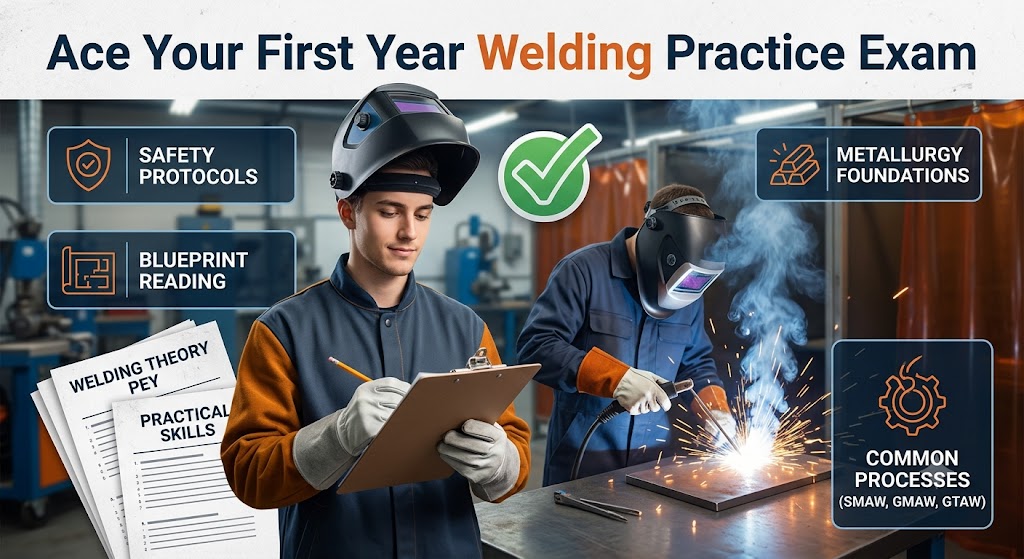
Additional Information
What the Course Entails and Exam Details
A first-year welding course provides a robust blend of theoretical classroom learning and hands-on workshop experience.
You will spend a significant amount of time studying comprehensive safety regulations, including the proper use of Personal Protective Equipment (PPE) and fire prevention techniques.
The syllabus heavily emphasizes blueprint reading and weld symbol interpretation, which are critical for executing projects accurately.
You will also explore the basics of metallurgy, learning how different metals react to heat and stress.
Practically, the course covers the setup and operation of primary welding processes such as Shielded Metal Arc Welding (SMAW), Gas Metal Arc Welding (GMAW), and Oxy-fuel cutting.
The exam details are structured to evaluate your proficiency in both the scientific theory behind welding and your physical ability to lay down a structurally sound bead.
What to Expect in the Final Exam
The final first-year welding exam is typically divided into two distinct components: a written theoretical test and a practical hands-on assessment.
The written portion generally consists of multiple-choice and true/false questions covering safety guidelines, equipment terminology, and blueprint symbols, often with a time limit of 60 to 90 minutes.
To pass the written exam, most institutions require a minimum score of 70% to 75%.
Following the written section, you will face the practical exam, where you must perform specific welds—such as a basic fillet weld or a flat groove weld—on standard carbon steel plates.
Inspectors will strictly grade your practical work based on the visual quality of the weld, proper penetration, uniformity, and your adherence to safety rules during the procedure.
How to Study and Exam Centers
Preparation is the absolute key to conquering your first-year welding test with confidence.
For the written portion, utilizing practice exams, flashcards for weld symbols, and reviewing your course manual daily will help cement your theoretical knowledge.
For the practical portion, nothing beats repetitive, focused arc time in the booth under the guidance of your instructor.
Make sure you practice the exact weld positions and joint types specified in your exam rubric.
When it comes time to take the test, written exams are often administered at local vocational schools, community colleges, or through authorized testing portals like Pearson VUE.
The practical welding test will always take place in a certified physical testing center, such as an American Welding Society (AWS) Accredited Test Facility (ATF) or your institution's dedicated welding laboratory.
Job Opportunities from the Course
Earning your first-year welding credentials opens the door to a variety of entry-level positions that allow you to earn a living while you continue to hone your craft.
You will be highly qualified for the role of a Welder Helper, where you will assist senior welders by preparing materials, grinding parts, and maintaining equipment.
Many graduates secure positions as Apprentice Welders, working under direct supervision to complete basic structural and fabrication tasks while gaining hours toward their journeyman status.
Additionally, this certification unlocks roles such as a Manufacturing Assembler or Production Welder, where you will perform repetitive, high-volume welds in a controlled factory setting.
You might also find opportunities as a Metal Fabricator Assistant, helping to cut, bend, and assemble metal components for commercial construction or automotive repair.
Frequently Asked Questions
Reviews
5.0
Based on 0 reviews
Leave a Review
No reviews yet. Be the first to review!