
FISDAP EMT Airway Practice Test
$69.00
- Buy to unlock unlimited access to all Quiz questions and Answers in this Quiz.
- After purchase you can print a PDF of the whole quiz at any point. The PDF will contain the questions and the correct answers.
About this Exam
The FISDAP EMT Airway Practice Test is a vital self-assessment tool designed specifically for students currently enrolled in or completing an Emergency Medical Technician (EMT) training program. It is not the final certification itself but a comprehensive practice exam focused solely on the critical subject of airway management. This targeted assessment is crafted to help aspiring EMTs gauge their understanding and readiness for subsequent, decisive certification exams, like those from the National Registry of Emergency Medical Technicians (NREMT).
The primary goal of this practice test is to identify knowledge gaps, practice answer application, and build confidence before taking larger, high-stakes assessments. It is an invaluable resource for students aiming to master airway skills, which are fundamental to effective emergency patient care. Who is it for? Primarily, it serves EMT students, educational programs, and instructors looking for a robust way to measure student understanding and preparedness in this specific, crucial competency area.
Ready to test your knowledge?
Buy Now to Access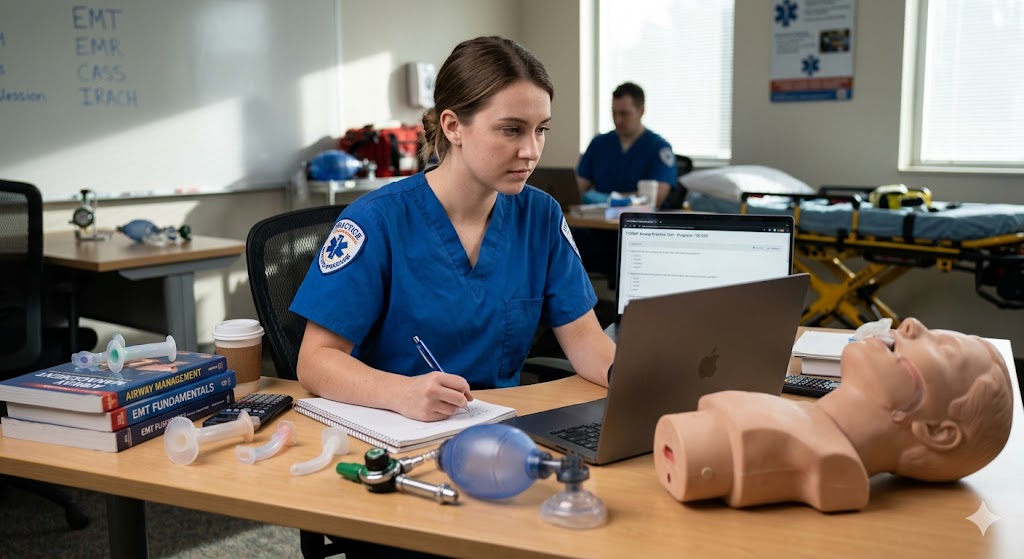
Additional Information
What the Course Entails and Exam Details
This practice test does not constitute a standalone course but is integrated into, or intended for use following, the airway management portion of a full EMT curriculum. As such, it covers the foundational knowledge and critical thinking required for effective airway intervention. Topics typically included are:
Anatomy and Physiology: Upper and lower airway structures, respiratory function, and pathophysiology of breathing difficulties.
Airway Assessment: Recognizing signs of adequate and inadequate breathing, including breath sounds, chest rise, and skin color.
Airway Techniques: Manual airway maneuvers (head-tilt-chin-lift, jaw-thrust), suctioning procedures, and foreign body airway obstruction management.
Airway Adjuncts: Proper sizing, insertion, and use of oropharyngeal and nasopharyngeal airways.
Oxygen Administration: Oxygen delivery devices (nasal cannula, non-rebreather mask, bag-valve-mask), tank safety, and regulator operation.
Ventilation: Techniques for assisting ventilations, including mouth-to-mask and two-person bag-valve-mask ventilation.
Special Considerations and Complications: Managing airways in pediatric, geriatric, and trauma patients, as well as recognizing and mitigating ventilation complications like gastric distention.
The exam details itself focus on testing knowledge and critical application rather than practical skills performance. It consists of multiple-choice questions designed to simulate the style and rigor of certification exams. FISDAP assessments generally emphasize scenario-based questioning, challenging you to apply your knowledge to realistic emergency medical situations.
What to Expect in the Final Exam
For this specific FISDAP EMT Airway Practice Test, you should expect a focused experience designed as a program's key readiness assessment for the airway subject. It is common for such tests to feature around 200 multiple-choice questions, accessible online through a portal provided by your EMT training program.
Expect a realistic, potentially timed environment that mimics real exam pressure. Instant feedback is a hallmark of FISDAP; once completed, you'll receive your score and typically a detailed "Learning Prescription" outlining your performance by topic, allowing you to focus your study on weak areas effectively. Keep in mind that while this is a rigorous practice final, the true final certification (cognitive and psychomotor) is administered through national or state bodies like the NREMT, using specific, often distinct procedures (such as public Pearson VUE centers for the cognitive part).
How to Study and Exam Centers
Effective preparation for this practice exam involves a multifaceted approach:
Utilize Course Materials: Review your EMT textbook, lecture notes, and program presentations, ensuring you understand both the 'what' and 'why' of airway management principles.
Practice Practical Skills: Even though this is a written test, practicing manual techniques and equipment usage on manikins helps reinforce conceptual understanding and skill application.
Leverage FISDAP Tools: Actively use the practice tests, quizzes, and detailed feedback provided by FISDAP within your program. Pay close attention to your Learning Prescription.
Study with Scenarios: Practice applying your knowledge to realistic scenarios, thinking critically about appropriate airway interventions and priorities in diverse patient situations.
Regarding exam centers, for the secure, proctored FISDAP EMT Airway Practice Test, you will typically access and take the exam online through your authorized EMT training program’s specific FISDAP portal. These tests are usually proctored by instructors or program staff within the school environment or an approved secure location. You would not typically go to a public Pearson VUE or other large testing center specifically for the FISDAP practice test version, unlike the final National Registry cognitive exam which is administered through such facilities.
Job Opportunities from the Course
Successfully preparing for and utilizing this practice test, as well as the complete EMT course, unlocks numerous rewarding career paths upon full state or national certification. While this test itself isn't a job-granting certification, obtaining your EMT certification is the key milestone that qualifies you for many vital roles in emergency medical services (EMS) and related fields. Opportunities unlocked by becoming a certified EMT, for which this test is critical preparation, include:
Emergency Medical Technician (EMT) - Ambulance services, fire departments, hospital emergency rooms.
Firefighter/EMT.
Lifeguard (with EMT certification).
Dispatcher (often requires/benefits from EMT knowledge).
Industrial EMT.
Emergency Room Technician.
Ski Patrol/Wilderness First Responder (often roles requiring or benefiting from EMT level care).
Frequently Asked Questions
Reviews
5.0
Based on 0 reviews
Leave a Review
No reviews yet. Be the first to review!