
FISDAP Obstetrics and Pediatrics Practice Test
$69.00
- Buy to unlock unlimited access to all Quiz questions and Answers in this Quiz.
- After purchase you can print a PDF of the whole quiz at any point. The PDF will contain the questions and the correct answers.
About this Exam
The FISDAP Obstetrics and Pediatrics Practice Test is an online, computer-based assessment specifically designed for individuals currently enrolled in Emergency Medical Technician (EMT), Advanced EMT (AEMT), or Paramedic programs. This test acts as a preparatory diagnostic tool, rather than a final certification itself. Its primary purpose is to evaluate a student's understanding of the unique, critical concepts involved in caring for maternal, newborn, and pediatric patients.
It allows students to identify their academic strengths and weaknesses before taking high-stakes final unit exams or the National Registry of Emergency Medical Technicians (NREMT) cognitive exam. By providing a realistic simulation of the types of questions and formatting found on the actual certification exams, the practice test builds confidence and refines test-taking strategies for these specialized and challenging populations.
Ready to test your knowledge?
Buy Now to Access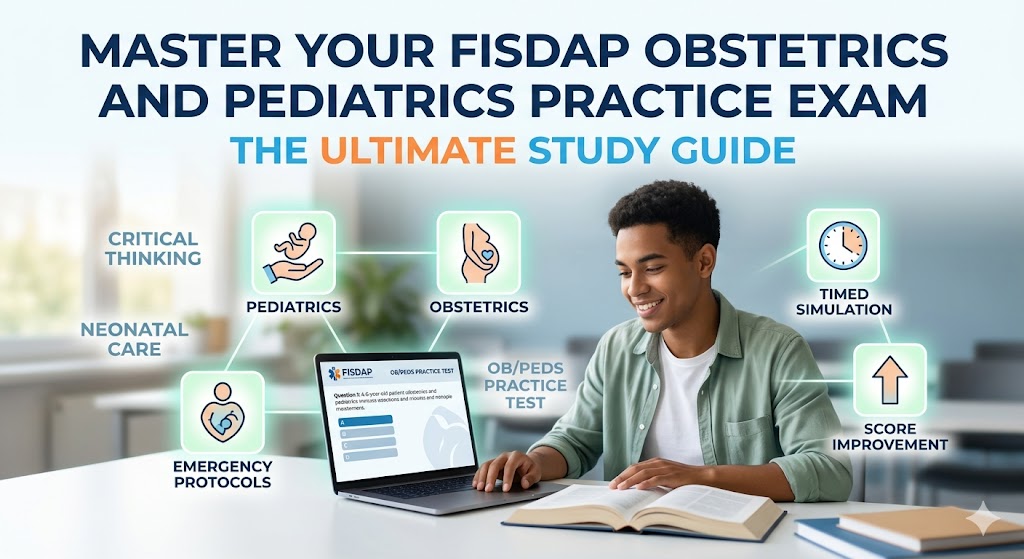
Additional Information
What the Course Entails and Exam Details
This practice test focuses intensely on two critical domains of emergency medical care: obstetrics and pediatrics. It is not a course, but rather an assessment of knowledge gained during the obstetrics/gynecology and pediatrics modules of an EMS program. The content is aligned with the latest National EMS Education Standards and American Heart Association (AHA) guidelines.
Key topics covered by the test items include:
Obstetrics and Gynecology
Anatomical and Physiological Changes of Pregnancy: Understanding trimester-specific changes in the mother's body.
Complications of Pregnancy: Recognizing and managing conditions like pre-eclampsia, eclampsia, placenta previa, abruptio placentae, supine hypotensive syndrome, and ectopic pregnancy.
Normal and Abnormal Delivery: Assessing and assisting in normal childbirth, and managing complications like breech presentation, prolapsed cord, limb presentation, and nuchal cord.
Neonatal Care and Resuscitation: Initial assessment (APGAR score), warming, suctioning, and providing advanced life support to newborns.
Postpartum Emergencies: Managing conditions such as postpartum hemorrhage and pulmonary embolism in the mother.
Pediatrics
Anatomical and Physiological Differences: Recognizing how children differ from adults regarding their airway, respiratory system, cardiovascular system, and compensation mechanisms.
Pediatric Assessment Triangle (PAT): Utilizing this tool to quickly form a general impression based on appearance, work of breathing, and circulation to the skin.
Respiratory Emergencies: Identifying and treating upper and lower airway obstructions, croup, epiglottitis, asthma, and bronchiolitis.
Shock and Hypoperfusion: Recognizing signs of compensated and decompensated shock in children.
Medical Emergencies: Management of seizures (including febrile seizures), meningitis, altered mental status, and diabetic emergencies.
Trauma in Pediatrics: Specific considerations for mechanism of injury, head trauma, and burn surface area calculation (using modified Rule of Nines).
Special Considerations: Understanding signs of child abuse and neglect, and managing children with special healthcare needs.
What to Expect in the Final Exam
While this is a practice test, it is designed to closely mimic the structure and style of the final unit exam or the NREMT cognitive exam you are preparing for. Students should treat the practice exam with the same seriousness as the final.
Format: The test consists entirely of multiple-choice questions. It uses the FISDAP "critical thinking" model, which means questions often go beyond simple recall and require the application of knowledge.
Question Types: Be prepared for scenarios where you must determine:
"What should you do first?"
"What is the most likely cause?"
"What should you suspect?" (often the most life-threatening condition).
Number of Questions: The practice test typically ranges from 75 to 100 questions.
Time Limit: There is usually a time limit, mirroring the pace required for the national certification exam (roughly 1 to 1.5 minutes per question), giving you approximately 1.5 to 2.5 hours to complete it.
Passing Score: As a practice diagnostic tool, there isn't a single universal "passing" score set by FISDAP. However, many EMS programs use the related FISDAP final unit exam as a gateway and may require a minimum score of 70% to 75% to achieve a learning prescription or be cleared to test for the NREMT. You should aim for a similar range on the practice test to ensure readiness.
How to Study and Exam Centers
Success on the FISDAP Obstetrics and Pediatrics Practice Test is a strong predictor of success on your certification exam. Approach your study with a structured plan.
Study Strategies and Practice Methods
Utilize FISDAP Study Tools: If your program provides access, use the accompanying FISDAP Study Tools. These include additional practice quizzes, detailed rationales for correct and incorrect answers, and learning prescriptions that tell you exactly what topics you missed.
Master Your Textbook and Workbook: Your primary EMS textbook is your best resource. Review the obstetrics and pediatrics chapters thoroughly and complete all corresponding workbook assignments.
Create Active Study Materials: Develop flashcards for key terms, signs and symptoms of specific emergencies, and pediatric drug dosages. Create flowcharts for normal and complicated delivery procedures.
Simulate the Exam Environment: When you take the practice test, do it in a quiet place, without interruptions, and within the suggested time limit to acclimatize to the pressure.
Review Rationales: The most crucial step is reviewing the rationales for every question you miss. Understand why the correct answer is correct and why your chosen answer was incorrect. This is how you refine your critical thinking.
Focus on "The First Action": For scenario-based questions, practice always identifying what your absolute first step should be (e.g., scene safety, ABCs, immediate life-saving intervention).
Exam Centers and Access
Because this is an online, instructor-administered practice test, you will not go to a third-party testing center like Pearson VUE.
Where to Take It: You will take the exam via the secure FISDAP online portal. It is generally taken within your specific physical classroom, computer lab, or as a proctored online session authorized by your EMS school.
How to Schedule: Your course instructor or program coordinator is responsible for scheduling the exam and providing you with the necessary access credentials or a proctor password. You cannot schedule secure FISDAP exams independently.
Job Opportunities from the Course
While the FISDAP Obstetrics and Pediatrics Practice Test itself is not a certification and does not directly grant licensure or job opportunities, passing the final certification exams it prepares you for unlocks a critical and rewarding career path. Successfully mastering this content and gaining certification as an EMT or Paramedic is the necessary gateway to the following job titles:
Emergency Medical Technician (EMT): Providing basic emergency medical care and transportation.
Advanced EMT (AEMT): Providing basic and limited advanced emergency medical care.
Paramedic: Providing comprehensive advanced emergency medical care, including advanced airway management, medication administration, and ECG interpretation.
Flight Paramedic: Providing critical care during air medical transport.
Critical Care Paramedic: Providing specialized transport care for unstable or critically ill patients.
Emergency Department Technician (ER Tech): Assisting in a hospital emergency department setting.
Firefighter/EMT or Firefighter/Paramedic: Many fire departments require EMS certification.
Tactical Paramedic: Providing medical support to law enforcement special operations teams.
Frequently Asked Questions
Reviews
5.0
Based on 0 reviews
Leave a Review
No reviews yet. Be the first to review!