
Fitness for Duty Practice Test
$69.00
- Buy to unlock unlimited access to all Quiz questions and Answers in this Quiz.
- After purchase you can print a PDF of the whole quiz at any point. The PDF will contain the questions and the correct answers.
About this Exam
The Fitness for Duty assessment is a critical, specialized evaluation designed to ensure an employee is physically, mentally, and emotionally capable of performing the essential functions of their job safely and effectively.
Unlike a general physical, a Fitness for Duty test is a targeted inquiry, typically initiated when an employer has objective evidence to believe an employee cannot perform their job duties, perhaps due to an injury, a serious health condition, or behavioral concerns that pose a safety risk to themselves or others.
A certificate in Fitness for Duty protocols is essential for Human Resources professionals, occupational health specialists, safety managers, and risk coordinators. It empowers them to navigate complex legal frameworks, manage return-to-work scenarios, and make defensible decisions that balance employee well-being with organizational safety. This practice exam is specifically created to help professionals master these concepts and prepare for formal certification in the field.
Ready to test your knowledge?
Buy Now to Access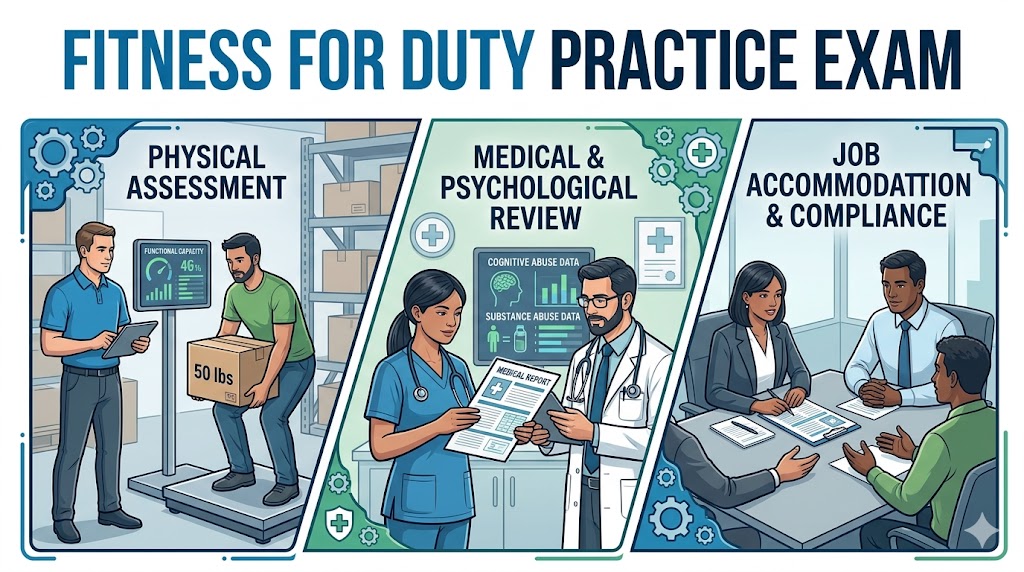
Additional Information
WHAT THE COURSE ENTAILS AND EXAM DETAILS
The core knowledge base for Fitness for Duty certification spans a range of topics, ensuring a holistic understanding of how to manage employee ability.
You must gain comprehensive mastery in three key areas:
1. Legal Compliance and Frameworks
This includes deep knowledge of federal and state laws, most notably the Americans with Disabilities Act (ADA) and the Family and Medical Leave Act (FMLA). It covers when a Fitness for Duty evaluation is legally "job-related and consistent with business necessity," and the boundaries of a "direct threat."
2. Assessment Types and Job Analysis
You will learn to differentiate between and appropriately request different types of tests, such as Functional Capacity Evaluations (FCE), psychological fitness assessments (FFDE), and medical examinations. Crucially, it entails the ability to define "essential functions" from "marginal functions" within a proper job description.
3. The Process, Reporting, and Accommodation
This section covers the standard protocol: objective referral, the medical or psychological assessment process, interpreting results, and engaging in the "interactive process" for reasonable accommodation when a limitation is identified.
WHAT TO EXPECT IN THE FINAL EXAM
This practice test is model after formal certification examinations.
The final exam is a comprehensive assessment of practical knowledge.
You should expect the final certification to consist of scenario-based multiple-choice questions.
A significant portion of the exam will present complex real-world situations, asking you to determine the next correct action, legal position, or interpretation of results. It is less about recalling definitions and more about applying them.
The final exam typically includes 75 questions to be completed within 90 minutes.
A passing score is generally 70%. The exam is usually proctored and may require a clean-desk policy and photo identification.
HOW TO STUDY AND EXAM CENTERS
Preparation should focus on practical application over rote memorization.
We recommend a multi-faceted study plan. First, study official guidance from federal agencies, including the EEOC and Department of Labor, on the ADA, FMLA, and specific regulations for safety-sensitive industries, such as the Department of Transportation (DOT). Next, analyze detailed case studies of proper and improper Fitness for Duty requests.
The best way to prepare is with practice questions, especially those that simulate the scenario-based format of the actual test. Work through the practice exam multiple times, taking note of why certain answers are correct.
For the formal certification, the exam is typically taken through an approved certifying body. These exams are often available as remote-proctored online tests, allowing you to take them from your home or office. Alternatively, you may be able to schedule a slot at a designated physical testing center, such as those operated by Pearson VUE, or at an authorized occupational health school. Check the official website of your specific certification provider for their registered centers.
JOB OPPORTUNITIES FROM THE COURSE
Mastery of Fitness for Duty principles and achieving certification opens diverse career paths in human resources, risk management, and occupational health.
The following are career paths and specific job titles unlocked or advanced by this certification:
Human Resources (HR) Manager or Director
Occupational Health and Safety (OHS) Specialist
Occupational Medicine Coordinator
Return-to-Work Coordinator
Risk Management Analyst
Leave of Absence (LOA) Administrator
ADA Compliance Officer
Legal Compliance Manager
Worker's Compensation Case Manager
Medical Evaluator (Physician or Nurse with special training)
Forensic Psychologist
Frequently Asked Questions
Reviews
5.0
Based on 0 reviews
Leave a Review
No reviews yet. Be the first to review!