
Fleet Marine Force (FMF) – Ground Combat Element (GCE) Written Practice Test
$69.00
- Buy to unlock unlimited access to all Quiz questions and Answers in this Quiz.
- After purchase you can print a PDF of the whole quiz at any point. The PDF will contain the questions and the correct answers.
About this Exam
The Fleet Marine Force (FMF) qualification is one of the most prestigious warfare insignia a United States Navy Sailor can earn.
Specifically, the Ground Combat Element (GCE) component is designed for Sailors, such as Hospital Corpsmen, Religious Program Specialists, and Supply personnel, who are assigned to operational Marine Corps units.
This rigorous qualification process signifies that a Sailor has not only mastered their Navy technical rating but has also gained the detailed knowledge, skills, and physical stamina required to serve and survive alongside Marines in a forward-deployed ground combat environment.
Earning the "FMF" device is a defining moment, marking a Sailor as a true professional within the Navy-Marine Corps team.
Ready to test your knowledge?
Buy Now to Access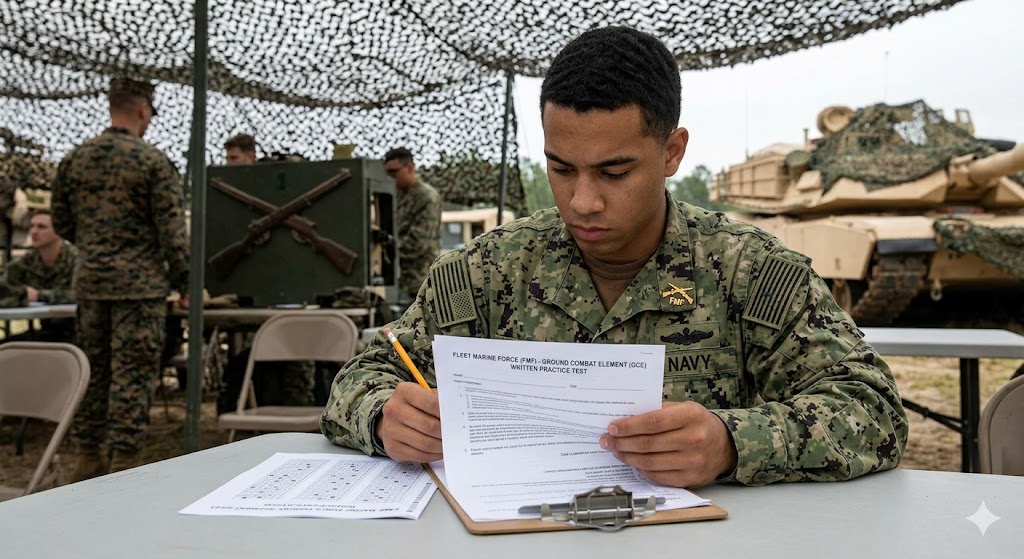
Additional Information
What the Course Entails and Exam Details
To earn the FMF GCE qualification, a Sailor must complete a personal qualification standard (PQS) that typically takes 12 to 18 months.
The process is divided into two main parts: a "Common Core" of general Marine Corps knowledge and a "GCE Specific" block of instruction.
The comprehensive curriculum covers an array of topics, including:
Marine Corps History and Traditions: Key dates, battles, and figures like Dan Daly and Smedley Butler.
Mission and Organization: The structure of the Marine Air-Ground Task Force (MAGTF) and its components.
Uniforms, Rank Structure, and Courtesies: Mastering the identity and protocol of their partner service.
Ground Combat Element Units: In-depth knowledge of infantry, artillery, tank, combat engineer, reconnaissance, and amphibious assault battalions.
Weapons Systems: Familiarity with service rifles (M4/M16), machine guns (M240, M2), and indirect fire systems.
Tactical Fundamentals: Small unit tactics, formations, hand-and-arm signals, and reports like SALUTE and SMEAC.
Land Navigation: Combat map reading, plotting, and using a compass in the field.
Combat Communications: Operating tactical radios, such as the SINCGARS, and understanding basic communication procedures.
First Aid and TCCC: Advanced life-saving skills in a tactical, pre-hospital environment.
CBRN Defense: Protection against Chemical, Biological, Radiological, and Nuclear threats.
The "written" portion of the FMF GCE exam is a crucial milestone, testing a Sailor's retention of this vast amount of information before they are permitted to face the final oral board.
What to Expect in the Final Exam
The FMF GCE written exam is a comprehensive test designed to be challenging and to verify your mastery of the Personal Qualification Standard.
Here is what you can typically expect:
Format: The exam consists primarily of multiple-choice and true/false questions. It may also include matching or short-answer questions.
Content: Expect questions from every section of your GCE PQS, with a strong emphasis on tactical application, unit missions, and weapon systems.
Passing Score: While specific requirements may vary slightly by command, a passing score of 80% or higher is a common standard for military warfare qualifications.
Time Limit: The exam is timed, typically giving you a fixed amount of hours to complete it. You should be prepared to work efficiently.
Rules: The exam is closed-book, and academic integrity is paramount. No external resources or electronic devices are permitted.
A strong performance on the written test is a key indicator to your command that you are ready for the final oral board, often known as the "murder board," where senior FMF-qualified leaders will verbally examine you.
How to Study and Exam Centers
Preparation is the absolute key to success for the FMF GCE exam. It is not a test you can "cram" for at the last minute.
Actionable Study Strategies:
Master Your PQS: Your Personal Qualification Standard (PQS) is your bible. Go through it section by section. Get "sign-offs" from subject matter experts (Marine NCOs or FMF-qualified Sailors) only when you truly know the material.
Create Flashcards: Use physical flashcards or digital apps to memorize key dates, definitions, weapon specs, and tactical terms.
Form Study Groups: Studying with your peers who are also in the process is highly effective. Quiz each other and explain concepts to reinforce learning.
Find an FMF Mentor: Seek out a mentor who already has their pin. They can provide invaluable tips, explain difficult topics, and give you practice oral boards.
Practical Application: Don't just read about it; do it. Practice land navigation, weapon disassembly/reassembly, and TCCC skills in a field or training environment.
Take Practice Tests: Seek out available practice tests from your command or reliable unofficial resources to familiarize yourself with the question types and time management.
Exam Centers:
The FMF GCE written exam is not administered at external testing centers like Pearson VUE. It is an internal Navy qualification. The exam is coordinated and proctored directly by your assigned Marine Corps unit or a designated command training school. You will need to coordinate with your unit’s FMF coordinator or training officer to schedule your test once you have completed all pre-requisite PQS and practical applications.
Job Opportunities from the Course
While the FMF device itself is an additional qualification rather than a separate job rating, earning it is a massive career booster and opens doors to a wide range of specialized billets and operational assignments within the Navy-Marine Corps team.
It makes you a "force multiplier" and demonstrates to leadership that you are capable of operating in the most demanding environments.
Specific job titles and roles for FMF GCE qualified Sailors include:
Hospital Corpsman (FMF): Serving as a "Doc" in an infantry platoon, artillery battery, or other GCE unit.
Religious Program Specialist (FMF): Providing ministry support and liaising between commands and religious communities in a field environment.
Logistics Specialist (FMF): Managing supply and embarkation for forward-deployed Marine GCE units.
FMF Instructor/Coordinator: After gaining experience, leading and mentoring other Sailors through the FMF qualification process.
Special Operations Support Billet: Serving as a specialized support person for Marine Raiders or other SOF units.
FMF Independent Duty Corpsman (IDC): Advanced clinical providers for operational units, requiring the FMF qualification as a baseline.
Medical/Dental Billet (Operational): Personnel assigned to Forward Resuscitative Surgical Systems (FRSS) or other mobile medical units.
Construction Battalion (SeaBee) (with GCE attachment): Engineers supporting GCE maneuver units.
Frequently Asked Questions
Reviews
5.0
Based on 0 reviews
Leave a Review
No reviews yet. Be the first to review!