
FLETC Fourth Amendment Practice Exam
$69.00
- Buy to unlock unlimited access to all Quiz questions and Answers in this Quiz.
- After purchase you can print a PDF of the whole quiz at any point. The PDF will contain the questions and the correct answers.
About this Exam
The Federal Law Enforcement Training Centers (FLETC) provide baseline legal and tactical training for dozens of federal agencies across the United States.
A critical component of this training is mastering constitutional law, specifically the rules surrounding search and seizure.
The FLETC Fourth Amendment exam is a mandatory, rigorous assessment designed for federal law enforcement trainees, criminal investigators, and officers who are currently in the academy.
Passing this exam proves that an aspiring agent understands the delicate balance between effective law enforcement and the constitutional rights of the citizens they serve.
Ready to test your knowledge?
Buy Now to Access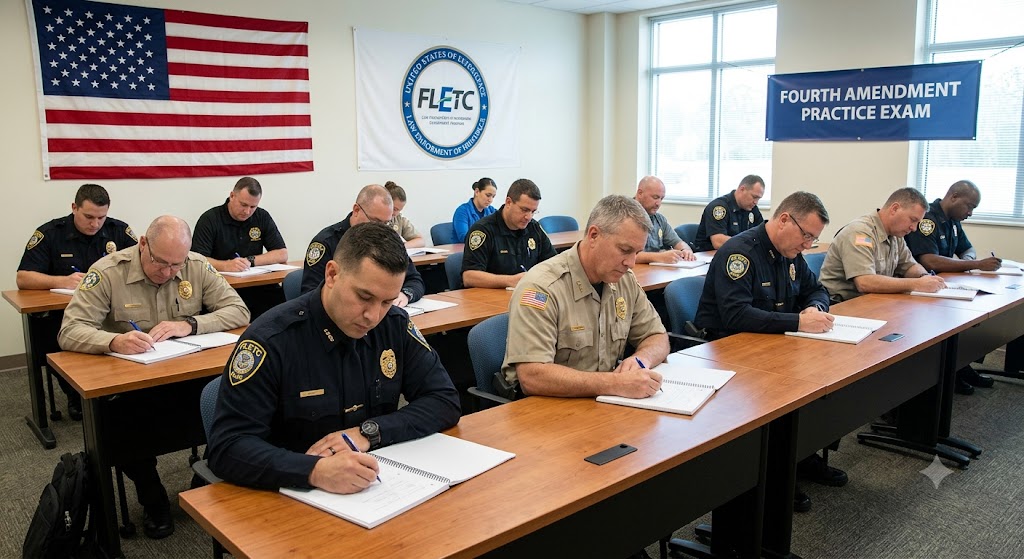
Additional Information
What the Course Entails and Exam Details
The legal course leading up to this exam is highly intensive and focuses heavily on practical application rather than mere memorization.
Trainees will dive deep into the fundamental principles of the Fourth Amendment, which protects citizens from unreasonable searches and seizures.
Core topics include understanding the legal definitions of reasonable suspicion and probable cause.
The syllabus covers the intricacies of drafting, obtaining, and executing search and arrest warrants.
Students will also master the critical exceptions to the warrant requirement, such as exigent circumstances, consent searches, plain view seizures, the motor vehicle exception, and searches incident to a lawful arrest.
Additionally, the curriculum emphasizes the exclusionary rule, teaching trainees how constitutional violations can lead to suppressed evidence in court.
What to Expect in the Final Exam
The final Fourth Amendment exam at FLETC is not your standard academic test; it is deeply scenario-based.
You can expect a multiple-choice format where you are presented with complex, real-world field scenarios.
You must quickly analyze the facts of the scenario, apply the correct case law, and determine whether a hypothetical search or seizure was lawful.
Depending on your specific agency’s requirements within the FLETC program, the passing score generally ranges from 70% to 80%.
The exam is strictly timed, often giving students between 60 to 90 minutes to complete a rigorous set of questions, which mimics the quick decision-making required in the field.
Calculators or outside materials are not permitted, and strict academic integrity rules are enforced throughout the testing period.
How to Study and Exam Centers
Success on the FLETC Fourth Amendment exam requires moving beyond rote memorization into applied critical thinking.
Your best study strategy is to form small study groups and run through hypothetical scenarios with your classmates.
Use flashcards to memorize the specific criteria for warrant exceptions, but spend the majority of your time reviewing the FLETC Legal Division reference materials and case studies.
Practicing with simulated multiple-choice questions will help you recognize trick answers that often rely on subtle legal distinctions.
As for the testing location, this exam is exclusively administered at official FLETC training facilities or authorized agency academies.
Primary exam centers include the main FLETC campus in Glynco, Georgia, as well as facilities in Artesia, New Mexico; Charleston, South Carolina; and Cheltenham, Maryland.
The exams are typically taken on secure computer portals in designated testing labs within these federal facilities.
Job Opportunities from the Course
Mastering the Fourth Amendment and passing this exam is a non-negotiable step toward earning your federal badge and credentials.
Successfully completing this training unlocks numerous high-level law enforcement career paths.
Special Agent (for agencies like the FBI, DEA, ATF, or HSI).
Customs and Border Protection (CBP) Officer.
United States Marshal or Deputy Marshal.
United States Secret Service Agent.
Federal Police Officer (for various federal agencies and installations).
Criminal Investigator for the Office of Inspector General (OIG).
Border Patrol Agent.
Frequently Asked Questions
Reviews
5.0
Based on 0 reviews
Leave a Review
No reviews yet. Be the first to review!