
FLETC Legal Practice Exam
$69.00
- Buy to unlock unlimited access to all Quiz questions and Answers in this Quiz.
- After purchase you can print a PDF of the whole quiz at any point. The PDF will contain the questions and the correct answers.
About this Exam
The FLETC Legal Practice Exam is a pivotal component of the foundational training provided by the Federal Law Enforcement Training Centers (FLETC). As the primary training provider for many of the nation’s 90+ federal law enforcement agencies, FLETC ensures that new recruits and existing officers possess the essential legal knowledge required to perform their duties constitutionally.
This examination is primarily designed for federal law enforcement personnel (excluding the FBI and DEA, which have their own academies, though many DEA agents still receive FLETC-based legal training) and often includes state, local, tribal, and international police officers attending FLETC programs. The certification serves as official validation that an individual understands the scope of their authority, the limitations imposed by the U.S. Constitution, and the essential procedural rules governing federal investigations and court appearances.
Ready to test your knowledge?
Buy Now to Access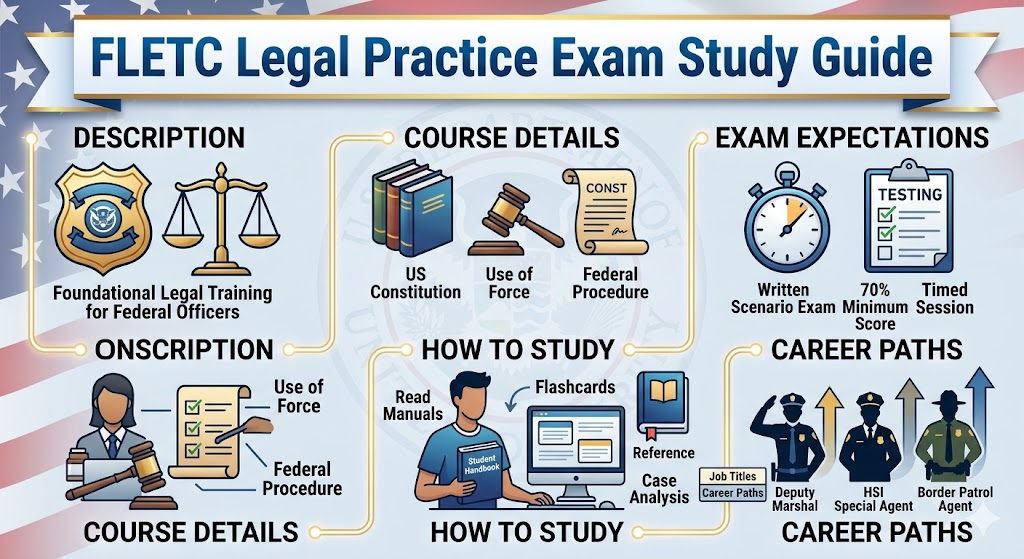
Additional Information
What the Course Entails and Exam Details
FLETC’s Legal Division provides the instruction leading to this exam. The curriculum is rigorous, focusing heavily on criminal law, constitutional limitations, and federal procedure.
The core topics and skills covered in the coursework and validated by the exam typically entail:
Constitutional Law: Dominant focus on the Fourth Amendment (Search and Seizure), Fifth Amendment (Self-Incrimination and Due Process), Sixth Amendment (Right to Counsel and Confrontation), and Eighth Amendment (Cruel and Unusual Punishment).
Use of Force: Legal standards governing the application of force, derived from Supreme Court precedents and Department of Justice policies.
Authority and Jurisdiction: Understanding the specific powers assigned to federal agencies, concepts of exclusive vs. concurrent jurisdiction, and the limitation of authority to specific federal offenses.
Federal Court Procedure: The structure of the federal court system, initial appearances before a U.S. Magistrate Judge, the grand jury process, indictments, and pre-trial motions.
Legal Interviewing and Interrogation: Focus on Miranda rights, voluntariness of statements, and legal pitfalls to avoid during questioning.
Liability: Understanding civil liability for law enforcement officers (Bivens actions) and mechanisms to avoid violating citizens' rights.
What to Expect in the Final Exam
While practical field exercises evaluate other components of FLETC training, the Legal Practice Exam is traditionally a structured, written assessment. Students should be prepared for a comprehensive test that assesses both rote knowledge and the ability to apply legal concepts to realistic scenarios.
Exam Format: The exam usually consists of a substantial number of multiple-choice and/or true-false questions. These questions are frequently framed as short vignettes or case studies, requiring you to determine the legality of an officer's actions or the admissibility of specific evidence based on the fact pattern.
Passing Score Requirements: FLETC maintains high academic standards. While the exact percentage can vary slightly by specific training program, students generally must achieve a minimum score of 70% or 80% to pass the legal portion of their training academy. Failure typically requires remediation and re-testing.
Time Limits: The exam is timed, often providing a strict window (e.g., 2–3 hours) to complete all questions, demanding speed and confidence in your legal knowledge.
Specific Rules: This is generally a "closed book" exam, requiring memory recall and internal synthesis of legal principles rather than looking up precedents.
How to Study and Exam Centers
Effective preparation for the FLETC Legal Practice Exam requires a deliberate and organized approach. The legal material is dense, and conceptual understanding is more valuable than simple memorization.
Actionable Study Strategies:
Master the FLETC Manuals: The definitive resources are the "Legal Training Student Handbook" and the "Legal Training Reference Book." These are your textbooks. Read every chapter assigned, highlight key concepts, and take detailed notes.
Adopt the Case Study Method: FLETC exams are scenario-based. Use the Legal Reference Book to study seminal Supreme Court cases (like Miranda v. Arizona, Terry v. Ohio, and Graham v. Connor). Do not just memorize the ruling; understand the facts, the legal question, and why the Court ruled the way it did. This is how exam questions are built.
Utilize Active Recall Tools: Create your own flashcards or use platforms like Brainscape to master definitions and core principles. Create scenario flashcards: "Can I search a vehicle if X, Y, and Z conditions are met?"
Simulate the Exam: Take every practice quiz and mock exam offered by your instructors. Time yourself to build stamina and speed. Pay close attention to question structure—the legal "trap" is often in the wording of the fact pattern.
Exam Centers:
FLETC examinations are administered internally at FLETC’s own training facilities as part of a structured academy curriculum. You cannot "register" for this exam through an online portal like Pearson VUE; you take it as an enrolled student in a FLETC program.
Physical FLETC Campuses: The primary testing centers are the established FLETC residential sites in:
Glynco, Georgia (Main Campus)
Artesia, New Mexico
Charleston, South Carolina
Cheltenham, Maryland
Exported Training: Occasionally, FLETC "exports" specialized legal training to host state, local, or tribal agencies, in which case the exam would be administered at the host agency’s facility.
Job Opportunities from the Course
Successfully completing your FLETC academy training and passing the Legal Practice Exam is a mandatory prerequisite for career advancement in federal law enforcement. This certification does not unlock "potential" careers; it is the final gate to beginning active duty in a wide range of essential roles.
This training and certification are required for the following specific job titles and career paths:
Deputy U.S. Marshal (U.S. Marshals Service)
Special Agent (many agencies, including DHS/HSI, DEA, Secret Service)
Federal Air Marshal
U.S. Border Patrol Agent
CBP Officer (Customs and Border Protection)
Uniformed Division Officer (U.S. Secret Service)
U.S. Capitol Police Officer
U.S. Park Police Officer
Federal Protective Service (FPS) Officer
Naval Criminal Investigative Service (NCIS) Special Agent
Frequently Asked Questions
Reviews
5.0
Based on 0 reviews
Leave a Review
No reviews yet. Be the first to review!