
Flight Paramedic Certification Practice Exam
$69.00
- Buy to unlock unlimited access to all Quiz questions and Answers in this Quiz.
- After purchase you can print a PDF of the whole quiz at any point. The PDF will contain the questions and the correct answers.
About this Exam
The Flight Paramedic Certification (FP-C) is a premier credential designed for highly experienced paramedics looking to elevate their careers into the specialized realm of critical care and aeromedical transport.
Administered by the International Board of Specialty Certification (IBSC), this rigorous certification serves as a benchmark for excellence in the field.
It is specifically tailored for seasoned EMS professionals who are ready to prove their mastery in advanced clinical concepts, complex patient management, and the unique challenges of treating patients at high altitudes.
Earning this certification demonstrates to employers and peers that you possess the elite knowledge required to safely manage critically ill and injured patients in austere, dynamic environments.
Ready to test your knowledge?
Buy Now to Access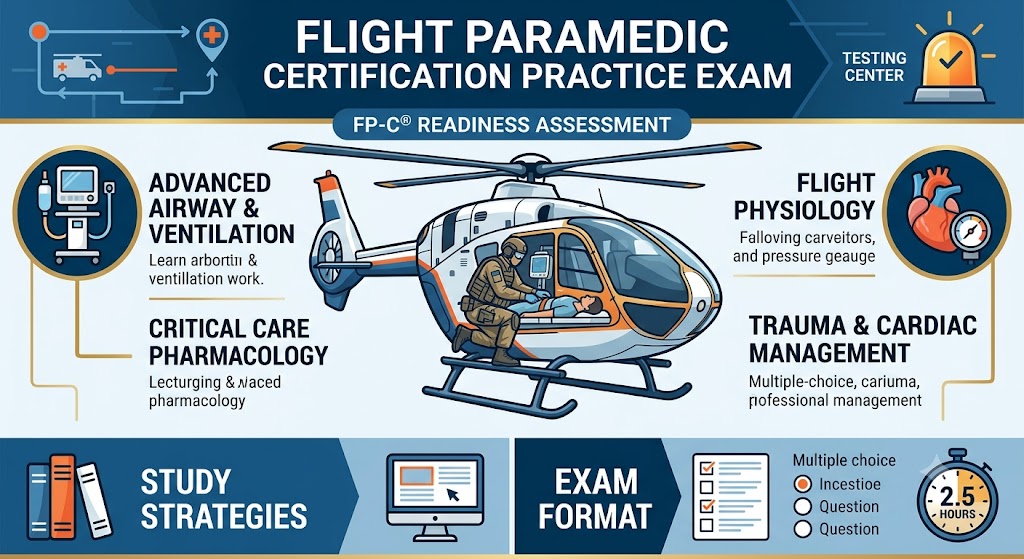
Additional Information
What the Course Entails and Exam Details
Preparing for the FP-C requires a deep dive into advanced medical science and critical care procedures that go far beyond standard paramedic training.
A central component of the syllabus is flight physiology, where you will learn how altitude, gas laws, and barometric pressure changes uniquely affect both the patient and your medical equipment.
The core topics extensively cover advanced airway management, including ventilator management and surgical airways, as well as complex trauma and burn resuscitation.
You will also be tested on neurological emergencies, severe cardiac events, toxicology, and the specialized transport of neonatal, pediatric, and high-risk obstetric patients.
Additionally, the exam covers crucial logistical and safety protocols, including aircraft fundamentals, survival strategies, and the Commission on Accreditation of Medical Transport Systems (CAMTS) guidelines.
What to Expect in the Final Exam
The final certification test is an intense, computer-based assessment designed to challenge your critical thinking and clinical judgment.
The exam strictly follows a multiple-choice format, presenting you with a total of 135 questions.
Out of these, 110 questions are scored, while the remaining 25 are unscored pre-test items used by the IBSC to evaluate future exam materials.
You will be given a strict time limit of 2.5 hours to complete the test, meaning time management and quick, confident decision-making are essential.
The passing score is determined through a modified Angoff method, which evaluates the difficulty of each specific test form, but candidates generally need to aim for a solid mastery of the material to ensure success.
How to Study and Exam Centers
Success on the FP-C exam relies heavily on structured, disciplined preparation rather than simple memorization.
One of the most effective study strategies is to consistently take high-quality practice exams to identify your weak areas and familiarize yourself with the phrasing of IBSC questions.
You should also invest in specialized critical care transport textbooks and focus heavily on mastering lab value interpretation, ventilator settings, and the physiological gas laws.
When you are ready to test, the exam is officially administered through Prometric testing centers.
You can register for your exam date via the IBSC website and choose to take the test at a physical Prometric location worldwide.
Alternatively, for those who meet the technical and environmental requirements, the exam can also be taken via a secure, live-proctored online portal from the comfort of your own home.
Job Opportunities from the Course
Earning your FP-C credential opens the door to some of the most exciting, high-paying, and prestigious roles in the emergency medical field.
Flight Paramedic: The most direct path, allowing you to work aboard rotary-wing (helicopter) or fixed-wing medical aircraft performing rescue and inter-facility transports.
Critical Care Transport (CCT) Paramedic: Operating highly equipped ground ambulances specifically designed to move intensive care patients between specialized hospitals.
Offshore and Industrial Paramedic: Working in remote locations such as oil rigs or international industrial sites, where advanced, independent medical care is required.
Emergency Department Critical Care Paramedic: Functioning at the top of your scope within high-acuity hospital emergency rooms alongside physicians and trauma surgeons.
Clinical Educator or Training Director: Using your advanced knowledge to train the next generation of EMS providers, developing protocols, and overseeing quality assurance for transport agencies.
Tactical Medical Provider: While often requiring additional specialized training, the critical care foundation of the FP-C makes you an ideal candidate for elite law enforcement or military medical support teams.
Frequently Asked Questions
Reviews
5.0
Based on 0 reviews
Leave a Review
No reviews yet. Be the first to review!