
Flight Paramedic Ventilator Patient Management Practice Test
$69.00
- Buy to unlock unlimited access to all Quiz questions and Answers in this Quiz.
- After purchase you can print a PDF of the whole quiz at any point. The PDF will contain the questions and the correct answers.
About this Exam
The Flight Paramedic Ventilator Practice Exam is a comprehensive, scenario-driven assessment designed for experienced emergency medical services (EMS) providers, particularly those looking to specialize as Flight Paramedics (FP-C) or Critical Care Transport Paramedics (CCT-P). Managing a critically ill patient who requires mechanical ventilation during high-altitude transport is one of the most challenging skills in pre-hospital medicine. This practice test bridges the gap between traditional EMS airway management and the advanced respiratory knowledge required in aeromedical environments. It ensures you possess the critical thinking skills needed to maintain alveolar recruitment and hemodynamic stability for some of the sickest patients you will ever encounter.
Ready to test your knowledge?
Buy Now to Access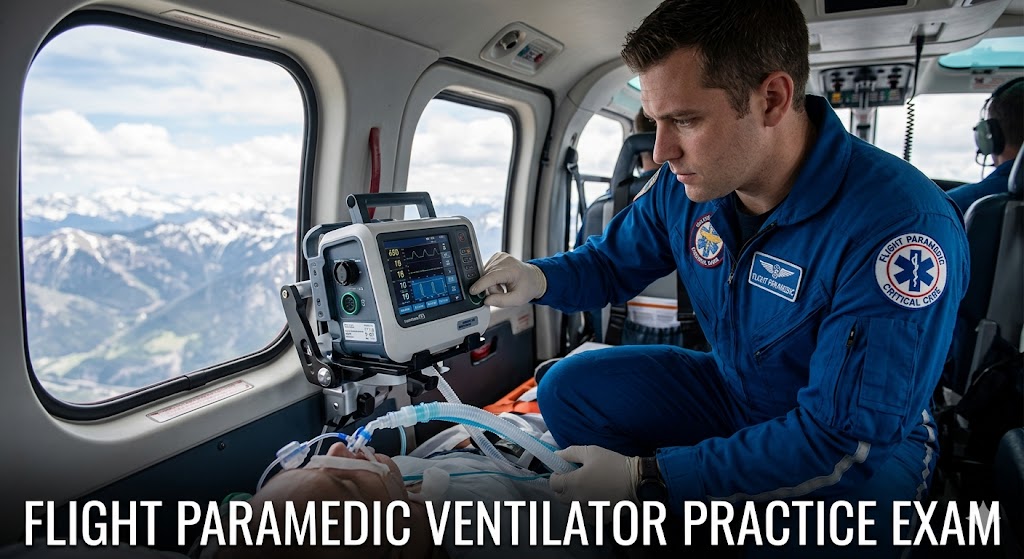
Additional Information
What the Course Entails and Exam Details
While this specific resource is a practice examination, the knowledge domain it assesses is typically covered in advanced Critical Care Transport or Flight Paramedic certification courses. This content area focuses strictly on the physiology, assessment, and dynamic management of ventilated patients in the transport environment. To pass this section of the certification or job entry exam, you must master several domains.
The exam content evaluates:
Advanced Respiratory Physiology: Including ventilation/perfusion (V/Q) mismatch, compliance, resistance, and the work of breathing in the critically ill.
Ventilator Modes and Settings: Distinguishing between and initiating modes such as Assist Control (AC), Synchronized Intermittent Mandatory Ventilation (SIMV), Pressure Support (PSV), and Non-Invasive Ventilation (NIV) like CPAP/BiPAP.
Parameter Optimization: Setting and adjusting Tidal Volume (VT), Respiratory Rate (RR), Positive End-Expiratory Pressure (PEEP), Fraction of Inspired Oxygen (FiO2), and Inspiratory Flow.
Arterial Blood Gas (ABG) Interpretation: Rapidly analyzing ABG results to make real-time ventilator adjustments and managing acid-base imbalances.
Troubleshooting and Alarm Management: Addressing the D.O.P.E. mnemonic (Dislodgement, Obstruction, Pneumothorax, Equipment failure) and managing critical alarms like high peak inspiratory pressure (PIP).
Pharmacology of Ventilation: Managing continuous infusions of sedative and paralytic agents, and administering rescue therapies like bronchodilators.
Transport Considerations: Managing altitude-related changes in barometric pressure and gas expansion during flight.
What to Expect in the Final Exam
The official certification exams, such as the Certified Flight Paramedic (FP-C) exam administered by the International Board of Specialty Certifications (IBSC), feature multiple ventilation-specific questions within their critical care domains. However, for a focused practice exam, the format is designed for intensive skill validation.
Here is what you should expect during the final practice examination:
Format: The practice exam typically consists of 50 to 75 questions, focusing purely on respiratory and ventilator management scenarios.
Scenario-Based Questions: Questions often present complex patient case studies (e.g., 'A 32-year-old drowning victim with ARDS...'), requiring you to interpret data, hypothesize pathologies, and make management decisions based on clinical presentation and ABG results.
Time Limit: You are usually allotted 90 to 120 minutes, simulating the time pressure of the actual certification exam.
Passing Score: While specific programs vary, a passing score of 70% or higher is typically recommended as a benchmark for competency before attempting the official FP-C or CCT-P exams.
How to Study and Exam Centers
Preparation is essential for success in advanced ventilator management. Success requires a combination of textbook knowledge and practical simulation.
Study Strategies:
Textbooks and Study Guides: Use core critical care transport textbooks, such as the AAOS Critical Care Transport book or comprehensive study guides specifically for the FP-C certification (e.g., Ace the FP-C Exam).
Dynamic Learning Tools: Programs like FlightBridgeED offer podcast-style education and dynamic study guides designed for the critical care clinician.
Simulation Labs: If your agency allows, practice in high-fidelity simulation labs to manage complex ventilator emergencies in a risk-free environment.
Practice Tests: Consistently taking practice exams is one of the most effective ways to identify weaknesses. Review every incorrect answer thoroughly, understanding the why behind the correct management decision.
Exam Centers:
If this practice exam is a formal program requirement, you will take it through a secured learning management system (LMS).
The official IBSC certifications (FP-C, CCP-C) are taken at authorized testing centers globally. These are often contracted facilities, such as PSI or Pearson VUE, which maintain strict security protocols.
Job Opportunities from the Course
Achieving competency in mechanical ventilation and securing certifications that validate these skills unlocks several specialized and highly sought-after career paths.
Job Titles and Career Paths:
Flight Paramedic (FP-C) (The primary goal of this curriculum and practice test).
Critical Care Transport Paramedic (CCT-P) (Handling high-acuity ground transport).
HEMS (Helicopter Emergency Medical Services) Crew Member.
Air Ambulance Paramedic (Fixed-wing international and long-distance patient repatriation).
Neonatal/Pediatric Critical Care Paramedic (Ground and Air specialty transport teams).
Clinical Educator (Teaching advanced airway and ventilation in EMS).
Emergency Department Paramedic (Hospital-based roles where ventilation management is crucial in the resuscitation bay).
Frequently Asked Questions
Reviews
5.0
Based on 0 reviews
Leave a Review
No reviews yet. Be the first to review!